
Last updated: September 2026. The 18th BRICS Summit was hosted by India at Bharat Mandapam, New Delhi, on 12–13 September 2026, under the theme “Building for Resilience, Innovation, Cooperation and Sustainability.” India assumed the BRICS Chairship on 1 January 2026 — its fourth chairship after 2012, 2016 and 2021. For CSE, this belongs first in GS II — groupings that affect India’s interests. The same facts also support GS III (trade, energy, climate) and Essay (Global South, multilateral reform). Do not file it as a two-day news recap.
Key highlights
- 11 full members; India hosted the 18th Summit in New Delhi on 12–13 September 2026
- Theme: Building for Resilience, Innovation, Cooperation and Sustainability
- Leaders adopted the New Delhi Declaration 2026 by consensus on 12 September
- PIB: members account for 49.5% of world population, 40% of GDP and 26% of trade
- China is the incoming chair for 2027
What BRICS is
BRICS is a grouping of major emerging economies that coordinates positions on global political, economic and development issues. It is not a treaty organisation with a UN-style secretariat. The presidency rotates each calendar year (1 January–31 December). The chair sets the agenda and hosts the summit. Cooperation sits on three pillars — political and security, economic and financial, and people-to-people — and decisions are by consensus.
Goldman Sachs economist Jim O’Neill coined BRIC in 2001. The four countries formed a political forum in 2006 and held the first leaders’ summit in Yekaterinburg, Russia, in 2009. Prelims 2014 tested the false claim that the first summit was in Rio de Janeiro.
Members, partners and institutions
| Track | Fact to lock |
|---|---|
| Original four (BRIC) | Brazil, Russia, India, China |
| Fifth member | South Africa — invited 2010; first leaders’ summit as a member at Sanya, 2011 |
| 2024 expansion | Egypt, Ethiopia, Iran, Saudi Arabia, UAE (full members from January 2024) |
| 2025 | Indonesia became the 11th full member (January 2025) |
| Partner countries (2025) | Belarus, Bolivia, Cuba, Kazakhstan, Malaysia, Nigeria, Thailand, Uganda, Uzbekistan, Vietnam |
| New Development Bank (NDB) | Proposed at India’s 2012 Delhi Summit; established 2014; headquarters Shanghai |
| Contingent Reserve Arrangement (CRA) | Liquidity backstop among members, conceived around the 2012–14 cycle |
Argentina was invited in the 2023–24 round and declined. South Africa’s join-year is a trap: Prelims 2014 treated it as last among the original five; PIB uses 2010 for the name change and 2011 (Sanya) for the first full-member summit. Indonesia is now the latest full member.
Snapshot of the 18th Summit
| Particular | Detail |
|---|---|
| Summit | 18th BRICS Summit |
| Host / Chair | India (Chairship from 1 January 2026) |
| Dates | 12–13 September 2026 |
| Venue | Bharat Mandapam, New Delhi |
| Theme | Building for Resilience, Innovation, Cooperation and Sustainability |
| Outcome document | New Delhi Declaration 2026 (adopted unanimously on 12 September) |
| Next host | China, 2027 |
Keep a short list of 2026 instruments for examples: BRICS AGRIN (seeds and farm inputs); GVC Action Plan 2026–2030; NIMHANS, Bengaluru as coordinating centre for a mental-health hub network; and the Remote Sensing Satellite Constellation (India’s Resourcesat-2 / 2A). Prime Minister Narendra Modi proposed a Continuity and Implementation Mechanism through the Troika (Brazil–India–China) and a Reform Roadmap on Representation, Responsiveness and Rule-making — Global South as rule-shaper, not only rule-taker.
New Delhi Declaration: what UPSC can potentially ask
Prepare the line India held — not a summary of the full declaration.
Trade and climate
- Condemned unilateral coercive measures (sanctions) and indiscriminate tariff rises
- Opposed the EU’s CBAM (carbon border adjustment mechanism) — an import levy on carbon-intensive goods such as steel and cement
- Restated CBDR-RC (common but differentiated responsibilities and respective capabilities)
- Said fossil fuels will still matter in developing-country energy mixes
- GS III use: energy security + CBAM as a disguised trade barrier
UN and security
- China and Russia support a greater role for Brazil and India in the UN, including the Security Council — language, not a pledged permanent seat
- Condemned the April 2025 Pahalgam attack for a second summit in a row (after Rio 2025)
- Called for action against terror safe havens
- Ukraine is not named
- West Asia: maximum restraint — kept Iran and the UAE inside the consensus
- Supported WTO accession bids by Iran and Ethiopia
What it did not do
- No common BRICS currency
- Operational line: cheaper local-currency and cross-border payments
Why the grouping matters for India
BRICS is one pillar of India’s multi-alignment, alongside the Quad, I2U2, SCO and G20. It gives India a table with energy producers and Global South markets, a parallel finance track in the NDB, and space to push IMF/WTO/UNSC reform without choosing a bloc.
The constraint is as examinable as the opportunity. Intra-BRICS trade is China-heavy. Expansion added Iran–UAE rifts. Consensus slows documents. A strong GS II answer says BRICS amplifies the Global South; it does not replace the G20 or the UN.
BRICS compared with G20, SCO and G7
Do not drop all four names into every IR answer. Lock one line per grouping, then pick the one the question actually needs.
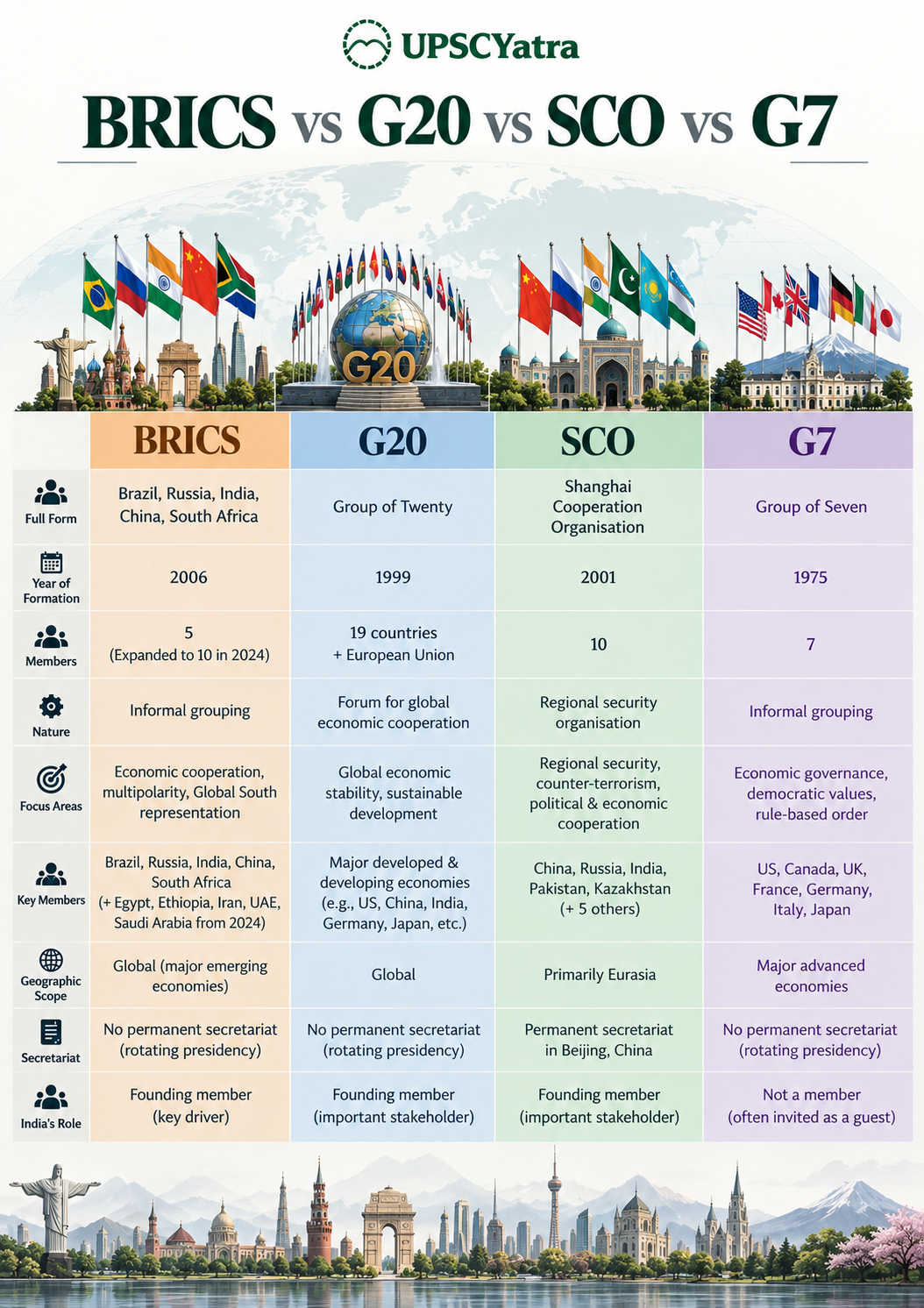
Use this for a quick compare. For 2026, lock 11 full members (Indonesia from January 2025) from the table below.
In one line
- BRICS — emerging-economy forum; voice of the Global South
- G20 — main table for the world economy
- SCO — Eurasian security and connectivity (India, China and Pakistan in one room)
- G7 — seven rich democracies; India is a guest, not a member
| Grouping | Members (2026) | Chair / HQ | India’s status | Own bank? |
|---|---|---|---|---|
| BRICS | 11 full + 10 partners | Rotating chair; no standing secretariat | Founding member; chair 2026 | NDB (Shanghai) + CRA |
| G20 | 19 countries + EU + African Union | Rotating presidency | Member; hosted 2023 | No |
| SCO | 10 | Secretariat in Beijing | Full member since 2017 | No |
| G7 | 7 | Rotating presidency | Regular invitee, not a member | No |
Which grouping goes in the answer?
| If the question is about… | Use |
|---|---|
| Global South, NDB, CBAM, local-currency payments, UNSC “greater role” | BRICS |
| Global growth, financial stability, AU joining the G20 (2023) | G20 |
| Terrorism, connectivity, Central Asia, India–Pakistan–China | SCO |
| “Western-led order” / who writes the economic rules | G7 as the contrast |
Prelims traps: BRICS is not a military alliance. SCO has a secretariat; BRICS does not. India is in G20 and BRICS, not in G7. G20 is not a UN organ.
UPSC syllabus mapping
| Paper | Head | 2026 hook |
|---|---|---|
| Prelims GS I | Current events; international institutions | Host, theme, 11 members, partner category, NDB HQ, first summit venue |
| Mains GS II | Bilateral, regional and global groupings affecting India’s interests | Is BRICS a counterweight or a cooperation platform? |
| Mains GS III | Economy, energy, environment, internal security (terrorism language) | CBAM, fossil-fuel transition, local-currency payments, Pahalgam |
| Essay | Global South, multilateralism, technology governance | Rule-shaper vs rule-taker; pyramid of privilege |
Mains 2026 already asked this theme, weeks before the Delhi summit: “BRICS acts as a powerful counterweight in global governance…” (GS II, 10 marks). For CSE 2027, expect a follow-up that uses the New Delhi Declaration as the example, not the quotation.
Prelims focus
UPSC tests venue, sequence, names and one wrong word.
- First BRIC summit: Yekaterinburg, 2009 — not Rio (Prelims 2014)
- 16th Summit (2024): Kazan, Russia; theme Strengthening Multilateralism — Prelims 2025 planted Multiculturalism
- Indonesia is a full member (Prelims 2025); partner country ≠ full member
- NDB HQ: Shanghai; CRA is a reserve, not a bank
- No common BRICS currency in the 2026 declaration
- Map: 11 members across four continents; Bharat Mandapam, Pragati Maidan; NDB at Shanghai
Mains focus
Open a 10-mark answer with a stance, not a membership list. The 2026 question used the word counterweight. A safe line: BRICS seeks to rebalance voice in global governance; it is not a military or anti-West alliance.
10 marks (150 words) skeleton
- Intro (25 words): BRICS is a consensus forum of 11 emerging economies; India used the 2026 chairship to keep it issue-based.
- Body — how it projects an alternative (2 subheads): (a) institutional: NDB, CRA, local-currency payments, GVC plan; (b) political: UNSC/IMF/WTO reform language, CBAM opposition, Global South framing.
- Body — limits: China-centric trade, Iran–UAE and Russia-related rifts, consensus rule, no common currency, “greater role” language on the UNSC is not a seat.
- Close: Reform the order, do not replace it — multi-alignment, not bloc politics.
For 15 marks, add India’s chairships (2012 NDB idea; 2016 Goa + BIMSTEC outreach; 2021 Counter-Terrorism Action Plan; 2026 Troika follow-up) and the India–China sidelines (three mutuals: respect, sensitivity, interest) to show that BRICS does not dissolve bilateral disputes.
Previous year questions
1. CSE Prelims 2014
With reference to a grouping of countries known as BRICS, consider the following statements:
- The First Summit of BRICS was held in Rio de Janeiro in 2009.
- South Africa was the last to join the BRICS grouping.
Which of the statements given above is/are correct?
- (a) 1 only
- (b) 2 only
- (c) Both 1 and 2
- (d) Neither 1 nor 2
Answer: (b) 2 only. Statement 1 is false — the first summit was at Yekaterinburg, Russia, in 2009, not Rio. Statement 2 is true for the original five.
2. CSE Prelims 2025
Consider the following statements with regard to BRICS:
I. The 16th BRICS Summit was held under the Chairship of Russia in Kazan.
II. Indonesia has become a full member of BRICS.
III. The theme of the 16th BRICS Summit was Strengthening Multiculturalism for Just Global Development and Security.
Which of the statements given above is/are correct?
- (a) I and II
- (b) II and III
- (c) I and III
- (d) I only
Answer: (a) I and II. Statement III is the trap — the official theme used Multilateralism, not Multiculturalism.
3. CSE Mains 2026, GS II, Q10 (10 marks)
“BRICS acts as a powerful counterweight in global governance, actively amplifying the voice and influence of the Global South.” Explain the role of BRICS in projecting itself as an alternative to other groupings.
Use now: no Ukraine line; CBAM and tariffs; Pahalgam; Troika follow-up; not an anti-West front. Practice the GS II 10-marker.
Frequently asked questions
Which country hosted the 18th BRICS Summit 2026?
India, at Bharat Mandapam, New Delhi, on 12–13 September 2026. Official background is on the PIB note on India’s BRICS chairship.
How many countries are in BRICS?
Eleven full members: Brazil, China, Egypt, Ethiopia, India, Indonesia, Iran, Russia, Saudi Arabia, South Africa and the UAE. Ten partner countries were added in 2025. Partners are not full members.
What is the theme of BRICS 2026?
“Building for Resilience, Innovation, Cooperation and Sustainability.” Decode it in answers as climate and supply-chain resilience, DPI/AI innovation, consensus cooperation, and green-growth sustainability.
Is BRICS an anti-Western military bloc?
No. It has no Article-5-style defence commitment. The 2026 declaration criticises unilateral sanctions, tariffs and CBAM, and it pushes institutional reform. India’s chairship line was practical cooperation among diverse members, not a crusade against the United States.
Who will host the BRICS Summit in 2027?
China. The Troika for follow-up is Brazil (2025), India (2026) and China (2027).
Key takeaways
- Memorise host, dates, venue, theme, 11 members, partner list, NDB HQ, first summit venue — these are Prelims items.
- The New Delhi Declaration is a consensus document: strong on tariffs, sanctions, CBAM, terrorism (Pahalgam) and UN voice; silent on Ukraine; cautious on West Asia.
- For GS II, BRICS is a voice amplifier and parallel finance track, not a substitute for the UN, IMF or G20.
- India’s exam-ready line: multi-alignment — reform global governance, keep strategic autonomy, avoid turning BRICS into China’s geopolitical platform.
- Re-work the 2026 GS II BRICS 10-marker with one paragraph of Delhi 2026 facts.