
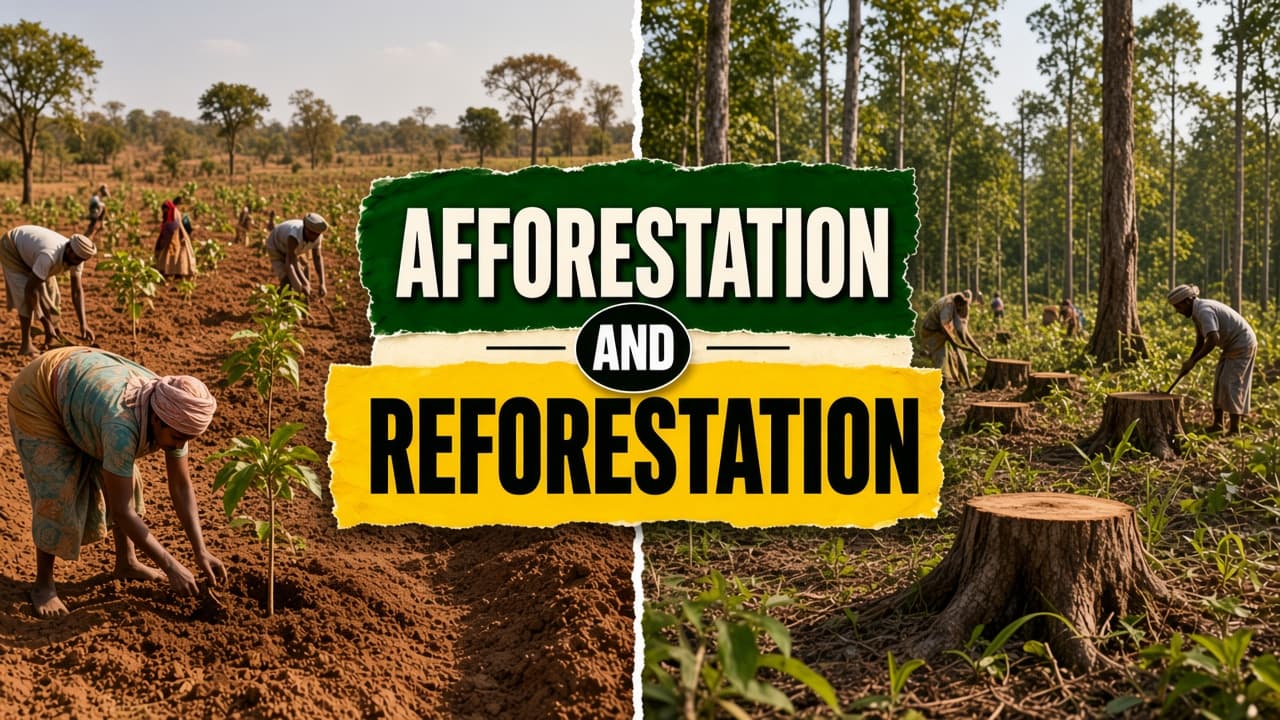
Afforestation is the creation of forest on land that has not been forest for a long time, including wasteland, scrub, and grassland. Reforestation is the restoration of tree cover on land that was recently deforested or that is degraded forest. Both appear in climate pledges and in CAMPA spending. Ecologists still separate them, because planting on natural grassland can harm biodiversity, while reforestation tries to repair recent loss.
Difference between afforestation and reforestation
| Feature | Afforestation | Reforestation |
|---|---|---|
| Meaning | New forest on land that was not forest for a long time | Tree cover restored on recently lost or degraded forest |
| Where | Wasteland, scrub, grassland, and non-forest plots | Recently cleared forest and degraded reserve forest |
| Law | Forest (Conservation) Act compensatory afforestation; UNFCCC LULUCF afforestation (A) | Working plans and CAMPA on degraded reserve forest; LULUCF reforestation (R) |
| Examples | Teak or eucalyptus on long-standing non-forest land | Native replanting on a mine patch that was forest a few years earlier |
| Species | Often a commercial monoculture such as eucalyptus or teak | Native mixes are preferred in restoration projects |
| Effect | A new carbon sink, with variable biodiversity and disputes over tribal rights | A chance to recover habitat if native structure returns; both count as carbon sinks when monitored |
At a glance
Land history
Non-forest for a long period
Recently deforested or degraded forest
Ecological risk
Concerns about converting grassland or wetland
Better chance of native species returning
Indian scheme link
Compensatory afforestation (CAMPA)
Forest restoration under Green India Mission
Carbon accounting
A new sink on non-forest land
Recapture of biomass that was recently lost
Example
Teak plantation on Rajasthan scrub vs restoring Chhattisgarh mine patch
Planting teak on land that was semi-arid scrub for centuries is afforestation. The land was not forest, and the plantation creates a new forest category. After an iron-ore lease ends in Chhattisgarh, mandatory reclamation that replants native species on what was forest five years earlier is reforestation. The first changes the land-use category. The second repairs a recent clearing.
What this means for the exam
Afforestation puts forest on land that had no recent forest. Reforestation puts forest back on land that lost its forest not long ago.
Afforestation
Afforestation establishes forest on land that was not forest for a long period. Under UNFCCC land categories it is the shift from non-forest to forest, marked A in LULUCF. Compensatory afforestation under the Forest (Conservation) Act often uses non-forest plots after forest land is diverted. CAMPA collects the levy and states spend it on plantations. A teak block on centuries-old Rajasthan scrub fits this category.
Hectare counts can hide ecological loss. A moist deciduous forest that took a hundred years to form is not replaced by a five-year eucalyptus block. Plantations on grassland can simplify the ecosystem and raise tribal rights disputes. India's reported forest cover has risen partly from such plantations. Van Mahotsav planting on school grounds is horticulture, not afforestation in the IPCC sense.
Reforestation
Reforestation restores tree cover on land that was recently forest. In IPCC terms it is forestland that remains forest after a temporary loss, marked R in LULUCF. Replanting native species on a Chhattisgarh mining patch that was forest five years earlier is the classroom example. Green India Mission and working plans for degraded reserve forest are the scheme links.
Both afforestation and reforestation can act as carbon sinks when they are monitored. Reforestation has a better chance of recovering habitat if native structure returns. Quality of the stand matters more than the number of hectares planted. The recent-forest test is what separates it from planting on land that was never forest.
Key takeaway
Afforestation creates forest on land that was not forest for a long time. Reforestation restores forest that was lost recently.
Difference between afforestation and reforestation FAQs
What is afforestation?
Afforestation is establishing forest on land that was not forest for a long time, such as wasteland, scrub, or grassland. In LULUCF it is the afforestation category, land moving from non-forest to forest.
What is reforestation?
Reforestation is restoring tree cover on land that was recently deforested or that is degraded forest. In LULUCF it is forestland that stays in the forest category after a temporary loss.
What is the main difference between afforestation and reforestation?
Afforestation creates forest on land that lacked forest for a long period. Reforestation restores forest on land that lost it recently. The land history is the dividing line.
Does reforestation mean planting trees on land that has never been forested?
No. Planting on land that has never been forest is afforestation. Reforestation requires recent prior forest cover.
Can both afforestation and reforestation act as carbon sinks?
Yes. Both activities can sequester carbon under climate agreements when they are monitored properly.
Does compensatory afforestation under the Forest (Conservation) Act usually plant on non-forest land?
Yes. When forest land is diverted, compensatory afforestation often uses non-forest plots. That practice is afforestation, funded through CAMPA.
PYQ linkage
Afforestation is best defined as: