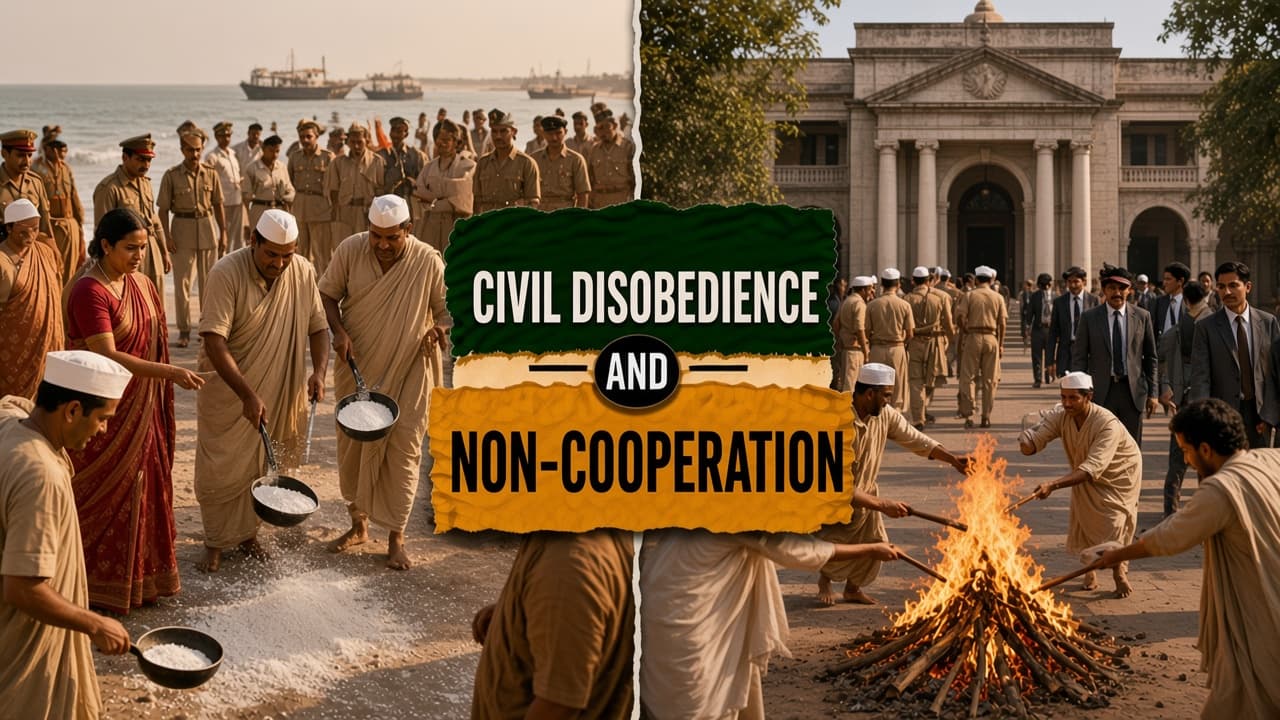
Difference between Civil Disobedience and Non-Cooperation
Non-Cooperation asked Indians to withhold cooperation from British institutions, and Civil Disobedience asked them to break specific colonial laws.
By UPSCYatra Editorial Team - Jun 1, 2026
Table of contents
Non-Cooperation, from 1920 to 1922, was a Gandhian mass movement that boycotted British titles, courts, councils, and foreign goods without breaking particular statutes. Civil Disobedience, from 1930 to 1934, deliberately broke colonial laws, above all the Salt Act, in order to fill jails and to demand poorna swaraj. The first followed Jallianwala Bagh, the Rowlatt Acts, and the Khilafat grievances, and Gandhi withdrew it after Chauri Chaura in February 1922. The second opened with the Dandi March in 1930 and later included forest-law breaches and no-tax campaigns.
Difference between Civil Disobedience and Non-Cooperation
Feature
Civil Disobedience
Non-Cooperation
Meaning
Withholding cooperation from British institutions
Open breach of specific colonial laws
When
1920 to 1922; withdrawn in February 1922 after Chauri Chaura
1930 to 1934; Dandi March in 1930; Gandhi-Irwin Pact in 1931
Goal
Swaraj within a year, in alliance with the Khilafat movement
Poorna swaraj, meaning full independence
Symbol
Swadeshi charkha and bonfires of foreign cloth
Salt: the Dandi March and illegal salt making
Who
Urban middle class, students, and some peasants; high early Muslim participation through the Khilafat
Wider peasant no-revenue and forest campaigns, including Dharasana; Muslim participation was lower
Effect
Repression and arrests; Congress-Khilafat partnership; movement halted in 1922
Mass arrests, then Gandhi-Irwin negotiations; socialists and communists were divided
Upgrade for access and purchase our mains 27 pass.
Satyagraha that broke salt, forest, and revenue laws
Immediate trigger
Civil Disobedience
Rowlatt, Jallianwala Bagh, and Khilafat grievances
Non-Cooperation
Simon Commission, the Lahore resolution of 1929 on poorna swaraj, and the salt tax
End
Civil Disobedience
Chauri Chaura violence, after which Gandhi withdrew the movement
Non-Cooperation
Gandhi-Irwin Pact of 1931, and the Second Round Table Conference
Example
Bonfire at Eidgah vs Dandi salt picking
In 1921, students in Allahabad picketed liquor shops and lit bonfires of foreign cloth. That was a lawful boycott. No salt law was broken. In 1930, Gandhi walked 240 miles to Dandi and picked up salt, a deliberate breach of British law. The first movement asked Indians to withdraw cooperation. The second asked them to defy unjust laws in the open and to fill the jails.
What this means for the exam
Non-Cooperation meant withdrawal from the institutions of the Raj. Civil Disobedience meant breaking particular laws through mass satyagraha.
Non-Cooperation
Gandhi launched Non-Cooperation after the Rowlatt Acts and Jallianwala Bagh, and he tied it to the Khilafat grievances. The method was progressive, non-violent refusal to cooperate: titles, courts, councils, schools, and foreign cloth. Students in Allahabad in 1921 picketed liquor shops and burnt foreign cloth. That was boycott, not a breach of the salt law. The stated aim was swaraj within a year, with the Congress-Khilafat partnership.
The movement stopped in February 1922 after violence at Chauri Chaura in the United Provinces. Gandhi had avoided mass law-breaking in part because of the trauma of Amritsar and the wish to keep the campaign non-violent. Muslim participation was high at the start because of the Khilafat. Salt satyagraha does not belong to these years.
Civil Disobedience
Civil Disobedience began with the Dandi March in 1930. Gandhi walked 240 miles and picked up salt, breaking the salt law in public. The salt tax touched rich and poor, so a small breach made imperial extraction visible. The Lahore resolution of 1929 had already declared poorna swaraj. The Simon Commission and the salt tax were the immediate triggers. The campaign then spread to forest laws and to no-tax and no-revenue actions, including Dharasana.
Participation reached further into the peasantry than Non-Cooperation had. Muslim participation was lower, and the communal gap had widened by the 1930s. The British answered with mass arrests and then with the Gandhi-Irwin Pact of 1931 and the Second Round Table Conference. By 1930 Gandhi judged that Indians were ready for a higher level of sacrifice, and the international press filmed Dandi. The Congress led the movement. Socialists and communists were divided about it.
Key takeaway
Non-Cooperation, from 1920 to 1922, boycotted British institutions. Civil Disobedience, from 1930 to 1934, broke laws, and the salt satyagraha was its symbol.
Difference between Civil Disobedience and Non-Cooperation FAQs
What was the Non-Cooperation Movement?
Non-Cooperation, from 1920 to 1922, was Gandhi's campaign of boycott against British titles, courts, councils, schools, and foreign goods. It was linked to the Khilafat movement and was withdrawn after Chauri Chaura in February 1922.
What was the Civil Disobedience Movement?
Civil Disobedience, from 1930 to 1934, deliberately broke colonial laws, starting with the Salt Act at Dandi in 1930. It demanded poorna swaraj and led to mass arrests and the Gandhi-Irwin Pact of 1931.
What is the main difference between Civil Disobedience and Non-Cooperation?
Non-Cooperation withdrew cooperation from Raj institutions without breaking the salt law. Civil Disobedience broke specific laws, above all the salt law, and demanded full independence.
Did the Non-Cooperation Movement involve mass violation of the salt laws?
No. Salt-law violation belongs to Civil Disobedience in 1930, not to Non-Cooperation in 1920 to 1922.
Why did Gandhi withdraw the Non-Cooperation Movement?
He suspended it in February 1922 after violence at Chauri Chaura in the United Provinces.
What was the Gandhi-Irwin Pact?
The Gandhi-Irwin Pact of 1931 ended the first phase of Civil Disobedience and was followed by the Second Round Table Conference. It belongs to the 1930s movement, not to Non-Cooperation.