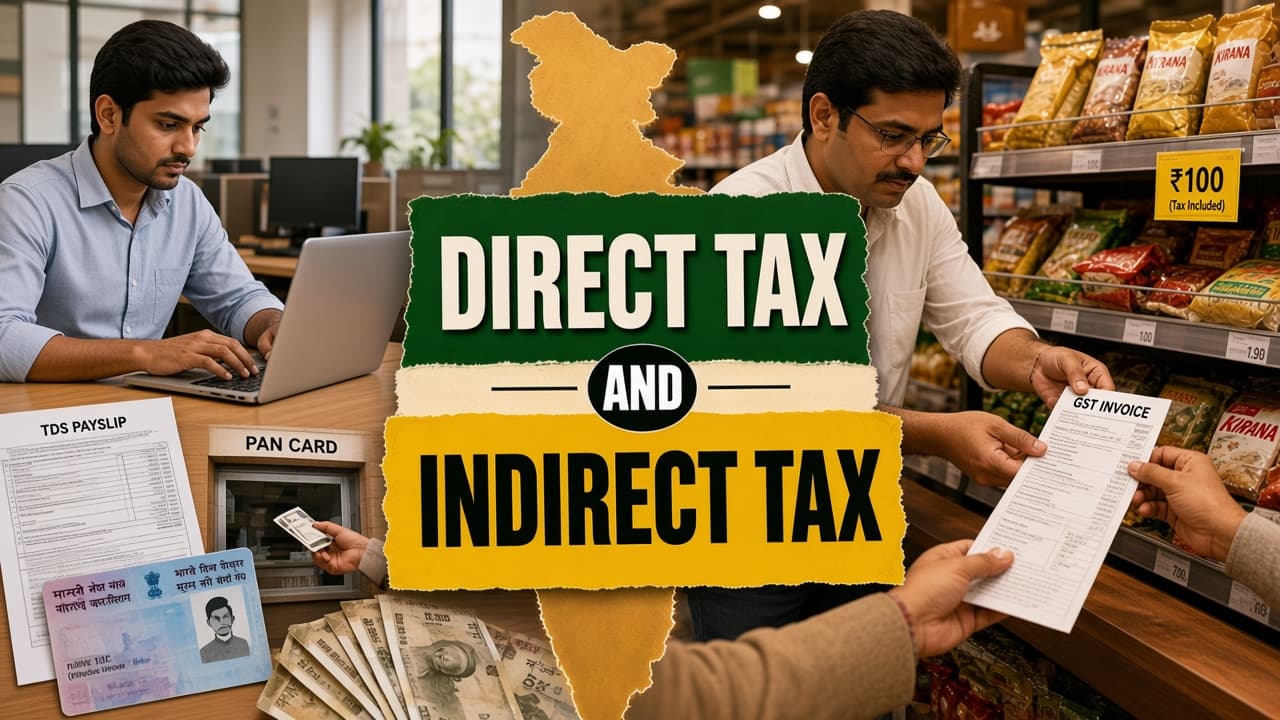
A direct tax is charged on income or wealth and stays with the person it is charged on, while an indirect tax is built into prices and is borne by the consumer.
By UPSCYatra Editorial Team - May 1, 2026
Table of contents
A direct tax is levied on the income or wealth of the person who pays it, and the law places both the legal and the economic burden on that person. An indirect tax is collected from a seller or intermediary and reaches the government through the price the consumer pays. When an employer deducts TDS from salary, the employee bears the tax. When GST is added to a ₹200 food order, the restaurant remits the tax and the diner pays it in the bill.
Difference between Direct Tax and Indirect Tax
Feature
Direct Tax
Indirect Tax
Share
About 55% of the Centre's gross tax revenue
About 45%, from GST, customs, and the excise share
Compliance
Income-tax returns, TDS, and advance tax
GST returns, e-way bills, and invoice matching
Evasion
Under-reporting of income
Fake invoices and under-invoicing under GST
Law
Union List entry for income tax
Union and states share GST under the 101st Amendment
Prices
Acts on disposable income, and does not enter the price of a good directly
Sits inside the price, so a GST hike raises the cost of living at once
Equity
Slab rates can rise with income
The same rate falls harder, as a share of income, on the poor
At a glance
Incidence
Direct Tax
Stays with the person assessed
Indirect Tax
Passed to the final consumer in the price
Examples (India)
Direct Tax
Income tax, corporate tax, STT, and wealth tax (abolished)
Indirect Tax
GST, customs duty, and excise (the last of these subsumed)
Progressivity
Direct Tax
Can use slab rates that rise with income
Indirect Tax
Same rate on the same good, so a larger share of a smaller income
Collection
Direct Tax
Central Board of Direct Taxes
Indirect Tax
Central Board of Indirect Taxes
Upgrade for access and purchase our mains 27 pass.
A salaried employee in Bengaluru and a kirana bill
Priya earns ₹12 lakh a year. She files an income-tax return and pays income tax to the government. That is a direct tax. The same month she buys dal, oil, and soap, and GST is already inside each price. The kirana owner remits the GST. Priya is the one who pays it. If GST on an item moves from 5% to 12%, her purchasing power falls even if her income tax is unchanged. Direct tax can use higher slabs for higher incomes. An indirect tax charges the same rate on a given good to a rich buyer and a poor one.
What this means for the exam
A direct tax is paid on income or wealth, and the slabs can be progressive. An indirect tax is paid when you buy something, and it often takes a larger share of a smaller income.
Direct tax
Income tax, corporate tax, and the securities transaction tax are the usual Indian examples. Wealth tax has been abolished. The Central Board of Direct Taxes collects them. Corporate tax is levied on company profits. Any later effect on shareholders or customers is secondary. STT is also direct: it is charged on the value of a securities transaction and borne by the trader or investor. Income tax sits in the Union List.
Compliance runs through returns, TDS, and advance tax. The main evasion is under-reporting of income. After demonetisation and GST, collections rose as more assessees entered the formal net. About 55% of the Centre's gross tax revenue comes from this side. The tax changes disposable income. A rate change does not, by itself, rewrite the sticker price of dal or soap.
Indirect tax
GST, customs duty, and the excise that GST subsumed are indirect. The Central Board of Indirect Taxes administers the central side. GST is shared by the Union and the states under the 101st Amendment. The seller remits the tax, and the buyer meets it in the price. A move from 5% to 12% on an item raises the cost of living at once. About 45% of the Centre's gross tax revenue comes from GST, customs, and the remaining excise share.
The same rate on the same good is why these taxes are described as regressive: a poor household spends a larger share of income on taxed goods. Buying a larger basket because you are richer is not a progressive tax. Fake invoices and under-invoicing are the GST versions of evasion. India's shift to GST changed the mix between the two kinds of tax. A change in a GST rate is a tax decision with an immediate price effect.
Key takeaway
A direct tax falls on income or wealth and can use rising slabs. An indirect tax sits inside the price and often takes a larger share of a smaller income.
Difference between Direct Tax and Indirect Tax FAQs
What is a direct tax?
A direct tax is levied on income or wealth and is paid by the person it is charged on. Income tax, corporate tax, and the securities transaction tax are examples. The Central Board of Direct Taxes collects them.
What is an indirect tax?
An indirect tax is collected from a seller and borne by the consumer through a higher price. GST and customs duty are the main examples in India. The Central Board of Indirect Taxes handles the central administration.
What is the main difference between a direct tax and an indirect tax?
A direct tax stays with the assessee and can use rising slabs. An indirect tax is shifted into the price. The same rate on the same good takes a larger share of a poorer household's income.
Are indirect taxes progressive because richer people buy more goods?
No. A larger shopping basket is not a progressive tax. Poor households spend a higher share of income on taxed goods, so the usual effect is regressive.
Is corporate tax a direct tax?
Yes. Corporate tax is levied on company profits. It is classified as a direct tax. Any passing of the cost to shareholders or customers is a later economic effect.
Is the securities transaction tax a direct tax?
Yes. STT is levied on the value of the transaction and is borne by the trader or investor. It is grouped with direct taxes.
PYQ linkage
2021 · Prelims
Which of the following is/are direct tax? (1) Corporate Tax (2) Customs Duty (3) Income Tax