
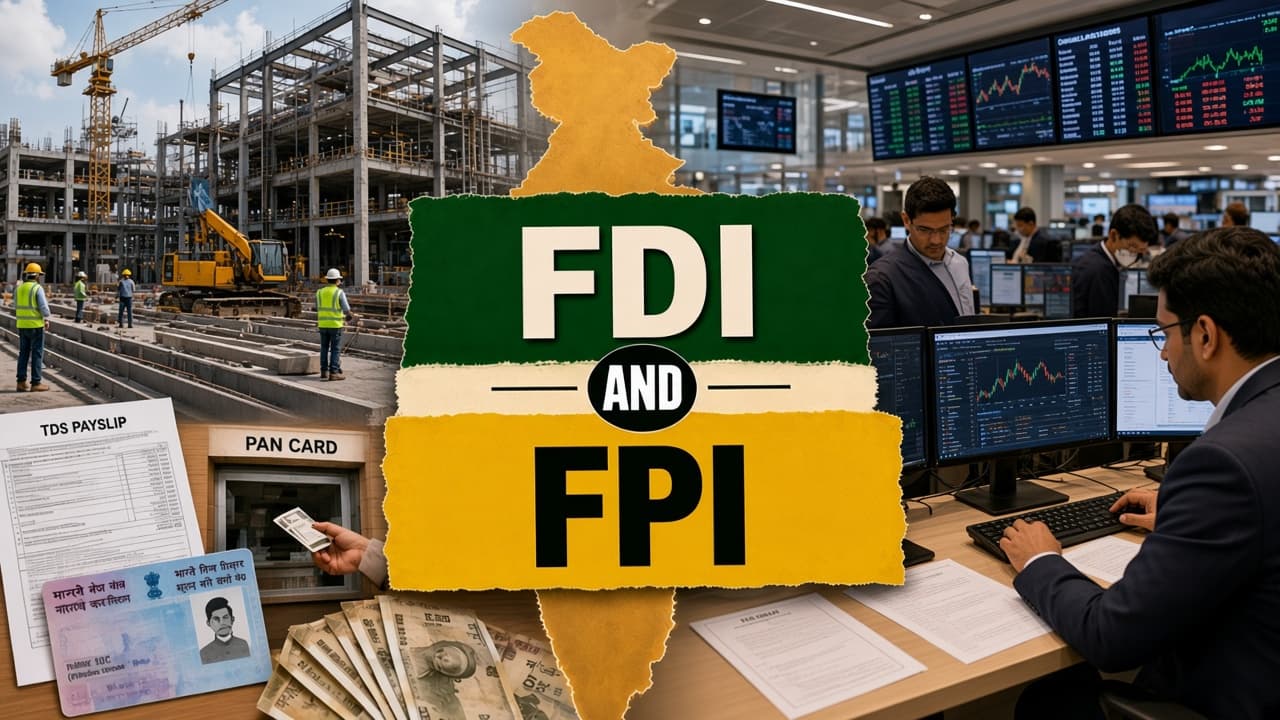
Foreign Direct Investment (FDI) is cross-border investment with a lasting interest in an enterprise. A holding of 10% or more of the equity is treated, under the IMF's BPM6 convention that India follows, as carrying management influence. Foreign Portfolio Investment (FPI) is a passive holding of listed securities, below that 10% line, without control. A foreign firm building a plant in India is FDI. A foreign fund buying shares on the NSE for a few months is FPI. On the balance of payments, FDI tends to stay. FPI can reverse and move the rupee.
Difference between FDI and FPI
| Feature | FDI | FPI |
|---|---|---|
| Account | Capital or financial account, and preferred because it does not create debt | Capital or financial account, as portfolio investment |
| Route | Automatic route or government route, by sector | Registration with SEBI, and sectoral caps apply |
| Rupee | Gradual, and tied to the real economy | Immediate: large flows move the rupee from day to day |
| Examples | Apple's suppliers in India, and the Walmart-Flipkart stake | Foreign holdings in HDFC Bank, and FPI purchases of government securities |
| Exit | Profits and capital can leave under FEMA and RBI rules for the sector | Freely repatriable: the investor sells the shares and leaves |
| Caps | Automatic or government route by sector, under DPIIT policy | Aggregate FPI limits in listed companies, with SEBI registration |
At a glance
Control
10% or more of equity is treated as a lasting interest
No management control, and the stake is typically below 10%
Horizon
Long term: greenfield, brownfield, or a merger
Short to medium term, and an exit can take days
Regulator
DPIIT sets the policy, and the RBI handles repatriation
SEBI, under the FPI regulations
Stability
Sticky, and less prone to sudden reversal
Volatile, and often called hot money
Example
Hyundai plant in Chennai vs a foreign fund on the Nifty
Hyundai invests ₹5,000 crore in a plant in Tamil Nadu, transfers technology, and holds 100% of the subsidiary. That is FDI: it stays, and it creates jobs. A US hedge fund buys ₹500 crore of Nifty 50 stocks and sells three months later when the Federal Reserve raises rates. That is an FPI outflow. In 2020 and again in 2022, FPI exits moved the rupee even while FDI projects continued. The RBI prefers FDI as a way of financing the current account.
What this means for the exam
FDI brings control, a long horizon, and a real asset. FPI is a liquid portfolio holding, and it moves with financial markets.
FDI
India classifies foreign investment of 10% or more in an Indian company as FDI, following IMF BPM6. Below 10% the same money is FPI. The line is a favourite Prelims fact, and it is what separates portfolio flow from direct investment in the balance of payments. A Tesla factory in India would count as FDI: a plant, jobs, and technology. DPIIT writes the sector policy, through the automatic route or the government route, and the RBI handles repatriation under FEMA. iPhone assembly is the export-and-technology case already on the ground.
The current account deficit is often financed by FPI, which leaves the rupee exposed when global investors step back. FDI is the stabler financing, and it is the form that brings technology and export capacity. Profits can still leave, under the sector's rules. They do not leave with the speed of a stock sale.
FPI
FPI is a holding without management control. An 8% equity stake by a foreign entity is FPI. A foreign mutual fund that buys Reliance shares on the NSE and holds them for six months is the same category: capital without control. The investor registers with SEBI, faces aggregate limits in listed companies, and can sell and repatriate the proceeds. A hedge fund on the Nifty, or an FPI buying government securities, is the usual picture. Large flows move the rupee on the day they arrive or leave.
The older term FII was merged into the FPI regime in 2014. FPI is the current name for these portfolio flows. The money is liquid, which is why 2020 and 2022 saw exits even while FDI projects carried on. A statement that gives an FPI investor board control reverses the 10% rule.
Key takeaway
FDI is a stake of 10% or more, with a lasting interest in a real asset. FPI is a portfolio holding without control, and it can leave quickly.
Difference between FDI and FPI FAQs
What is FDI?
Foreign Direct Investment is a cross-border stake with a lasting interest, typically 10% or more of equity, and with influence over management. A plant, a subsidiary, and a sector cleared by DPIIT are the usual forms.
What is FPI?
Foreign Portfolio Investment is a holding of shares or bonds without management control, typically below 10% of equity. The investor registers with SEBI and can sell and leave. The older name FII was folded into this regime in 2014.
What is the main difference between FDI and FPI?
FDI is a long-term stake in a real business, at or above the 10% line, and it tends to stay. FPI is a liquid portfolio holding without control, and it can reverse quickly enough to move the rupee.
Does FPI give management control of an Indian company?
No. FPI has no management control. Lasting interest and control are the marks of FDI, at a stake of 10% or more.
Is an 8% equity stake by a foreign investor FDI or FPI?
It is FPI. India follows the IMF BPM6 line: below 10% the investment is portfolio investment, and at 10% or above it is FDI.
Why does the RBI prefer FDI for financing the current account?
FDI is tied to plants, jobs, and technology, and it reverses slowly. FPI can leave in a risk-off spell, as in 2020 and 2022, and those exits move the rupee even when FDI projects continue.
PYQ linkage
Foreign investment in which of the following is considered FDI? (1) Equity ≥10% (2) Portfolio without control