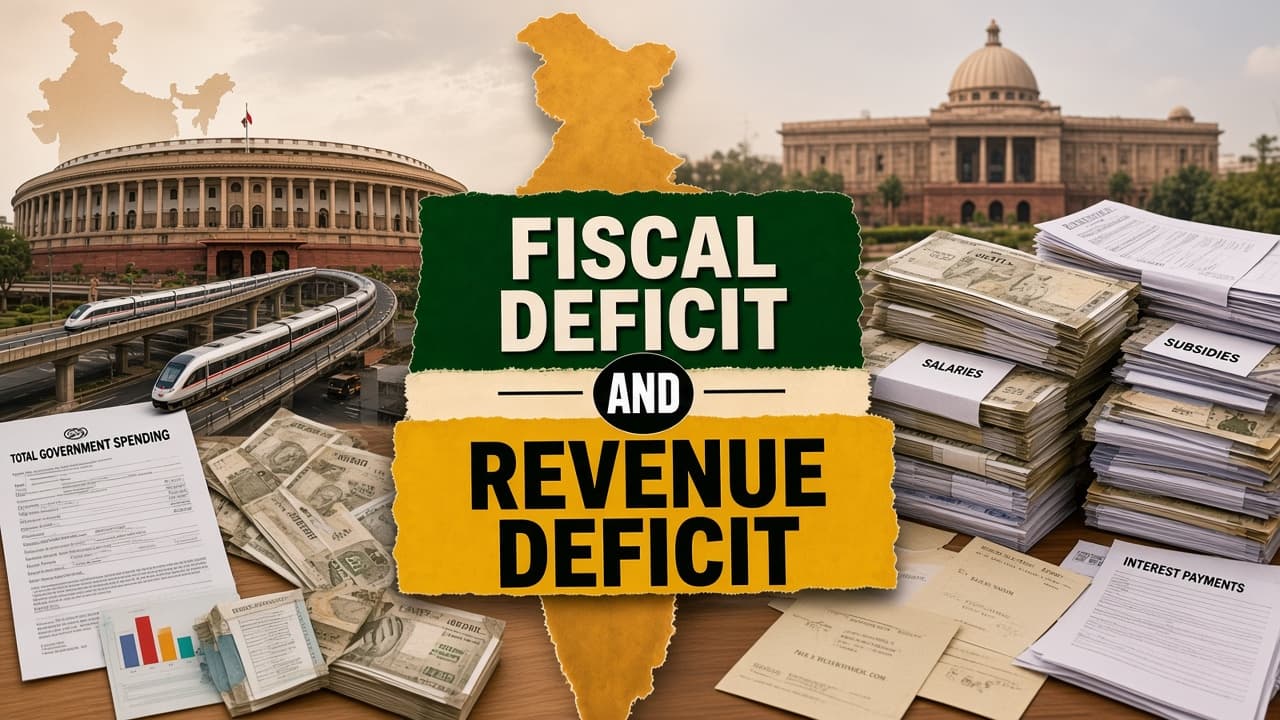
Difference between Fiscal Deficit and Revenue Deficit
The fiscal deficit is the government's total borrowing need for the year, while the revenue deficit is the part of that gap that comes from day-to-day spending.
By UPSCYatra Editorial Team - May 1, 2026
Table of contents
The fiscal deficit is the gap between total government expenditure and total receipts excluding borrowings. It is the amount the government must borrow in the year. The revenue deficit is narrower. It is revenue expenditure minus revenue receipts, on the day-to-day account. A fiscal deficit can include borrowing for roads and railways. A revenue deficit means the government is borrowing even to cover current spending.
Difference between Fiscal Deficit and Revenue Deficit
Feature
Fiscal Deficit
Revenue Deficit
Meaning
Total expenditure minus receipts, with borrowings left out of the receipts
Revenue expenditure above revenue receipts
Interest
Interest is inside the expenditure side of the fiscal deficit
Interest is revenue expenditure, so it widens the revenue deficit
Assets
Capital expenditure can account for part of the fiscal deficit
A revenue deficit means the borrowed funds created no asset
Primary
Fiscal deficit minus interest payments equals the primary deficit
A high revenue deficit often keeps the primary deficit high as well
Level
About 4.9% of GDP in the 2024-25 Budget Estimates
Narrowed after the pandemic, and still watched
Law
FRBM target of 3% of GDP, with escape clauses
FRBM aim of eliminating the revenue deficit, with a revenue surplus treated as desirable
Upgrade for access and purchase our mains 27 pass.
Total expenditure minus revenue receipts and non-debt capital receipts
Revenue Deficit
Revenue expenditure minus revenue receipts
Includes capital spending?
Fiscal Deficit
Yes, it is the gap for the whole budget
Revenue Deficit
No, it covers the revenue account only
FRBM focus
Fiscal Deficit
A target of 3% of GDP, with escape clauses
Revenue Deficit
Elimination, with a revenue surplus treated as desirable
Interpretation
Fiscal Deficit
The overall borrowing requirement
Revenue Deficit
Borrowing for day-to-day operations
Example
A home loan and a grocery bill
A family earns ₹1 lakh a month. It spends ₹70,000 on rent, food, and EMIs, and ₹30,000 on renovating the kitchen. If income is only ₹80,000 and the family borrows ₹20,000 in all, that ₹20,000 gap is like the fiscal deficit. If ₹10,000 of the borrowing covers groceries and rent, that ₹10,000 is like the revenue deficit. The kitchen renovation sits on the capital side of the wider gap. The same pattern shows up when India borrows to fund MGNREGS wages or interest payments without matching revenue.
What this means for the exam
The fiscal deficit is the full borrowing gap for the year. The revenue deficit is the slice of borrowing that covers the revenue account, where no asset is created.
Fiscal deficit
The fiscal deficit equals total expenditure minus revenue receipts and non-debt capital receipts. Borrowings are left out of the receipts side, because the deficit is the gap those borrowings fill. Credit rating agencies and the bond market watch the figure, usually as a share of GDP. In the 2024-25 Budget Estimates it was about 4.9% of GDP. The FRBM target is 3% of GDP, with escape clauses.
The deficit is the annual addition to public debt, along with other balance-sheet items. It is not the stock of debt itself. A moderate fiscal deficit can still fund productive capital spending, such as roads and railways, which has a multiplier. Subtract interest payments and what remains is the primary deficit. A large revenue deficit often pushes that primary deficit up as well, and it leaves less room for capital spending.
Revenue deficit
The revenue deficit appears when revenue expenditure exceeds revenue receipts. Salaries, subsidies, and interest sit on this side. Interest on past debt widens the deficit even when no new project is being built. Borrowed money on this account is spent in the year, and next year's interest remains without a matching addition to productive capacity. The FRBM Act originally required the revenue deficit to be eliminated by 2008-09, and a revenue surplus is the preferred outcome.
After the pandemic the revenue deficit narrowed, and it remains a watch item. When it stays high, fiscal space for capital expenditure shrinks. MGNREGS wages and interest, paid without matching revenue, are the kind of gap the household example isolates: borrowing for the grocery bill, beside any borrowing for the renovation.
Key takeaway
The fiscal deficit is the government's total borrowing need for the year. The revenue deficit is borrowing that covers day-to-day revenue spending, and it creates no asset.
Difference between Fiscal Deficit and Revenue Deficit FAQs
What is the fiscal deficit?
The fiscal deficit is total government expenditure minus total receipts excluding borrowings. It is the government's borrowing requirement for the year. In the 2024-25 Budget Estimates it was about 4.9% of GDP.
What is the revenue deficit?
The revenue deficit is revenue expenditure minus revenue receipts. It arises when the government borrows to meet day-to-day spending such as salaries, subsidies, and interest.
What is the main difference between the fiscal deficit and the revenue deficit?
The fiscal deficit is the gap for the whole budget, including capital spending. The revenue deficit covers only the revenue account. A revenue deficit means borrowed funds created no asset.
Does a revenue deficit arise when revenue expenditure exceeds revenue receipts?
Yes. That is the budget identity. Revenue expenditure above revenue receipts is the revenue deficit.
Are borrowings counted as receipts when the fiscal deficit is calculated?
No. Borrowings are excluded from receipts. The fiscal deficit is the gap that borrowings then fill.
How is the primary deficit related to these two measures?
The primary deficit is the fiscal deficit minus interest payments. A high revenue deficit often keeps the primary deficit elevated, because interest itself is revenue expenditure.
PYQ linkage
2016 · Prelims
Revenue deficit will only when revenue receipts fall short of revenue expenditure — correct?