
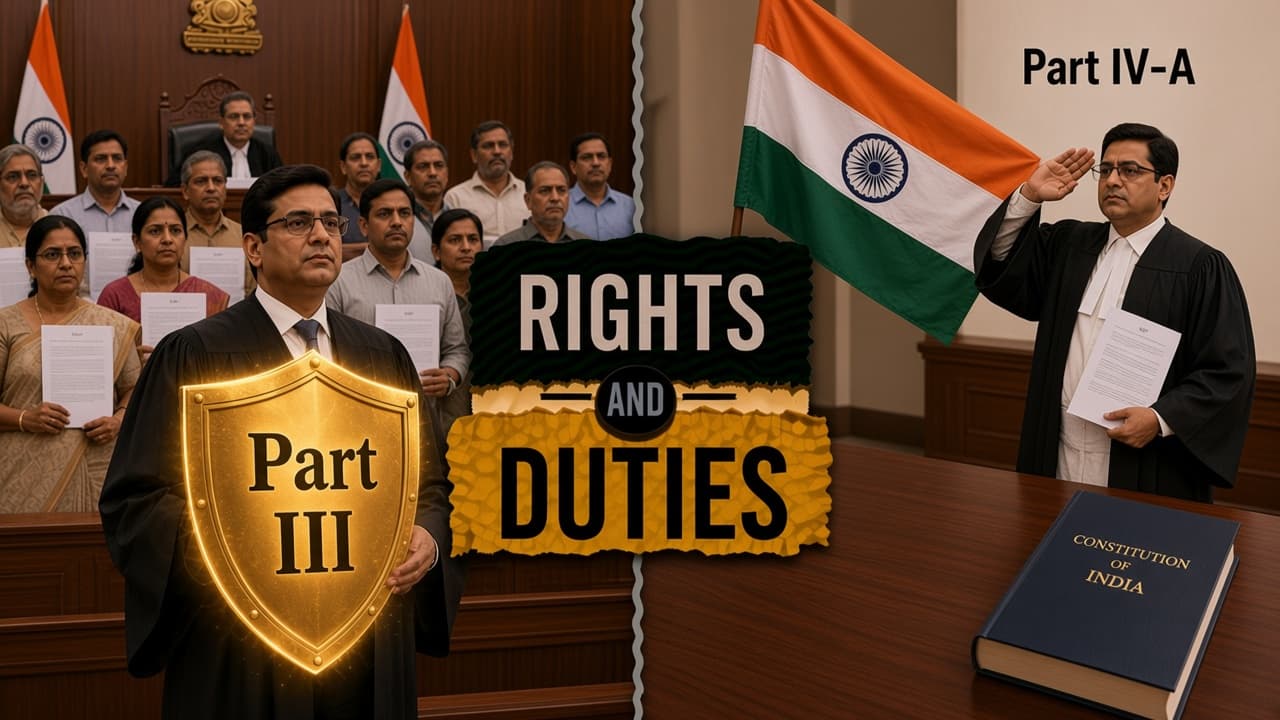
A Fundamental Right is a justiciable guarantee in Part III, enforceable against the State by writs under Articles 32 and 226. A Fundamental Duty is an obligation in Part IV-A. Article 51A binds citizens and is not directly enforceable in court. The 42nd Amendment in 1976 inserted eleven duties, on the recommendation of the Swaran Singh Committee. A twelfth duty came with the 86th Amendment. Duties are not Directive Principles. Part IV guides the State. Part IV-A speaks to citizens.
Difference between Fundamental Rights and Fundamental Duties
| Feature | Fundamental Rights | Fundamental Duties |
|---|---|---|
| Meaning | Justiciable guarantees against the State | Moral and constitutional obligations of citizens |
| Law | Part III; writs under Articles 32 and 226 | Part IV-A, Article 51A; 42nd Amendment, 1976; 86th Amendment added the education duty |
| Count | Six broad groups, later widened by interpretation | Twelve duties: eleven in 1976, plus the 86th Amendment duty on education |
| Who | Some rights, such as Article 21, are available to others as well as citizens | Article 51A binds every citizen, not foreigners |
| Emergency | Can be suspended, except Articles 20 and 21 | Not suspended as a separate list |
| Effect | Habeas corpus and other writs | Courts cite Article 51A, including 51A(g) on the environment, when reading other laws; no writ for a duty alone |
At a glance
Constitutional part
Part III, Articles 12 to 35
Part IV-A, Article 51A only
Justiciability
Justiciable under Articles 32 and 226
Not directly justiciable
Added by
Original Constitution, 1950
42nd Amendment, 1976, on the Swaran Singh Committee's recommendation
Bind whom
The State, in favour of citizens and, for some rights, others
Citizens only
Example
Flag hoisting on Independence Day
A college makes flag hoisting compulsory. A student cannot sue the college for breach of the duty in Article 51A(a), because that duty does not give a standalone writ. If the college stops him from speaking peacefully, Article 19(1)(a), a Fundamental Right, is enforceable. If he burns the national flag, the Prevention of Insults to National Honour Act may punish him. That is a specific law, not a suit for breach of duty. Rights protect. Duties orient conduct. The route to court is different.
What this means for the exam
Courts can enforce Fundamental Rights directly. Fundamental Duties need a specific law before a penalty can follow.
Fundamental Rights
Part III contains the rights, in Articles 12 to 35. They are enforceable. Article 32 in the Supreme Court and Article 226 in the High Courts are the writ routes. The rights include protections that are negative, in the sense of limits on the State, and protections that require the State to act. During an emergency they can be suspended, except Articles 20 and 21. Some, notably Article 21, are not limited to citizens.
A college that stops peaceful speech is in Article 19(1)(a) territory, which is a right. The original Constitution of 1950 brought these guarantees in. They can be amended by the special majority used for constitutional amendments, subject to the limits the courts have drawn. They are not the same chapter as the duties.
Fundamental Duties
The Swaran Singh Committee in 1976 recommended duties, drawing in part on the Soviet Constitution. Parliament inserted them by the 42nd Amendment during the Emergency, the same amendment that cut back several rights. There were eleven duties. The 86th Amendment in 2002 added the duty of parents and guardians to provide education to children aged 6 to 14, in line with Article 21A. Article 51A says it shall be the duty of every citizen.
A writ does not lie for breach of a duty alone. Specific laws, such as the Prevention of Insults to National Honour Act, can attach a penalty to conduct that a duty also describes. Judges cite Article 51A when they interpret statutes, including environmental litigation and cases on the flag and the anthem. Article 51A(g) is the environment duty used that way. Duties are not Directive Principles. Those are Part IV and are addressed to the State. Duties do not bind foreigners.
Key takeaway
Fundamental Rights are in Part III and can be enforced by writs. Fundamental Duties are in Part IV-A, were added by the 42nd Amendment, bind citizens, and are not directly enforceable.
Difference between Fundamental Rights and Fundamental Duties FAQs
What are Fundamental Rights?
Fundamental Rights are the justiciable guarantees in Part III. They protect people against the State and can be enforced by writs under Articles 32 and 226.
What are Fundamental Duties?
Fundamental Duties are the citizen obligations in Part IV-A, Article 51A. The 42nd Amendment added them in 1976 on the Swaran Singh Committee's recommendation. They are not directly enforceable by a writ.
What is the main difference between Fundamental Rights and Fundamental Duties?
Rights in Part III can be taken to court. Duties in Article 51A cannot, unless a separate law creates a penalty. Rights primarily restrain the State. Duties bind citizens.
Are Fundamental Duties enforceable by a writ under Article 32?
No. Article 51A is not directly justiciable. A specific law may create legal consequences for related conduct.
Who recommended the Fundamental Duties, and which amendment added them?
The Swaran Singh Committee recommended them. The 42nd Amendment of 1976 inserted them.
Are Fundamental Duties the same as the Directive Principles?
No. Duties are Part IV-A and bind citizens. Directive Principles are Part IV and guide the State. Neither is directly justiciable.