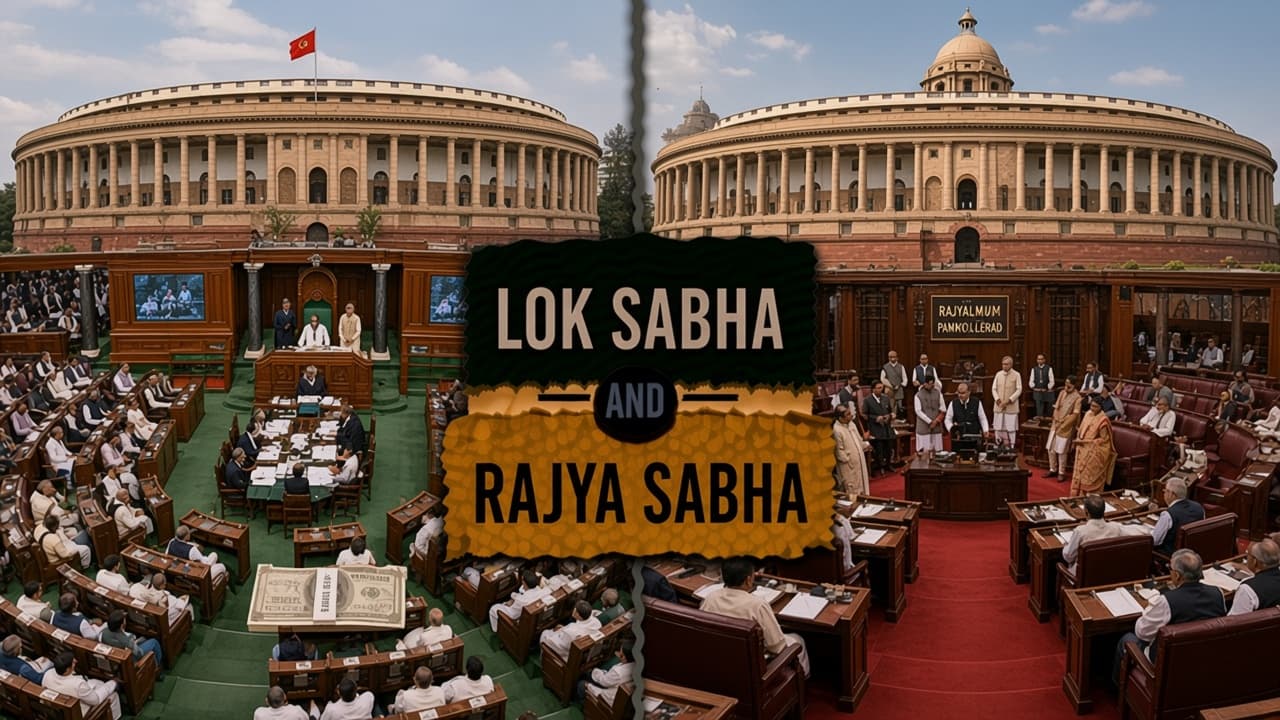
The Lok Sabha is the directly elected House that controls money and confidence, while the Rajya Sabha is the permanent House that represents the states.
By UPSCYatra Editorial Team - May 1, 2026
Table of contents
The Lok Sabha is the House of the People. Its members are elected directly, and it can be dissolved. The Rajya Sabha is the Council of States. Its members are elected indirectly by state assemblies, with nominated members as well, and the House itself is never dissolved. One-third of its members retire every two years. The Lok Sabha carries the popular mandate, including money bills and the confidence of the government. The Rajya Sabha carries state interests and a second look at ordinary legislation.
Difference between Lok Sabha and Rajya Sabha
Feature
Lok Sabha
Rajya Sabha
Money
A Money Bill is introduced only here
Cannot amend or reject it, and has a 14-day window for recommendations
Power
The no-confidence motion
Article 249, which lets Parliament legislate on a State List matter
Age
25 years
30 years
Strength
Maximum 552: 530 from the states, 20 from the Union territories, and 2 nominated Anglo-Indian seats, the last of which has been abolished
Maximum 250: 238 elected and 12 nominated
Joint
The Speaker presides over a joint sitting, which can resolve a deadlock on an ordinary bill under Article 108
A joint sitting cannot be convened for a Money Bill or a constitutional amendment bill
Term
Dissolved every 5 years, or earlier
A continuous House, and it is never dissolved
At a glance
Election
Lok Sabha
Direct, by adult franchise
Rajya Sabha
Indirect, by MLAs, plus nominated members
Tenure
Lok Sabha
5 years, and it can be dissolved
Rajya Sabha
Permanent, with one-third retiring every 2 years
Presiding officer
Lok Sabha
Speaker
Rajya Sabha
Chairman, who is the Vice-President, ex officio
Upgrade for access and purchase our mains 27 pass.
A Money Bill is introduced only in the Lok Sabha. The Rajya Sabha has 14 days to suggest changes, and the Lok Sabha may ignore those suggestions. The bill still passes. That is why the classification of a bill as a Money Bill matters, a point argued in cases such as the Aadhaar Act.
What this means for the exam
The Rajya Sabha cannot reject or amend a Money Bill. It can only send recommendations, and it has 14 days to do so.
Lok Sabha
Members of the Lok Sabha are chosen by adult franchise, and the minimum age is 25. The House lasts five years unless it is dissolved sooner. The maximum strength is 552: 530 seats for the states, 20 for the Union territories, and 2 nominated Anglo-Indian seats. Those nominated seats have been abolished. The Speaker presides, and also presides over a joint sitting under Article 108.
Money Bills start only here, and the government holds office while it has the confidence of this House. A joint sitting can break a deadlock on an ordinary bill. It cannot be used for a Money Bill or for a constitutional amendment. Financial accountability in the parliamentary system runs through this House.
Rajya Sabha
The Rajya Sabha represents the states and Union territories. Members are elected by MLAs, and the President nominates 12 members. The minimum age is 30. The maximum strength is 250, of which 238 are elected. The House is never dissolved. One-third of the members retire every two years. The Vice-President is the Chairman, ex officio, and is not a member of either House.
On a Money Bill the House has 14 days to recommend changes, and it cannot reject or amend the bill. On a constitutional amendment it has equal powers with the Lok Sabha: both Houses must pass the bill. Article 249 is its special federal power, allowing Parliament to legislate on a matter in the State List. Federalism in the bill process depends on which House holds which power.
Key takeaway
The Lok Sabha controls money bills and the confidence of the government, and it can be dissolved. The Rajya Sabha represents the states, is never dissolved, and has equal powers with the Lok Sabha on constitutional amendments.
Difference between Lok Sabha and Rajya Sabha FAQs
What is the Lok Sabha?
The Lok Sabha is the directly elected House of the People. It can be dissolved, Money Bills are introduced only here, and the government must keep its confidence. The minimum age of a member is 25, and the Speaker presides.
What is the Rajya Sabha?
The Rajya Sabha is the Council of States. Members are elected by MLAs, with 12 nominated by the President. It is a permanent House, one-third of members retire every two years, and the Vice-President is the Chairman.
What is the main difference between the Lok Sabha and the Rajya Sabha?
The Lok Sabha is directly elected, can be dissolved, and leads on money and on confidence. The Rajya Sabha is permanent, represents the states, and can delay ordinary bills. The two Houses have equal powers on constitutional amendments.
Can the Rajya Sabha reject a Money Bill?
No. The Rajya Sabha cannot reject or amend a Money Bill. It may recommend changes within 14 days, and the Lok Sabha may ignore those recommendations.
Do the two Houses have equal powers on a constitutional amendment?
Yes. Both Houses must pass a constitutional amendment bill. Neither House can do it alone, and a joint sitting is not available for such a bill.
Is the Vice-President a member of the Rajya Sabha?
The Vice-President is the Chairman of the Rajya Sabha, ex officio. The Vice-President is not a member of either House.