
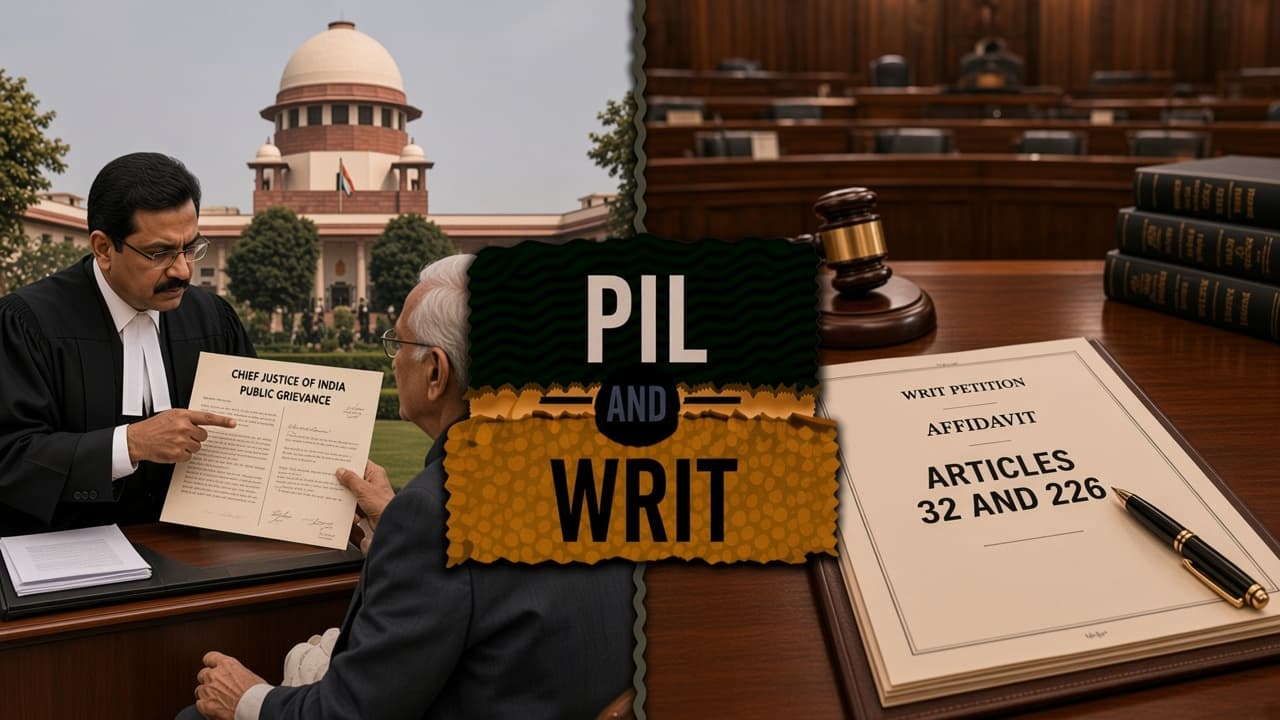
A writ petition is a formal application under Article 32 or Article 226. The five writs are habeas corpus, mandamus, prohibition, certiorari, and quo warranto. Public interest litigation is not a sixth writ. It is a relaxation inside writ jurisdiction. Letters, postcards, and third parties can bring cases for bonded labourers, people harmed by pollution, or under-trial prisoners. Hussainara Khatoon in 1979 and S.P. Gupta in 1981 are the origin cases. Dr Ambedkar called Article 32 the heart and soul of the Constitution. High Courts under Article 226 hear many of these cases as well.
Difference between a PIL and a writ petition
| Feature | PIL | Writ Petition |
|---|---|---|
| Meaning | A formal constitutional application for one of the five writs | A writ case with relaxed standing, brought in the public interest |
| Law | Articles 32 and 226; five named writs | The same articles; Hussainara Khatoon, 1979, and S.P. Gupta, 1981 |
| Who | The aggrieved person, with a formal affidavit | A public-spirited person, a letter, or the court on its own motion |
| Where | Supreme Court under Article 32 for Fundamental Rights; High Court under Article 226 | The same two courts; a PIL is not a separate court |
| Rights | Fundamental Rights in the Supreme Court; Fundamental Rights and other legal rights in a High Court | Often Articles 21, 14, and 19, read widely |
| Effect | An adversarial case led by the parties | A more investigative case, with amicus, commissions, and suo motu action; misuse is called publicity interest litigation |
At a glance
Locus standi
Strict: the person who is aggrieved
Relaxed: any public-spirited person
Form
A formal petition and an affidavit
A letter or a postcard may be enough
Purpose
A violation of an individual right
A collective or public grievance
Constitutional tag
A remedy under Article 32 or 226
A procedure inside that same remedy
Example
Undertrial prisoner for 8 years
A lawyer reads that a villager has been in jail for years without trial. She writes to the Chief Justice. The letter is treated as a public interest writ petition. The court issues directions in the nature of habeas corpus or mandamus. An ordinary writ petition is usually filed by the person affected, with affidavits, alleging a specific breach of Article 21 or Article 22.
What this means for the exam
A PIL lowers the barrier of who may file. The remedy underneath is still a writ under Article 32 or Article 226.
Writ petition
The five writs are the kinds of relief: habeas corpus, mandamus, prohibition, certiorari, and quo warranto. Article 32, which Dr Ambedkar called the heart and soul of the Constitution, lets the Supreme Court issue them for Fundamental Rights. Article 226 lets a High Court issue them for Fundamental Rights and for other legal rights. A conventional petition is formal. The person affected files it, with an affidavit, and the case runs as an adversarial dispute.
The forum depends on the right and on geography. A Fundamental Right can go to the Supreme Court. A High Court is often the practical court, because Article 226 is wider. Calling a PIL a writ issued by the High Court under Article 226 uses the wrong category. The writ is habeas corpus or mandamus or another of the five. The PIL is the way the case arrived.
PIL
Public interest litigation grew when the court accepted that the people most affected could not always reach the registry. Hussainara Khatoon in 1979 and S.P. Gupta in 1981 are the dates used. Letters and postcards were treated as petitions. Justice P.N. Bhagwati is associated with popularising the practice, and a 2006 question treats him as Chief Justice when it was introduced. Justice V.R. Krishna Iyer is treated as a progenitor. He was never Chief Justice of India, which is the 2008 pattern: the progenitor statement stands, and the claim that he was Chief Justice does not.
The court may appoint an amicus, set up a commission, or act suo motu. The risk is the vexatious or publicity-seeking petition. PILs run in High Courts under Article 226 as well as in the Supreme Court. They are often more frequent in High Courts for local grievances. The standing rule is relaxed. The constitutional hook is still Article 32 or 226.
Key takeaway
A writ petition is the formal remedy under Articles 32 and 226. A PIL is relaxed standing inside that remedy, and it is not a separate writ.
Difference between a PIL and a writ petition FAQs
What is a writ petition?
A writ petition is a formal application under Article 32 or Article 226 for one of the five writs: habeas corpus, mandamus, prohibition, certiorari, or quo warranto.
What is a PIL?
A public interest litigation is a writ case with relaxed standing. A public-spirited person, or even a letter, can ask the court to act for people who cannot come themselves. It is not a sixth writ.
What is the main difference between a PIL and a writ petition?
A writ petition is the constitutional remedy, usually filed by the person affected. A PIL uses that remedy with easier standing and a public grievance. The underlying relief is still a writ.
Is public interest litigation a writ issued by the High Court under Article 226?
No. PIL is a procedural form. Habeas corpus, mandamus, and the other three named writs are the writs. High Courts hear PILs, but the PIL is not itself a writ.
Was Justice V.R. Krishna Iyer Chief Justice of India, and what was his link to PIL?
He was not Chief Justice of India. He is regarded as a progenitor of public interest litigation as a judge. That split is the 2008 question.
Can only the Supreme Court hear a PIL?
No. High Courts hear PILs under Article 226, and they do so often for local grievances. Article 32 is the Fundamental Rights route to the Supreme Court.
PYQ linkage
Who was the Chief Justice of India when PIL was introduced to the Indian judicial system?
Justice V.R. Krishna Iyer was CJI / progenitor of PIL — which statement(s) correct?