
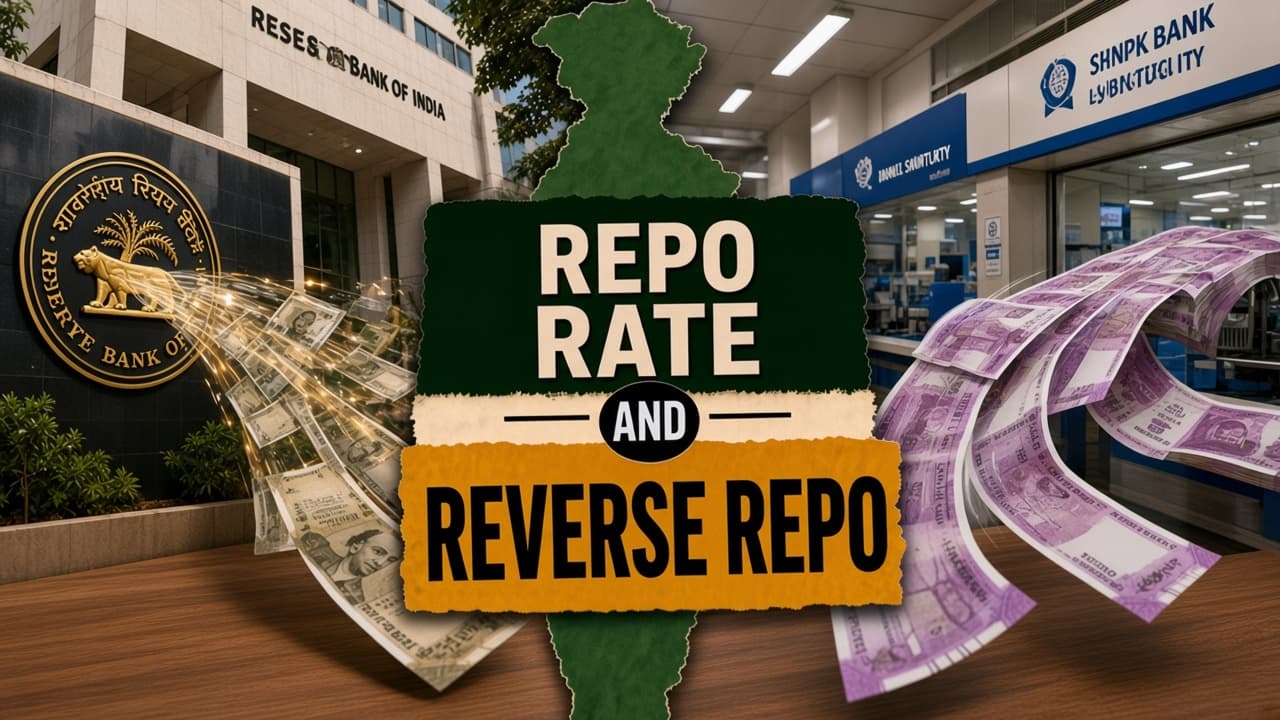
The repo rate is the rate at which the RBI lends short-term funds to banks against government securities. The reverse repo rate is the rate at which the RBI accepts surplus funds from banks and pays them interest. Repo puts money into the banking system. Reverse repo takes surplus money out. The two rates form the policy corridor, with repo as the ceiling and reverse repo as the floor.
Difference between Repo Rate and Reverse Repo Rate
| Feature | Repo Rate | Reverse Repo Rate |
|---|---|---|
| Collateral | Government securities | Government securities |
| Credit | A higher repo rate lifts lending rates and cools demand | A higher reverse repo rate gives banks a stronger reason to park funds |
| Interest | The bank pays the RBI on borrowed funds | The RBI pays the bank on parked funds |
| Purpose | Benchmark policy rate set by the Monetary Policy Committee | Floor of the liquidity corridor |
| Tenure | Overnight and other short-term repo windows | Overnight absorption |
| Liquidity | Injects liquidity into the banking system | Drains excess liquidity from the system |
At a glance
Direction
RBI lends to the bank
The bank parks funds with the RBI
Effect
Liquidity injection
Liquidity absorption
Rate level
Higher
Lower
Example
Bank has extra cash after festival season
After heavy deposits during Diwali, a bank has surplus funds. Parking that money with the RBI at the reverse repo rate is safe, and the RBI pays the bank. When liquidity is tight before tax outflows, the RBI lends through the repo window so banks can keep lending to businesses. The bank pays the RBI interest on those borrowed funds.
What this means for the exam
Repo injects liquidity, and the bank pays the RBI. Reverse repo absorbs liquidity, and the RBI pays the bank. The repo rate stays above the reverse repo rate.
Repo rate
Under a repo, the RBI lends short-term money to banks and takes government securities as collateral. The bank pays the interest. Since 2016 the Monetary Policy Committee, chaired by the RBI Governor, has set the policy repo rate every two months under the inflation-targeting framework. A higher repo rate feeds into lending rates, EMIs, and business credit, and that can cool demand when inflation is high.
The repo rate is the ceiling of the corridor. A statement that puts the reverse repo rate above the repo rate reverses the corridor. Typical deals are overnight or otherwise short term.
Reverse repo rate
Under a reverse repo, banks place surplus funds with the RBI, again against government securities, and the RBI pays the bank. The operation drains excess liquidity. The rate sits below the repo rate and forms the floor of the corridor. It matters most when the system is flush with cash, as after a festival deposit surge.
The direction of the interest payment is the usual mix-up. In a repo the bank pays the RBI. In a reverse repo the RBI pays the bank. A higher reverse repo rate makes parking funds more attractive and pulls money out of lending.
Key takeaway
The repo rate is the rate at which the RBI lends to banks and injects liquidity. The reverse repo rate is the rate at which banks park surplus funds and liquidity is absorbed. The repo rate is always higher.
Difference between Repo Rate and Reverse Repo Rate FAQs
What is the repo rate?
The repo rate is the rate at which the RBI lends short-term funds to banks against government securities. The bank pays the interest, and the loan injects liquidity. The Monetary Policy Committee sets this rate.
What is the reverse repo rate?
The reverse repo rate is the rate at which banks park surplus funds with the RBI. The RBI pays the bank, and the operation absorbs liquidity. It is the floor of the policy corridor.
What is the main difference between the repo rate and the reverse repo rate?
At the repo rate the RBI lends to banks and money enters the system. At the reverse repo rate banks park surplus money and money leaves the system. The repo rate is always the higher of the two.
Is the reverse repo rate higher than the repo rate?
No. The repo rate is the ceiling of the corridor, and the reverse repo rate is the floor. The repo rate is always higher.
Who decides the repo rate?
The Monetary Policy Committee, chaired by the RBI Governor, sets the policy repo rate. Since 2016 it has done so every two months under the inflation-targeting framework.
Who pays interest in a repo and in a reverse repo?
In a repo the bank pays the RBI on the funds it borrows. In a reverse repo the RBI pays the bank on the funds the bank has parked.
PYQ linkage
Treasury bills are issued only by Union Government — correct?