
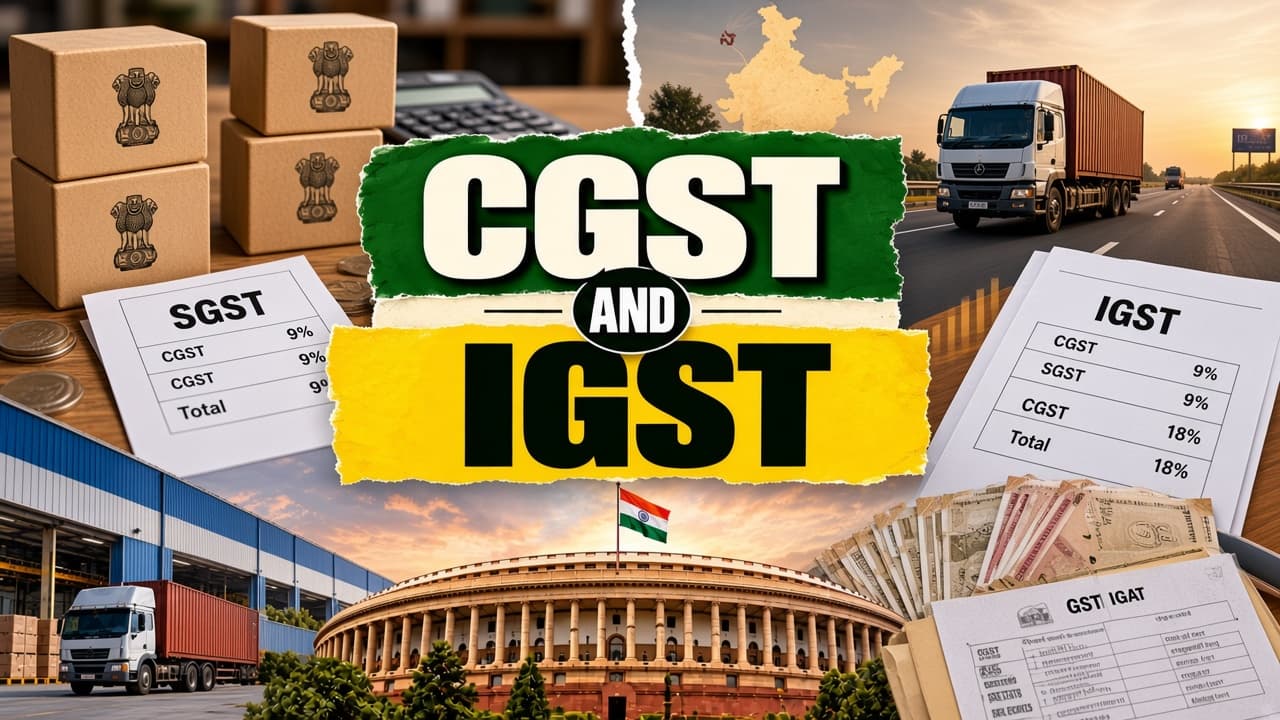
State GST (SGST) is the state component of GST on a supply that stays inside one state, and it is credited to the state where the supply is consumed. Integrated GST (IGST) is the tax on a supply that moves from one state to another, and on imports. The Centre collects IGST and apportions it to the destination state. On a local sale the invoice shows CGST and SGST. On a cross-state sale those two lines are replaced by one IGST line at the combined rate.
Difference between SGST and IGST
| Feature | SGST | IGST |
|---|---|---|
| Law | The State GST Act, 2017 | The Integrated GST Act, 2017 |
| Credit | Can be set off against CGST on the same invoice | Carries the credit chain across states through the IGST pool |
| Exports | Zero-rated, with a refund of accumulated input tax credit | Zero-rated, and IGST may be paid and then refunded |
| Articles | Article 246A: states levy GST on an intra-state supply | Article 269A: inter-state supply is assigned to the Centre for apportionment |
| Invoice | Shown as SGST, half of the total rate, on an intra-state bill | A single IGST line replaces CGST and SGST on an inter-state bill |
| Cess | Compensation cess is not charged as SGST. It applies separately on notified goods | IGST plus cess on luxury and sin goods, with settlement through the GST Council pool |
At a glance
Transaction type
Inside one state
Across states, and also imports
Collected by
The state government
The central government, then shared
Revenue goes to
The state, directly
The destination state, after IGST settlement
Typical rate split
Half of the total GST rate, such as 9% of 18%
The full combined rate, such as 18%
Example
Cafe bill in Mumbai vs parcel to Delhi
A meal at a Mumbai cafe costs ₹500 before tax. At 18% GST the bill shows 9% CGST and 9% SGST on the same sale, split between the Centre and Maharashtra. The same packaged snacks, sent from Mumbai to a customer in Delhi, carry 18% IGST, collected by the Centre. Maharashtra can use SGST credit on its inputs. Delhi receives its share after the IGST settlement. The rate is one rate. The routing depends on whether the supply crossed a state border.
What this means for the exam
A supply inside one state is charged as CGST plus SGST. A supply across states is charged as IGST at the full combined rate, and the Centre collects it.
SGST
SGST is levied under the State GST Act, 2017, on a supply that does not leave the state. Article 246A is the constitutional hook for a state levy on an intra-state supply. On an 18% supply the SGST line is usually 9%, paired with an equal CGST line. The state receives this share directly. Input tax credit of SGST can be set off against CGST on the same invoice.
Exports under this head are zero-rated, and accumulated input tax credit can be refunded. Compensation cess is a separate levy on notified goods. It is not folded into SGST. Early IGST settlement problems hit exporters and small firms even when the state share itself was clear, because the credit chain stalled while the clearing house caught up.
IGST
Before GST, a manufacturer in Gujarat who paid state VAT could not easily set that tax off against central excise on a sale to Tamil Nadu. IGST, under the Integrated GST Act, 2017, is one inter-state tax collected by the Centre. An automated clearing house then moves the revenue to the state where the goods are consumed. Article 269A assigns inter-state supply to the Centre for that apportionment. Destination-based taxation stays, and the credit chain stays intact.
The IGST rate equals CGST plus SGST for the same supply. On the cross-state bill there is one line, at 18% in the cafe example, in place of the two 9% lines. Imports are covered the same way. Luxury and sin goods can carry IGST plus compensation cess, settled through the GST Council pool. IGST can also be paid on a zero-rated export and then refunded. Calling IGST a third tax stacked on top of CGST and SGST misreads the invoice: it replaces those two components on an inter-state supply.
Key takeaway
SGST is the state share on a supply inside one state. IGST is the combined-rate tax on a supply across states, collected by the Centre and shared with the destination state.
Difference between SGST and IGST FAQs
What is SGST?
SGST is the state component of GST on a supply inside one state. It is levied under the State GST Act, 2017, and the revenue goes to that state. On an 18% rate it is usually charged at 9%, alongside 9% CGST.
What is IGST?
IGST is the tax on an inter-state supply and on imports, under the Integrated GST Act, 2017. The Centre collects it and later apportions the revenue to the destination state. The rate equals CGST plus SGST for the same supply.
What is the main difference between SGST and IGST?
SGST applies when the supply stays inside one state and is credited to that state. IGST applies when the supply crosses a state border, or is an import, and the Centre collects it for later sharing with the destination state.
Is IGST an extra tax on top of CGST and SGST?
No. On an inter-state supply, IGST replaces CGST and SGST. It is a single charge at the combined rate, collected by the Centre.
Who collects IGST on an inter-state supply?
The central government collects IGST and apportions it to the destination state under the GST law. Article 269A is the constitutional basis for that assignment.
Why was IGST needed?
Under the old system a state VAT paid in one state often could not be set off against central excise on a sale into another state. IGST keeps one credit chain and still sends the revenue to the state where the goods are consumed.
PYQ linkage
Under GST, inter-state supply of goods is taxed under: