
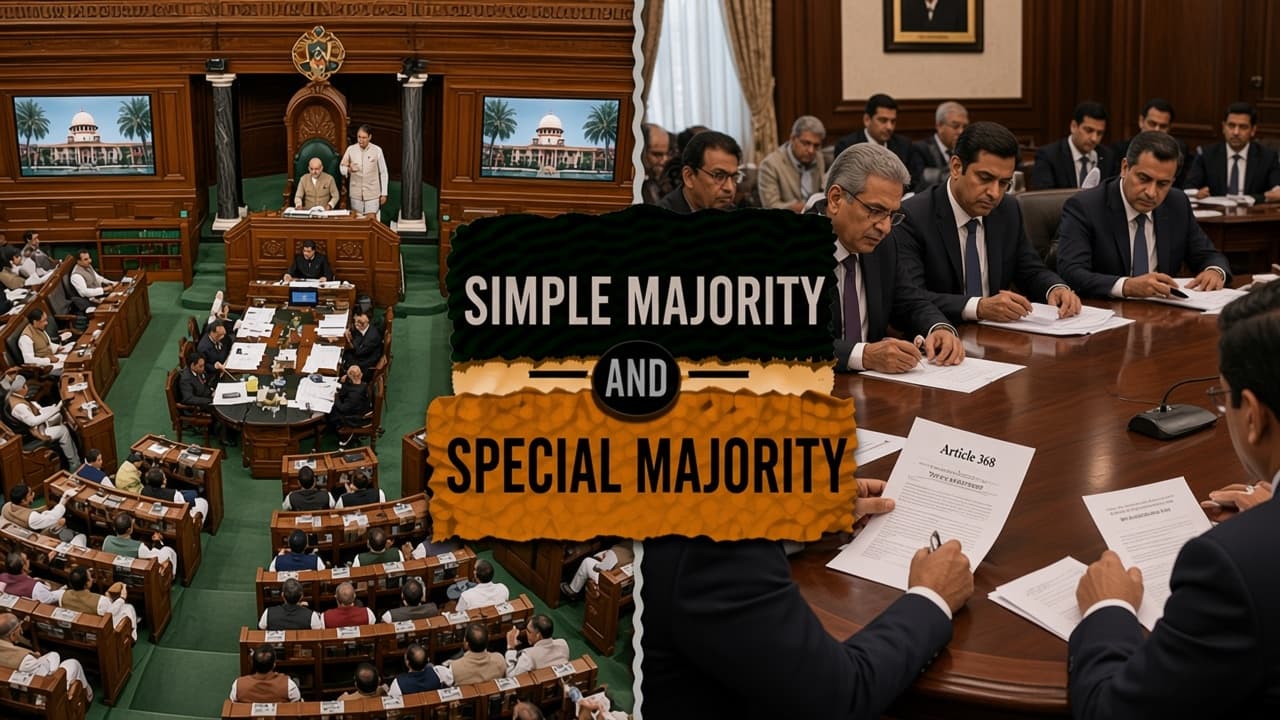
A simple majority is a majority of the members present and voting. A special majority under Article 368 is a twin test: a majority of the total membership of the house, and at least two-thirds of the members present and voting. Abstentions drop out of the simple-majority count. The special majority still uses both the full membership and the members who vote. Some amendments also need ratification by at least half the state legislatures, which is a further step. Impeachment of the President uses two-thirds of the total membership, which is a different formula.
Difference between a simple majority and a special majority
| Feature | Difference Between Simple Majority and Special Majority |
|---|---|
| Meaning | More votes in favour than against, among those who vote |
| Law | The ordinary rule for most bills and motions |
| Use | Ordinary legislation and Money Bills in the Lok Sabha |
| States | State legislatures are not asked to ratify |
| Impeachment | Not the formula for impeachment of the President |
| Effect | Empty seats and abstentions are outside the denominator |
At a glance
Denominator
Members present and voting
Typical use
Ordinary bills, resolutions, and a no-confidence motion
Abstentions
They only shrink the number of effective voters
State ratification
Not required
Example
543-seat Lok Sabha votes on a constitutional amendment
The Lok Sabha has 543 seats. Suppose 400 members are present and 380 vote, with 20 abstaining. A simple majority needs more than 190 votes in favour. A special majority needs more than 271 votes in favour, which is a majority of the total membership of 543, and also at least two-thirds of the 380 who vote, which is at least 254. If only 250 vote yes, the total-membership test has already failed. A bill that passes 300 to 80 on ordinary business can still fail as a constitutional amendment because it has missed the total-membership threshold.
What this means for the exam
A simple majority looks only at members present and voting. A special majority under Article 368 needs a majority of the total membership and two-thirds of those present and voting.
Simple majority
The count is members present and voting. Abstentions are ignored. Empty seats are ignored. Ordinary bills, resolutions, and a vote of no confidence use this rule. A Money Bill in the Lok Sabha also passes by a simple majority. It does not need the Article 368 test. In the illustration, 380 members vote, so more than 190 votes in favour are enough.
Students lose the question by swapping denominators. "Present and voting" is not "total membership". A large winning margin on a thin house can be a simple majority and still miss the amendment test.
Special majority
Article 368 requires each house to pass an amendment bill by a majority of its total membership and by not less than two-thirds of the members present and voting. Both limbs are compulsory. In a Lok Sabha of 543, the first limb is more than 271. The second limb depends on how many actually vote. If 380 vote, two-thirds is at least 254. Amendments that touch federal provisions also need the consent of not less than half the state legislatures.
Impeachment of the President is often given the same name and is a different fraction: two-thirds of the total membership. Removal of the Vice President and of judges uses still other rules. Kesavananda Bharati sits on top of this arithmetic. An amendment that clears Article 368 can still be tested against the basic structure. The fractions themselves are the prelims point.
Key takeaway
A simple majority is a majority of members present and voting. A special majority under Article 368 is a majority of the total membership plus two-thirds of the members present and voting.
Difference between a simple majority and a special majority FAQs
What is a simple majority?
A simple majority is more votes in favour than against, among the members present and voting. Abstentions are not counted. Ordinary bills use this rule.
What is a special majority under Article 368?
It is a majority of the total membership of the house, and also at least two-thirds of the members present and voting. Both conditions are required in each house.
What is the main difference between a simple majority and a special majority?
A simple majority looks only at those who vote. A special majority for an amendment also requires a majority of the entire membership. Some amendments then need half the states as well.
Does a constitutional amendment need only two-thirds of the members present and voting?
No. It must also be passed by a majority of the total membership. The two-thirds limb alone is not enough.
Is impeachment of the President the same special majority as Article 368?
No. Presidential impeachment uses two-thirds of the total membership. Article 368 uses total-membership majority plus two-thirds of those present and voting.
How does the total-membership test work in a Lok Sabha of 543?
A majority of 543 is more than 271 votes in favour, even if fewer members are in the chamber. The two-thirds test is then applied to those present and voting.