
Why gold prices are rising: safe-haven demand, the US dollar, real interest rates, central-bank buying, and India’s import bill — explained for UPSC economy.
(Editorial Team)
UPSCYatra’s editorial team researches and publishes syllabus guides, exam trends, previous years' questions analysis, and conceptual deep-dives for serious UPSC aspirants.
Valid till Mains 2027
Walk past a jewellery shop in any Indian city and you will notice the same thing: the gold rate board has a fresh number, higher than last month, often higher than last year.
Your mother may say gold always rises. Your uncle may call it the safest investment. A friend may complain that wedding shopping just got more expensive.
They are all touching the same economic story. Gold is not just a shiny metal in a showcase. It is a global financial asset — and right now, the world is buying more of it than ever.
So why are prices at record highs? The short answer: when the world feels uncertain, money runs to gold. And several forces — a softer US dollar, low real interest rates, central banks stockpiling, and India's own import dependence — are keeping that rush going.
In one line
Gold hits record highs when global fear pushes safe-haven demand up, the US dollar weakens, real interest rates fall, and central banks buy more — and in India, a weaker rupee and festive demand add extra pressure on top.
Look at the chart below and one pattern stands out immediately: gold did not rise in a straight line.
From 2016 to 2019, global prices were relatively flat — hovering around $1,250–$1,400 per ounce. Indian rates moved in a similar band near ₹28,500–₹35,000 per 10 grams. Then came the break.
2020 changed everything. COVID uncertainty, rate cuts, and stimulus sent gold past $1,770 globally and close to ₹49,000 in India in a single year. Prices stayed elevated through 2021–2022, then accelerated again from 2023 onward as geopolitical tension, central-bank buying, and dollar volatility combined.
By 2024, global bullion averaged about $2,386 per ounce and Indian 24K gold about ₹77,900 per 10 grams. 2025 pushed further — global averages near $3,430 and India near ₹92,000. By mid-2026, year-to-date averages are even higher: global bullion above $4,600 and Indian gold above ₹1,34,000 per 10 grams (about ₹13,400 per gram). That is the record-high sticker you see on shop boards today.
Notice how the India line climbs faster than the global line in some years. That is the rupee channel at work: even when dollar gold is flat, a weaker rupee can still push domestic prices up.
Annual averages (2026 = year-to-date through July), rounded for illustration. India series reflects global bullion pass-through and rupee movement; jeweller rates vary by city and date. Sources: LBMA/WGC (global), BankBazaar/IBJA (India).
The rest of this article explains the forces behind that slope — why each surge happened, and what it means for India's imports, reserves, and your wallet.
Before the mechanics, one distinction that clears up a lot of confusion.
The gold in a shop window is physical. But the price on the board is financial. It tracks international markets — mainly London and New York — where gold trades in US dollars per troy ounce.
India is the world's second-largest consumer of gold. We love it for weddings, festivals, and savings. But we produce very little. Almost all the gold Indians buy is imported. That single fact explains why global shocks and the rupee–dollar rate both show up at your neighbourhood jeweller.
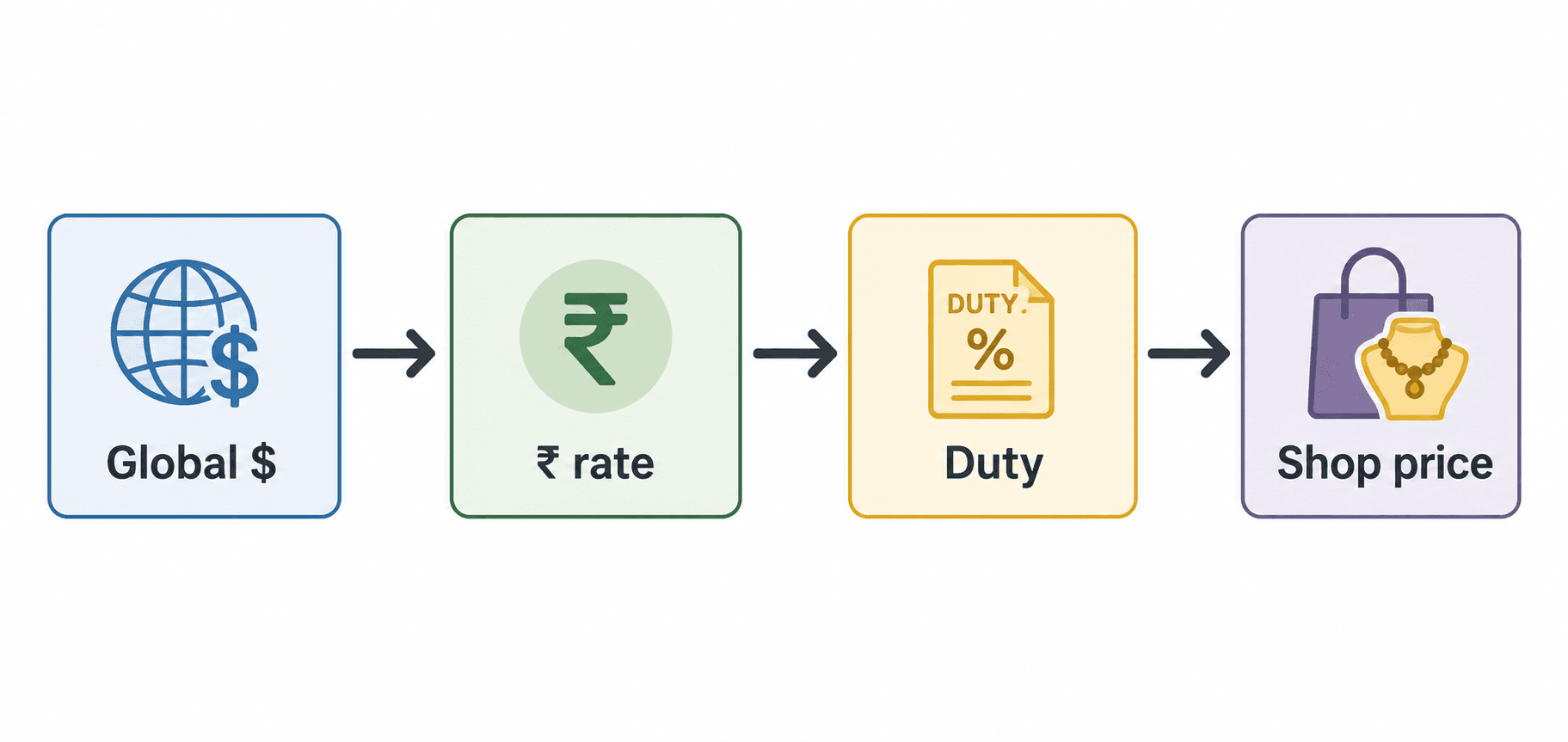
Think of it as a simple chain:
Global dollar price × rupee exchange rate + taxes and charges = what you pay per gram.
When any link in that chain moves, the sticker on the shop window moves with it.
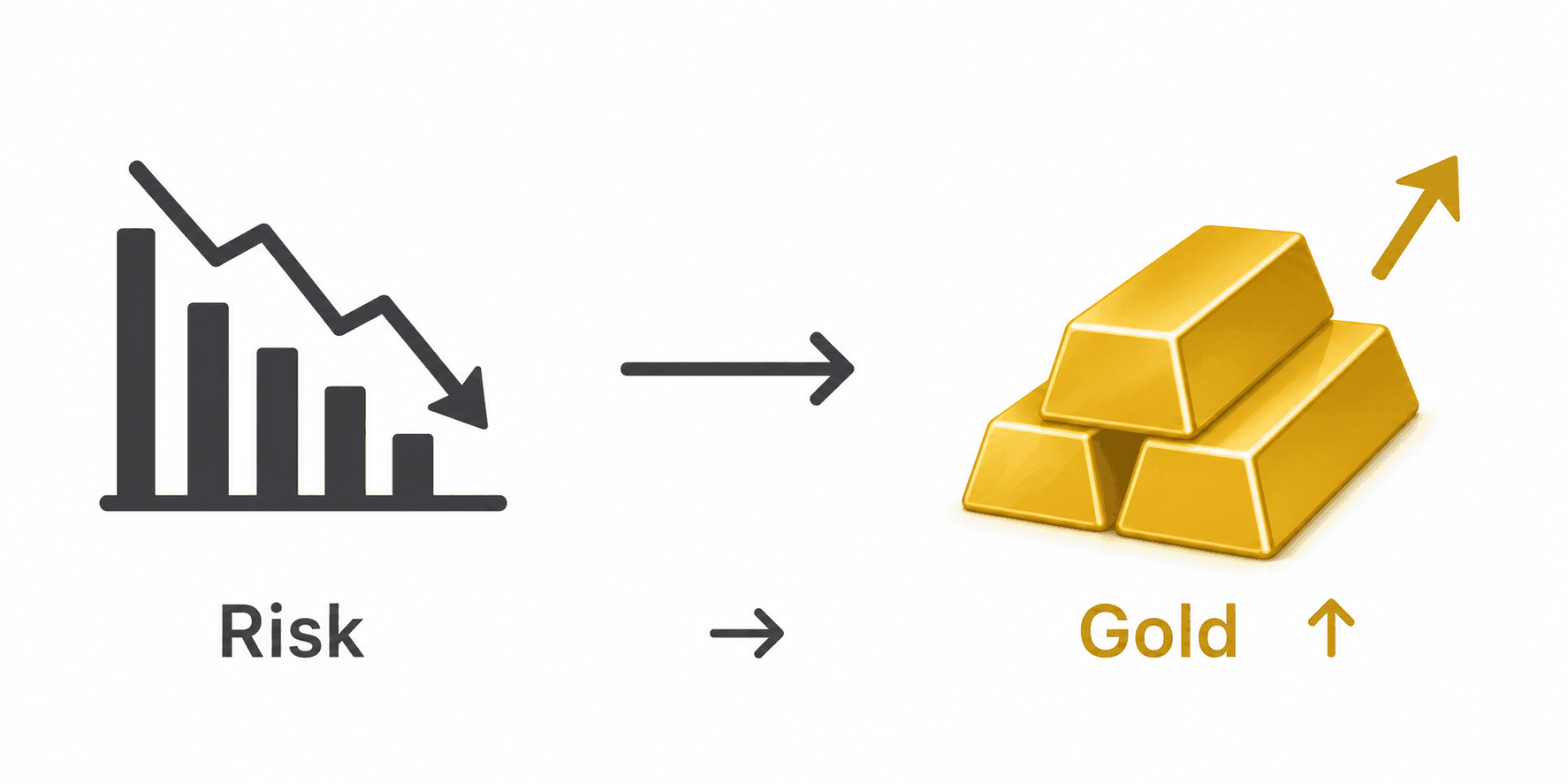
Gold has almost no industrial use compared to copper or steel. People buy it for one enduring reason: trust.
When stock markets fall, when wars break out, when banks look shaky, investors sell risky assets and buy what has held value for thousands of years. Economists call gold a — the financial equivalent of moving valuables into a strong room when a storm is coming.
This is not superstition. It is observable market behaviour. During the 2008 financial crisis, gold rallied. During the COVID shock in 2020, gold surged. When geopolitical tension rises — conflicts in Europe or the Middle East, trade friction between major powers — gold often climbs again.
Gold does not pay interest. It does not declare dividends. It just sits there, heavy and yellow, while the world panics. That quiet reliability is exactly the product people are buying when headlines turn dark.
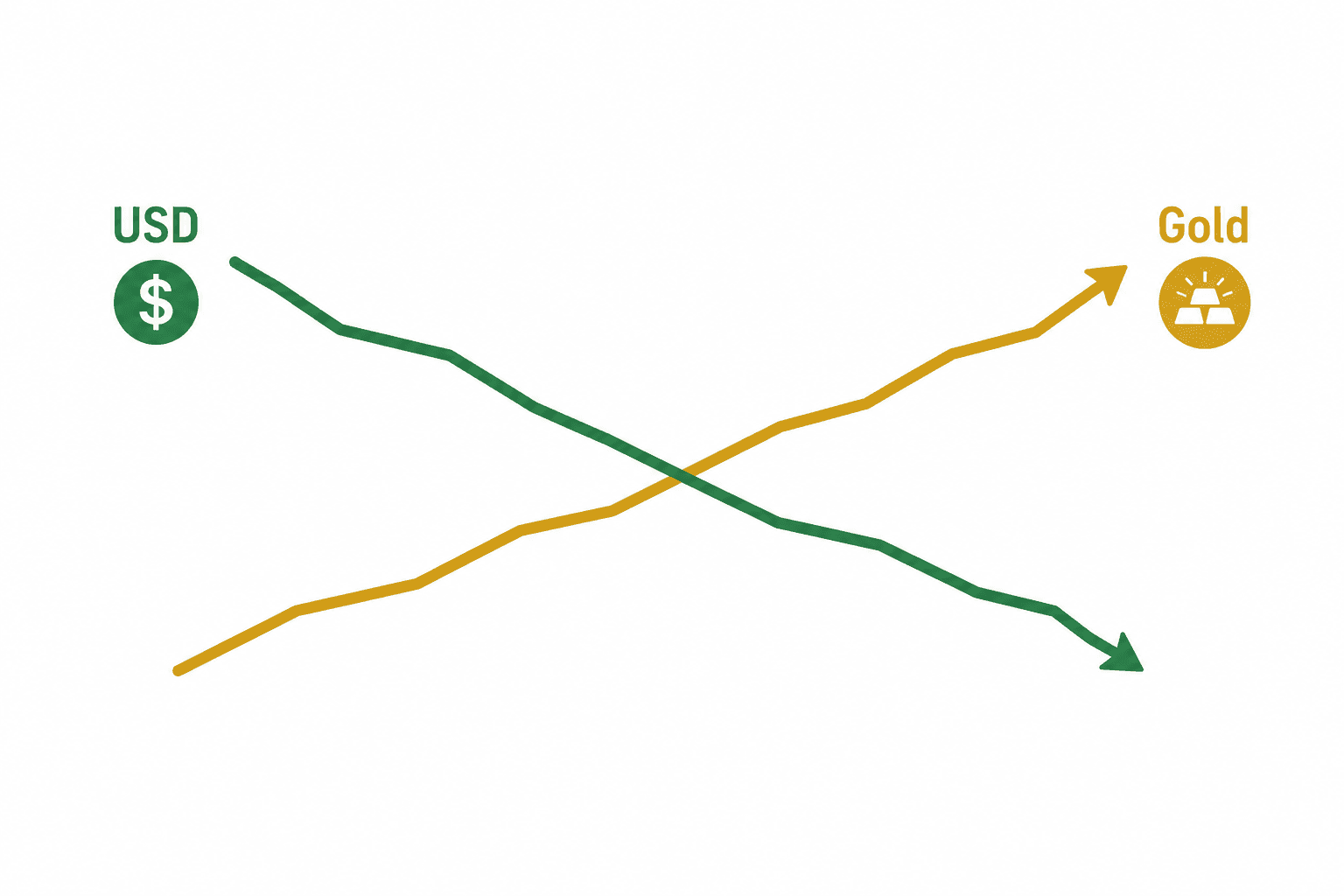
Here is a relationship UPSC loves to test: gold and the US dollar usually move in opposite directions.
Why? Because gold is priced in dollars. When the dollar weakens, the same ounce of gold costs fewer euros, yen, or rupees — so buyers outside America find gold cheaper, demand rises, and the dollar price of gold itself often climbs.
The Federal Reserve's interest-rate decisions matter here. When US rates are high, global money flows into dollar assets for yield. When rate-cut expectations build, the dollar can soften — and gold frequently benefits.
For India, this channel matters twice. A weaker dollar can lift global gold. And if the rupee weakens against the dollar at the same time, domestic gold prices get a double push.
Gold pays you nothing. Zero coupon. No quarterly payout.
So every gram of gold you hold has an — the return you give up by not putting that money in a fixed deposit, bond, or mutual fund.
That trade-off is clearest through : the nominal return minus .
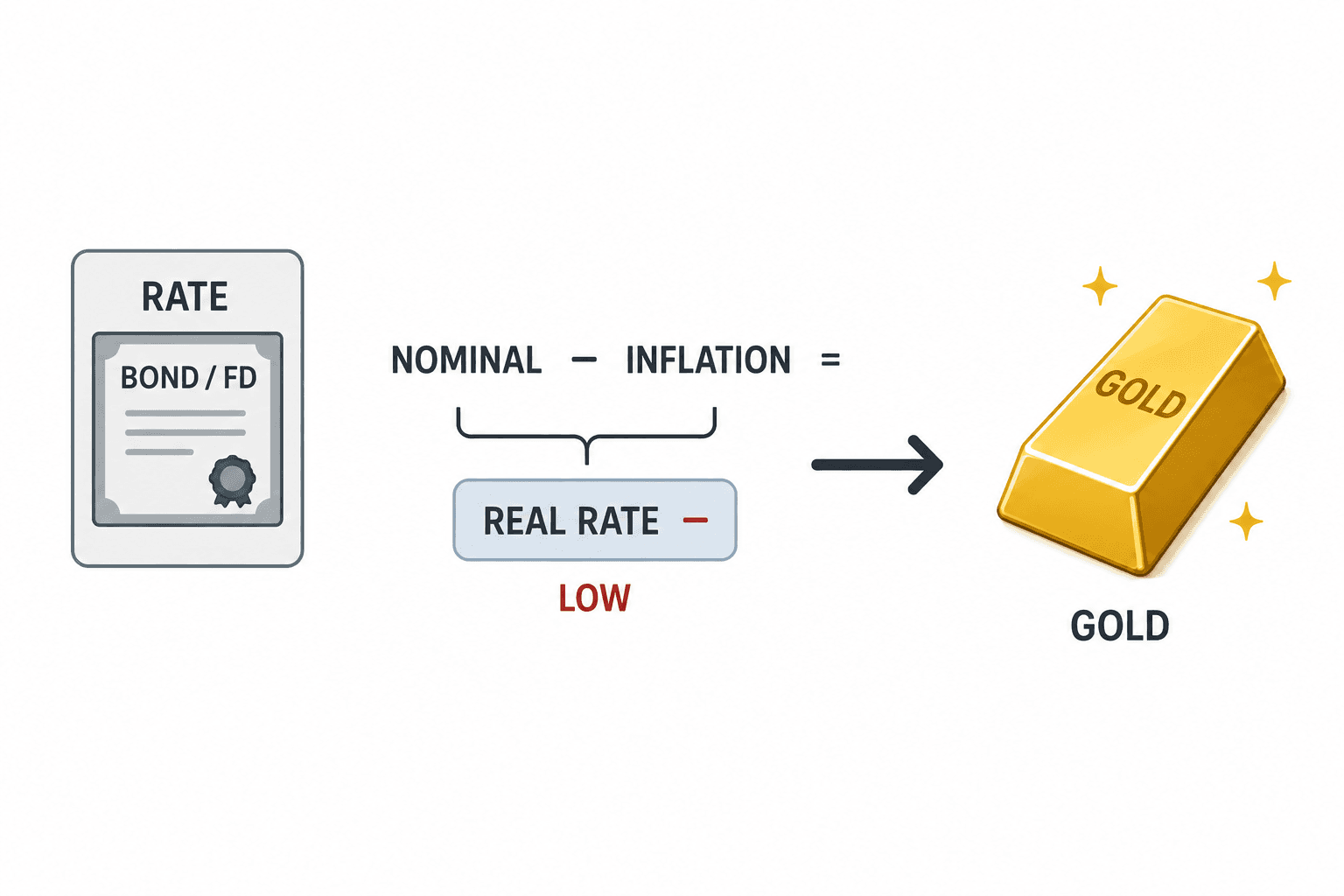
When real rates are high — say a 7% FD and inflation at 3% — holding gold feels expensive. You are giving up a solid real return.
When real rates are low or even negative — inflation at 5% but deposits paying 6% before tax — gold looks more attractive. It may not earn interest, but it is not obviously losing the race against rising prices either.
Central banks, including the RBI, watch this tension closely. It is one reason gold rallies in periods when policy rates lag behind inflation — and why gold can cool when central banks tighten aggressively.
A quieter but powerful driver of recent record highs: official sector demand.
Central banks — China's, Poland's, Turkey's, India's RBI among them — hold gold as part of their . After the West froze a large share of Russia's dollar reserves in 2022, many emerging economies accelerated gold purchases. The message was simple: diversify away from assets that can be sanctioned.
When central banks buy tonnes of bullion, they remove supply from the market and signal long-term confidence in gold as a reserve asset. That structural bid sits underneath the day-to-day jewellery demand you see at home.
For UPSC, remember: RBI's gold holdings are part of India's official reserves alongside foreign currency assets and SDRs. Rising global gold prices increase the rupee value of those holdings — a balance-sheet gain for the central bank even as imports hurt the current account.
India's relationship with gold is emotional — but the economics are blunt.
We import most of what we consume. Gold is India's second-largest import item after crude oil. A surge in gold imports widens the and pressures the rupee, which in turn can push domestic gold prices higher still. A feedback loop, not a one-way street.
The government uses on gold — raised and cut over the years — to cool physical demand and protect the external account. Higher duty makes imported bullion costlier; lower duty can trigger import spikes, as seen when duties were cut sharply in 2024.
On top of duty comes GST on making charges, plus the jeweller's margin. Wedding season and festivals like Akshaya Tritiya and Dhanteras add predictable demand spikes. None of this creates new gold; it just concentrates buying into a few weeks, which can nudge prices locally even when global rates are flat.
For households who want gold exposure without importing metal, the government offers (SGBs) — paper gold linked to domestic bullion prices, with a small interest coupon and no storage hassle. They are one tool to channel savings away from physical imports, though SGB issuance pauses when the fiscal maths shifts.
Everything above maps cleanly to syllabus topics you already study.
Inflation and price indices — gold as an informal inflation hedge, and why CPI movements shape real returns on deposits.
Money and banking / monetary policy — repo rate, bond yields, and the real-interest-rate channel that makes gold more or less attractive versus financial assets.
External sector — gold imports, the , current account balance, and forex reserve composition.
Government intervention — import duty changes, SGB scheme, and occasional restrictions on gold loans or imports during stress.
The next time you read about RBI's forex reserves or the trade deficit in the Economic Survey, you are not looking at abstract numbers. You are looking at the macro backdrop behind the gold rate board you passed on the way home.
Gold rises when investors seek a safe store of value during uncertainty, when the US dollar weakens, when real interest rates are low, and when central banks buy large quantities for reserves. These forces increase demand while mine supply changes slowly, pushing prices to new highs.
Indian gold prices start from the international bullion rate quoted in US dollars, multiplied by the rupee–dollar exchange rate, plus import duty, GST, and jeweller margins. Because India imports most of its gold, both global price moves and rupee depreciation affect domestic rates.
Gold is priced in US dollars on global markets. When the dollar weakens, gold becomes cheaper for buyers in other currencies, which tends to increase demand and push the dollar price of gold up. Hence gold and the dollar often move in opposite directions.
Gold does not pay interest, but it has historically retained purchasing power over long periods. When inflation erodes the real value of cash and low nominal rates fail to compensate, households and investors often shift savings into gold, supporting its price.
Gold is a major import item for India. Higher gold imports increase the import bill, widening the current account deficit if not offset by exports or remittances. This is why the government adjusts import duty and promotes schemes like Sovereign Gold Bonds to moderate physical demand.
Sovereign Gold Bonds are government securities whose value is linked to domestic gold prices. Investors earn a small fixed interest and can redeem in cash at maturity based on the prevailing gold price, without holding physical metal — reducing pressure on gold imports.