
India's FTAs with UAE, Australia, UK, and EFTA explained — what an FTA is, CEPA vs FTA, benefits, risks, and why India is signing so many now.
(Editorial Team)
UPSCYatra’s editorial team researches and publishes syllabus guides, exam trends, previous years' questions analysis, and conceptual deep-dives for serious UPSC aspirants.
Valid till Mains 2027
Open a business newspaper on any week in 2024 or 2025 and the same word keeps appearing: FTA.
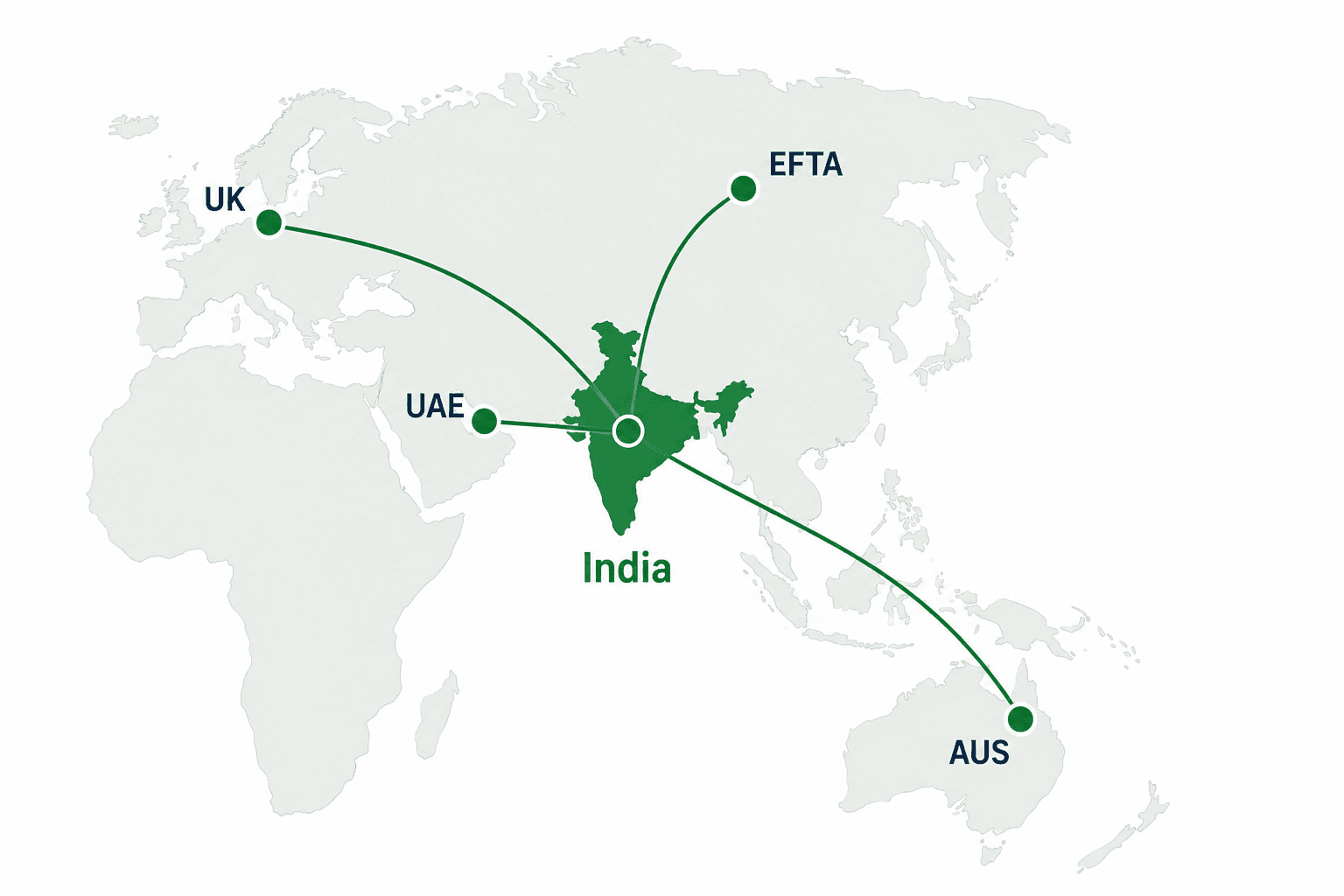
India signed a trade deal with the UAE. Then Australia. Then the United Kingdom. Then the four-nation European bloc called EFTA. Negotiations are underway with the European Union, Oman, Peru, and others.
If you grew up hearing that India is cautious about trade agreements — worried about cheap imports flooding in — this burst of deal-making can feel sudden. Why now? And what changes for you when tariffs fall between countries?
The short answer: India has decided it cannot grow exports or join global supply chains while sitting outside trade networks. After walking away from the giant RCEP pact in 2019, it is building a web of smaller, carefully negotiated bilateral deals instead.
In one line
A Free Trade Agreement cuts border taxes and eases market access between partner countries — and India is signing many of them now to boost exports, attract investment, and reduce dependence on any single trade route.
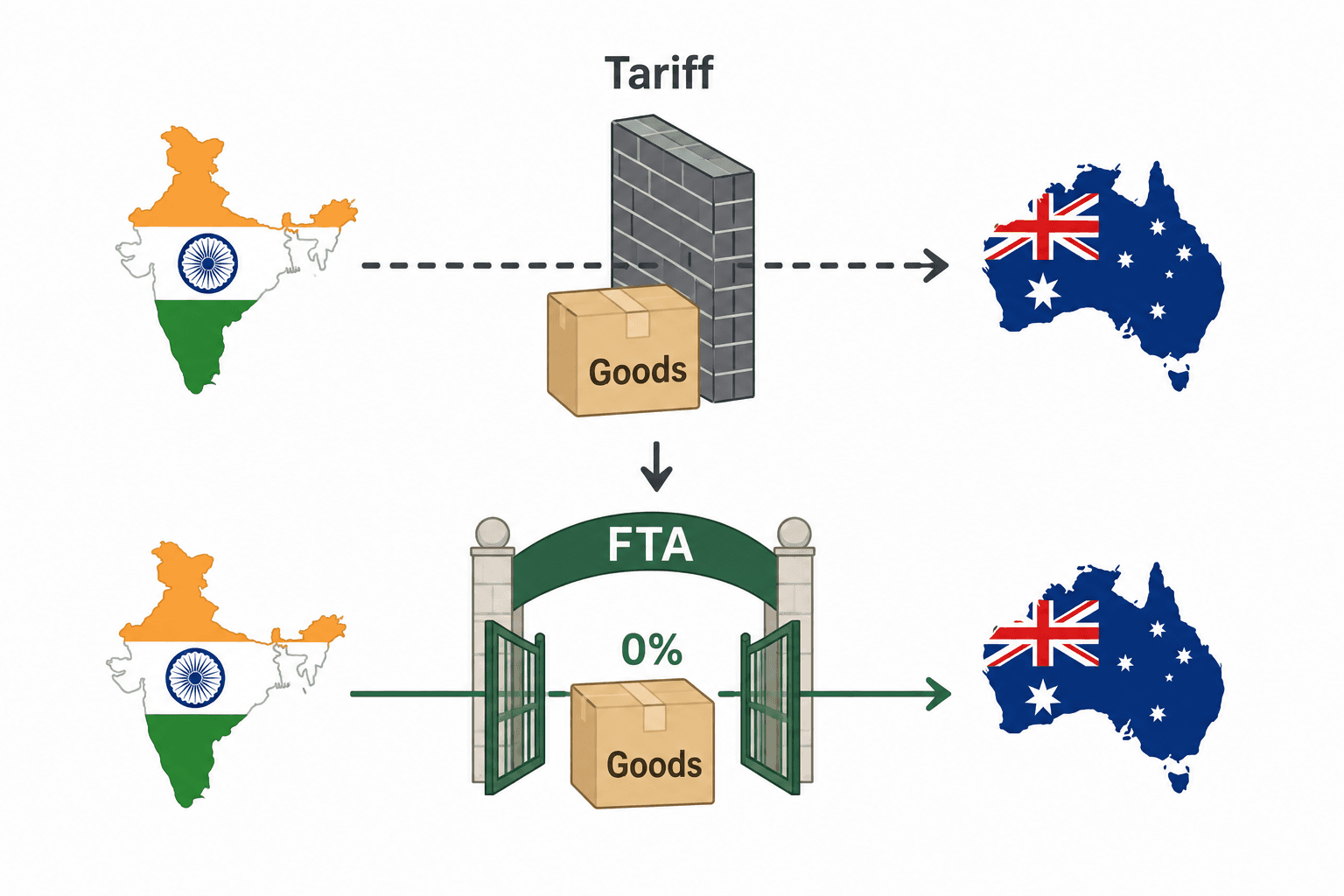
A (or ) is a treaty between two or more countries to reduce or eliminate s — the import taxes charged at the border — on each other's goods and services.
Without an FTA, a shirt exported from Tiruppur to Dubai might face a 5% customs duty on arrival. With an FTA, that duty can drop to zero, provided the shirt meets the agreement's (proof that it was genuinely made in India, not just shipped through a third country).
FTAs are not only about goods. Modern deals — often called CEPA () or TEPA (Trade and Economic Partnership Agreement) — also cover services (IT, nursing, finance), investment rules, customs cooperation, and dispute settlement.
Think of an FTA as lowering the fence between two gardens, but with a gatekeeper who checks that what passes through was actually grown on your side.
India negotiates these through the Ministry of Commerce and Industry, with input from line ministries (agriculture, dairy, pharmaceuticals) and industry bodies. Every sensitive product — milk, automobiles, electronics — is fought over line by line before the pen touches paper.
For much of the 2000s and 2010s, India signed few major FTAs and remained wary of deep liberalisation. That posture shifted sharply after 2019, when India declined to join RCEP — the Regional Comprehensive Economic Partnership that would have tied it to China and fifteen Asia-Pacific economies.
The message from that decision: India will open on its own terms, through bilateral deals where it can protect sensitive sectors and negotiate safeguards.
Several forces converged to make now the moment:
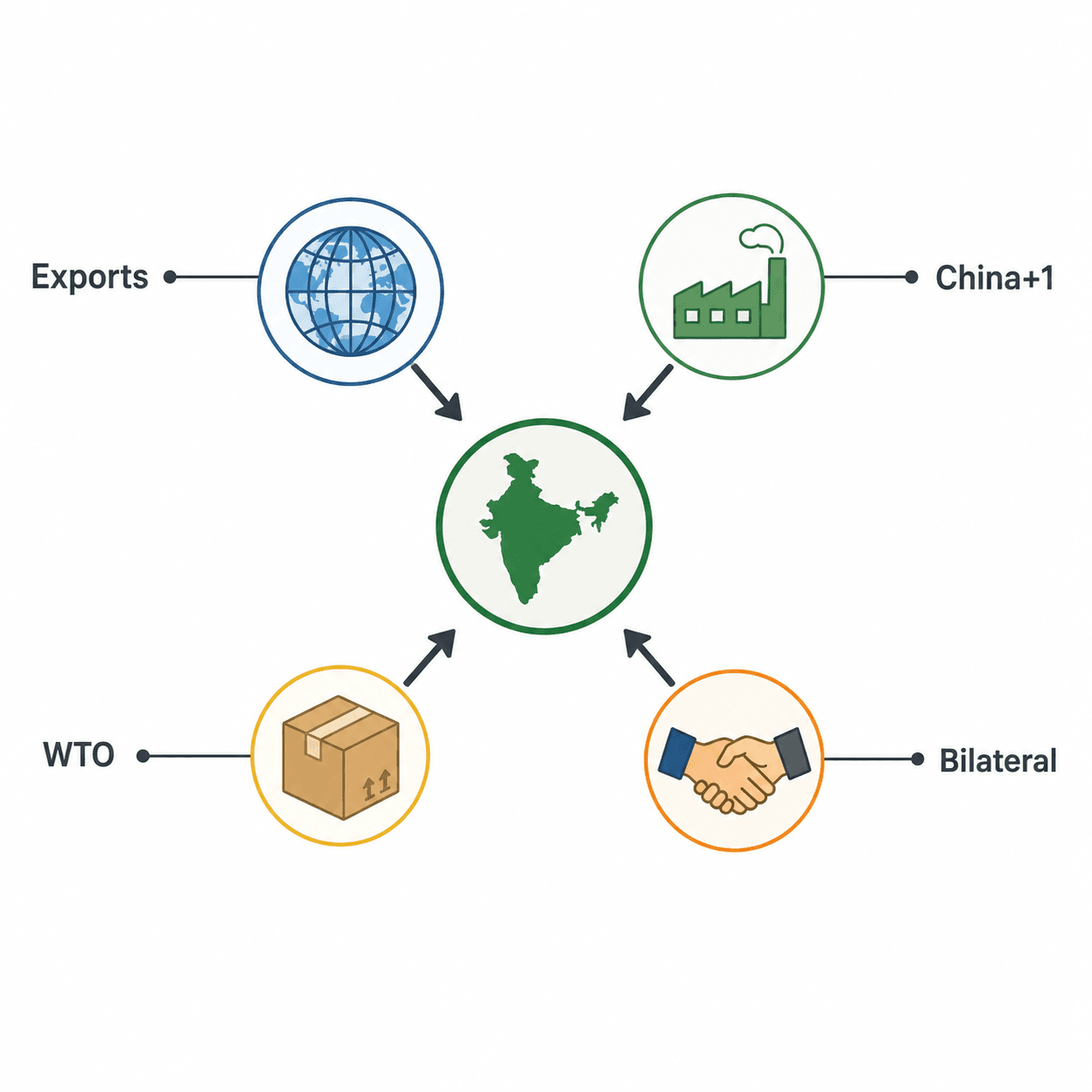
Export ambition. India has set aggressive merchandise export targets (including the $1 trillion goods exports goal). Without preferential access in rich markets, Indian textiles, gems, and engineering goods compete at a tariff disadvantage against rivals like Bangladesh or Vietnam.
China+1 and supply chains. After COVID and geopolitical tension, global firms want manufacturing capacity outside China. FTAs with the UAE, UK, and Australia help Indian factories become nodes in s — not just suppliers to the domestic market.
WTO slowdown. Multilateral trade talks at the World Trade Organization have stalled for years on agriculture and subsidies. Bilateral FTAs are faster: two parties, one table, fewer veto players.
Geopolitical realignment. Post-Brexit Britain needed new partners. The Gulf wants food and security ties. EFTA countries seek market access to 1.4 billion consumers. India's large domestic market is leverage.
Domestic reform confidence. Production-linked incentive (PLI) schemes and infrastructure spending gave policymakers confidence that some Indian industry can withstand import competition if exports also expand.
India's first major FTA in over a decade. Signed in February 2022, in force from May 2022.
The UAE is India's third-largest trading partner. The deal slashes tariffs on Indian gems, jewellery, textiles, and engineering goods while giving UAE petrochemical and aluminium products easier entry. Dubai's ports also make the UAE a re-export hub to Africa and West Asia — so an Indian product cleared in Dubai can reach markets beyond the Gulf.
Signed April 2022, entered force December 2022. An Economic Cooperation and Trade Agreement — a stepping-stone, not a full CEPA.
Australia wanted access for coal, lentils, and wine; India wanted duty relief for textiles, pharmaceuticals, and labour mobility for Indian professionals. Dairy and agriculture were the hardest lines — Australia is a dairy superpower, and India protected its farmers. The deal shows how even "interim" FTAs take years of sectoral bargaining.
Signed July 2023, with implementation rolling through 2024. Post-Brexit Britain needed a flagship deal with a large developing economy.
India gains on textiles, leather, gems, and IT services. The UK gains on whisky, cars, and financial services. Visa mobility for Indian professionals was a major Indian ask. Both sides target doubling bilateral trade by 2030.
Signed March 2024 with Iceland, Liechtenstein, Norway, and Switzerland — the bloc, separate from the European Union.
Unusually, EFTA committed to $100 billion investment in India and support for one million jobs over 15 years, in return for market access. Switzerland's pharma and machinery, Norway's seafood, and India's textiles and IT feature prominently. It is one of the few trade deals globally that binds investment pledges to tariff concessions.
More negotiations — with the EU, Oman, Peru, and Israel — are in various stages. The pattern is consistent: open export doors, protect the politically sensitive, and bundle investment where possible.
Cheaper inputs and consumer goods. Lower tariffs on imports can reduce costs for manufacturers (machinery, components) and consumers (electronics, food items where permitted).
Export market access. Indian exporters gain a price edge in partner markets — critical for labour-intensive sectors that compete with Vietnam, Bangladesh, and China.
Investment and technology. Deals like EFTA's investment chapter and the UAE's hub status can channel capital and know-how into Indian manufacturing.
Supply-chain integration. FTAs make it easier to import parts, assemble in India, and re-export — the model behind mobile-phone and electronics manufacturing growth.
Trade diversification. Reducing over-dependence on any one market (or route) strengthens resilience when geopolitics shifts.
Faster than multilateralism. A bilateral deal can close in two to three years; WTO agreements can take decades.
FTAs are not free of controversy. Domestic lobbies — dairy cooperatives, steel producers, MSME associations — often oppose them.
Import competition. When tariffs fall, cheaper foreign goods can undercut local producers who lack scale or efficiency.
Agriculture and dairy sensitivity. Australia's dairy and New Zealand's historical demands show why farmers fear FTAs. India has long excluded most agricultural products from deep liberalisation.
risk. If imports surge faster than exports, the bilateral widens. Critics point to India's experience with some earlier FTAs (such as with ASEAN) where imports rose sharply.
MSME compliance burden. Small exporters must meet paperwork and quality standards to claim FTA benefits — capacity many lack.
s persist. Sanitary rules, licensing, and local content norms can block trade even at zero tariff. An FTA does not erase regulatory walls overnight.
Revenue loss. Customs duties are a revenue source for the government. Tariff cuts mean offsetting that income elsewhere.
Policymakers balance these risks with safeguard clauses (temporary tariff snap-backs if imports surge), negative lists (products excluded from cuts), and long phase-out periods (tariffs reduced over 5–15 years, not overnight).
Here is how this everyday headline maps to what UPSC tests.
External sector and balance of payments — FTAs affect the trade account (merchandise exports minus imports) and can influence the . Watch whether deals improve the trade balance or widen it.
Trade policy instruments — tariffs, quotas, subsidies, and anti-dumping duties sit in GS-III Economy. FTAs are the opposite instrument: negotiated openness instead of protection.
WTO vs regional/bilateral agreements — Article 24 of GATT allows customs unions and free-trade areas. UPSC may ask how FTAs relate to the multilateral trading system, or why India left RCEP but pursues CEPA with the UK.
Sectoral issues — Agriculture (MSP, WTO dispute), dairy cooperatives (Amul, NDDB), textiles (labour intensity), pharmaceuticals (IP and patents in trade deals), and services (Mode 1–4 under GATS).
Institutions — Ministry of Commerce and Industry, DGFT (Directorate General of Foreign Trade), CBIC (customs), and EXIM policy.
Contemporary developments — India-UAE CEPA, India-UK CEPA, EFTA TEPA, ongoing EU FTA talks, and the Atmanirbhar Bharat tension with export-oriented openness.
When you read about an FTA in the news, ask three examiner-style questions: Who gains on exports? Who faces import competition? How does it affect the current account?
A Free Trade Agreement is a pact between countries to reduce or eliminate tariffs and ease market access for each other's goods and services. Modern FTAs also cover investment, services, customs procedures, and rules of origin to prevent third-country products from slipping through at concessional rates.
India is pursuing FTAs to boost exports, join global supply chains after the China+1 shift, and secure market access after opting out of RCEP in 2019. Bilateral deals are faster than stalled WTO negotiations and help diversify trade partners in a fragmented global economy.
A Comprehensive Economic Partnership Agreement (CEPA) goes deeper than a basic FTA — it typically covers goods, services, investment, intellectual property, and movement of professionals, not just tariff reductions. India's deals with the UAE and UK are CEPAs; the Australia pact is a lighter ECTA.
Key recent agreements include the India-UAE CEPA (2022), India-Australia ECTA (2022), India-UK CEPA (2023), and the India-EFTA TEPA (2024) with Iceland, Liechtenstein, Norway, and Switzerland. Talks continue with the EU, Oman, Peru, and others.
Benefits include cheaper imports for industry and consumers, preferential export access for textiles, pharma, gems, and engineering goods, foreign investment inflows, integration into global value chains, and faster trade liberalisation than multilateral routes.
Risks include stronger import competition for domestic firms and MSMEs, pressure on agriculture and dairy, a widening trade deficit if imports outpace exports, loss of customs revenue, and persistent non-tariff barriers even after tariffs are cut.
FTAs connect to GS-III Economy (external sector, trade policy, current account), international relations (bilateral diplomacy), and contemporary issues. Expect questions on specific deals, RCEP vs bilateral strategy, WTO rules, sectoral sensitivities (dairy, agriculture), and institutions like DGFT and the Commerce Ministry.