
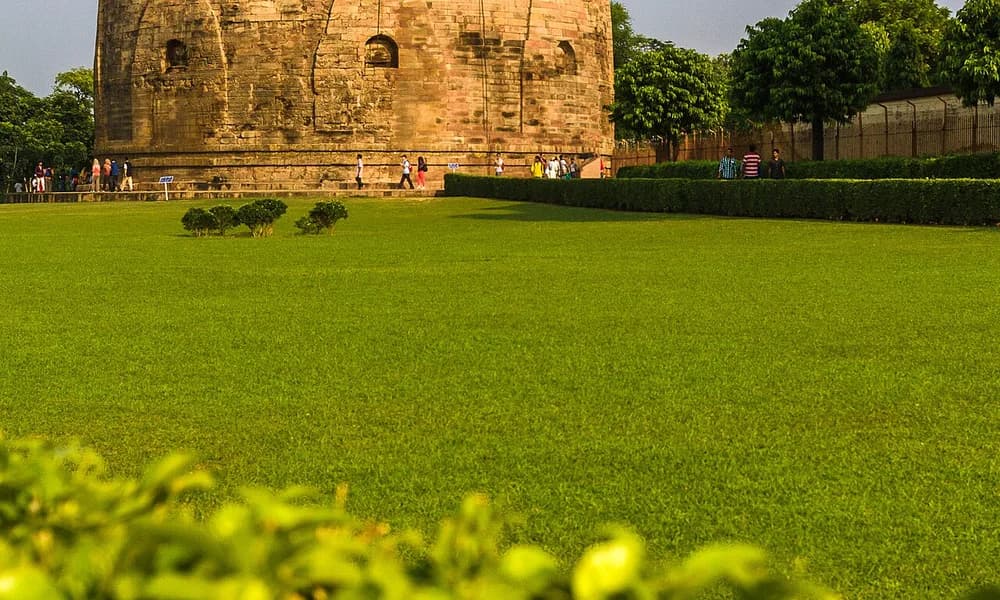
The Ancient Buddhist Site of Sarnath, near Varanasi in Uttar Pradesh, was inscribed on the UNESCO World Heritage List on 25 July 2026. The decision was taken at the 48th session of the World Heritage Committee in Busan, Republic of Korea. It is India’s 45th World Heritage property. The official name is not “Sarnath” alone. UNESCO listed a serial cultural property made of two archaeological zones: Chaukhandi Stupa and the Archaeological Remains of Sarnath, which include Dhamek Stupa and the Ashokan pillar. The Committee accepted cultural criteria (iii) and (vi). India now ranks sixth globally and second in the Asia-Pacific by number of World Heritage properties. Sarnath is Uttar Pradesh’s fourth, after the Taj Mahal, Agra Fort and Fatehpur Sikri.
Key highlights
- Inscription date: 25 July 2026, 48th World Heritage Committee, Busan.
- Official name: Ancient Buddhist Site of Sarnath.
- Rank: India’s 45th World Heritage property; UP’s 4th; India 6th globally, 2nd in Asia-Pacific.
- Form: Serial site — Chaukhandi Stupa + archaeological remains (Dhamek, Ashokan pillar, and associated monuments).
- Criteria: (iii) and (vi) only.
- Tentative List: 1998; formal nomination sent in January 2025.
- Exam hook: Site of the Buddha’s first sermon (Dharmachakra Pravartana); the Lion Capital from Sarnath is India’s National Emblem.
- Official sources: UNESCO new inscriptions, 48COM; United Nations in India; The Hindu.
Where is Sarnath?
Sarnath lies a short distance north-east of Varanasi, on the Ganga plain of eastern Uttar Pradesh. Buddhist texts also call the place Rishipatana, Isipatana (Ishipatana) or Mrigadava — the Deer Park. After enlightenment at Bodh Gaya, the Buddha is believed to have come here in the 6th century BCE, met his first five disciples, and delivered the first sermon. That event is Dharmachakra Pravartana, “setting in motion the Wheel of Dharma.” It is also treated as the founding moment of the Sangha.
The inscribed property is not the modern town and it is not every temple in the neighbourhood. It is two protected archaeological zones that together carry the outstanding value. Chaukhandi Stupa stands apart from the main excavated complex. The main zone holds Dhamek Stupa, the Dharmarajika remains, the Ashokan pillar, and associated monastic and temple ruins. DD News, citing the Archaeological Survey of India, also notes Mulagandhakuti Vihara among the monuments in that historic landscape.
| Fact | Detail |
|---|---|
| Official UNESCO name | Ancient Buddhist Site of Sarnath |
| State / district | Uttar Pradesh / Varanasi |
| Coordinates (approx.) | 25.38° N, 83.02° E |
| Inscription date | 25 July 2026 |
| Committee session | 48th, Busan, Republic of Korea |
| Property type | Serial cultural property (two zones) |
| Criteria | (iii) and (vi) |
| India’s tally | 45th World Heritage property |
| UP tally | 4th (after Taj Mahal, Agra Fort, Fatehpur Sikri) |
| Tentative List | 1998 |
| National emblem link | Lion Capital of the Ashokan pillar, now in the Sarnath Museum |
This page is a news and exam explainer. It is not a substitute for the site entries on the UNESCO World Heritage Sites hub, which hold the standing inventory of India’s properties.
What is a UNESCO World Heritage Site?
A World Heritage Site is a place inscribed on the List maintained under the 1972 World Heritage Convention. The World Heritage Committee decides which nominated properties have Outstanding Universal Value — significance that is so exceptional it transcends national borders. India ratified the Convention in 1977. Properties may be cultural, natural, or mixed. Sarnath is cultural.
Inscription is not automatic after a famous name enters the Tentative List. A State Party may keep a site on that waiting list for decades. It then submits a full nomination, which advisory bodies evaluate. For cultural sites the usual adviser is ICOMOS. The Committee can inscribe, refer, defer, or reject. It can also accept fewer criteria than the State proposed.
The United Nations in India note on this inscription recorded that the World Heritage List had grown to 1,248 properties in 170 countries. Those global totals move as each Committee session adds and, sometimes, deletes or endangers sites. Use them as context, not as a frozen Prelims number unless a question cites a specific year.
Why Sarnath was inscribed — criteria (iii) and (vi)
UNESCO’s published description of the new property is the text to learn, not a coaching paraphrase. The serial property “contains the architectural and archaeological remains of Sarnath, the sacred site where the Buddha is believed to have delivered his first sermon in the 6th century BCE and met his earliest disciples.” The Buddha himself identified it as one of the four principal Buddhist pilgrimage sites. The place then grew through royal, monastic and lay patronage. After flourishing as a major centre, it declined in the 12th century CE and was largely forgotten until rediscovery in the 18th century. It is now two archaeological zones, a tourist destination, and a revived pilgrimage site.
Criterion (iii) is about exceptional testimony to a cultural tradition or civilisation. At Sarnath that testimony is the long Buddhist building history — stupas, temples and viharas raised and rebuilt over many centuries.
Criterion (vi) is about a direct and tangible association with events, living traditions, ideas or beliefs of outstanding universal significance. Here the association is the first sermon, the first disciples, and the ideas that spread from Deer Park.
The Committee inscribed the property on (iii) and (vi). For Prelims, those are the only two criteria to cite for the 2026 decision.
The four principal pilgrimage sites in the tradition are Lumbini (birth), Bodh Gaya (enlightenment), Sarnath (first sermon) and Kushinagar (parinirvana). Lumbini (Nepal) and the Mahabodhi Temple Complex at Bodh Gaya are already World Heritage properties. With Sarnath’s inscription, three of the four are on the List. Kushinagar is not. That comparison is the cleanest “Buddhist circuit” fact for 2026.
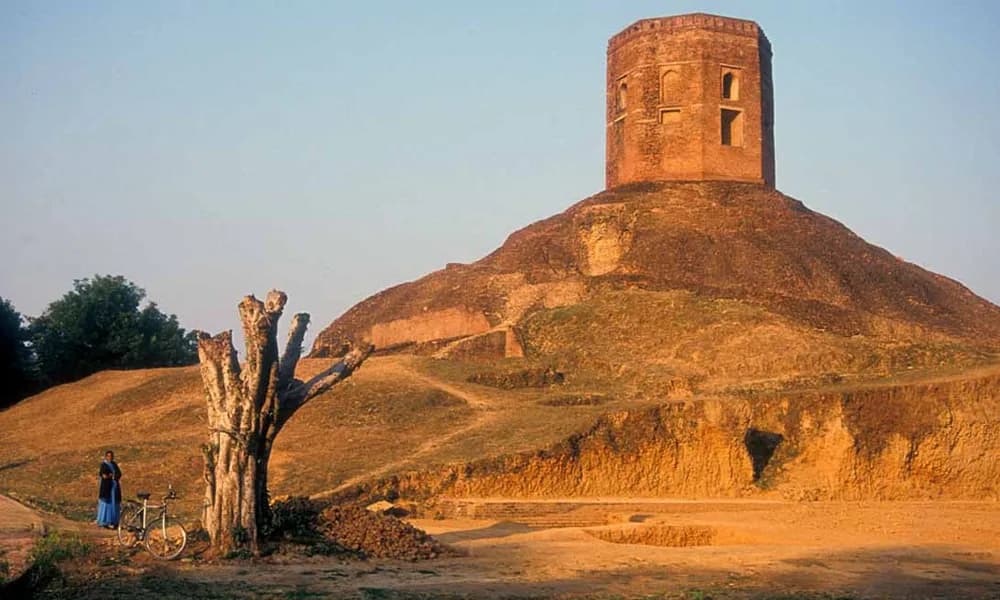
The serial site, the pillar, and the museum
A serial property is one World Heritage listing made of two or more physically separate components that share one outstanding value. Sarnath’s two components are:
- Chaukhandi Stupa — associated with the meeting of the Buddha and his first five disciples.
- Archaeological Remains of Sarnath — the main excavated zone, including Dhamek Stupa, the Dharmarajika remains, and the Ashokan pillar.
Dhamek is the large cylindrical stupa that most photographs show. It is not the whole property. A statement that “Dhamek Stupa is India’s 45th World Heritage Site” is too narrow. The property name is the Ancient Buddhist Site of Sarnath.
The Lion Capital that once crowned Ashoka’s pillar at Sarnath was adopted as the National Emblem of India. The capital is housed in the Sarnath Archaeological Museum, established in 1904 and often described as India’s oldest site museum. The pillar remains on the archaeological site. Keep object and find-spot distinct: the emblem comes from Sarnath; the sculpture is in the museum.
ASI describes a long occupation, from pre-Mauryan remains (5th–4th century BCE) through to the 12th century CE — a span of roughly 1,600 years of building, rebuilding and monastic life. Gupta-period sculpture from the site, including the celebrated Dharmachakrapravartana Buddha image, is also in the museum. Those art-historical details belong in an Art and Culture answer. They are not a second inscription.
From the 1998 Tentative List to Busan
Sarnath entered India’s Tentative List in 1998. The wait was 28 years. The formal nomination went to the World Heritage Centre in January 2025. DD News reports an evaluation of about 18 months, including ICOMOS consultation and an on-site inspection, before the Committee inscribed the property in Busan. The 48th session ran from 19 to 29 July 2026. The Sarnath decision was announced on 25 July.
That timeline is the process lesson. Tentative listing is not inscription. A January nomination is not a July guarantee. Advisory-body evaluation can narrow the criteria. The Committee, chaired at this session by Lee Byong Hyun, takes the final decision.
Uttar Pradesh’s earlier inscriptions are all in the Agra belt: Taj Mahal (1983), Agra Fort (1983) and Fatehpur Sikri (1986). Sarnath is the state’s first World Heritage property in the Varanasi region and its first Buddhist archaeological serial site. Do not call it Uttar Pradesh’s first World Heritage Site.
After the inscription, official briefings said India had 69 properties still on the Tentative List, and that a State Party may nominate one site a year for Committee consideration. Those figures are useful for a Mains line on nomination strategy. They will change as new tentative entries are added or old ones are inscribed.
India’s tally: 45, sixth in the world
| Fact | Figure after 25 July 2026 |
|---|---|
| India’s World Heritage properties | 45 |
| Global rank by count | 6th |
| Asia-Pacific rank | 2nd |
| Uttar Pradesh properties | 4 |
| Buddhist pilgrimage sites on the List (of the traditional four) | 3 (Lumbini, Bodh Gaya, Sarnath) |
| Years on the Tentative List before inscription | 28 (1998–2026) |
India’s list already included other Buddhist or Buddhist-linked properties: the Mahabodhi Temple Complex, Nalanda, Sanchi, and Ajanta. Sarnath does not replace those. It fills the first-sermon site that students already know from ancient-history textbooks and from the Lion Capital.
A 1998 Prelims question famously mixed Sarnath with the Lion Capital and Rajgir. The correct association is Sarnath — first sermon; the Lion Capital is from Sarnath, not from Rajgir. The 2026 inscription does not change that pairing. It adds a contemporary current-affairs wrapper: 45th property, Busan, serial site, criteria (iii) and (vi).
This explainer sits with the Places in News timeline, which logs the inscription as a geography-and-culture event, and with the standing UNESCO World Heritage Sites inventory.
Why this matters for UPSC
Art and Culture plus current affairs is the usual Sarnath package. The 2026 decision adds ranks and criteria to a site that was already high-yield.
Prelims. Official name, serial components, date, session and city, India’s 45th, UP’s fourth, criteria (iii) and (vi), Tentative List 1998, Lion Capital / National Emblem, first sermon / Deer Park. Traps: placing Sarnath in Bihar (confusion with Bodh Gaya or Nalanda), calling Dhamek the entire property, listing extra criteria, or saying India is first in the world by count.
GS-1. A Mains paragraph can connect: (a) the four pilgrimage sites and the spread of the Sangha; (b) Mauryan pillar art and the Republic’s emblem; (c) Gupta Buddhist sculpture; (d) decline after the 12th century and colonial-era archaeology; (e) World Heritage as cultural diplomacy with Buddhist-majority countries. Keep the last point short and official — the Culture Ministry said as much after the vote — and do not turn it into a tourism brochure.
GS-2 / IR (light touch). Inscription at a Committee session is a multilateral cultural decision, not a bilateral gift. India remains one State Party among many. The useful institutional facts are the 1972 Convention, the Committee, ICOMOS, and the Tentative List / one-nomination-a-year practice.
Map. Varanasi on the Ganga; Sarnath just outside it; Bodh Gaya in Bihar; Kushinagar in eastern Uttar Pradesh; Lumbini across the Nepal border. One sketch map beats a paragraph of place-name lists.
Facts that are easy to mix up
Official name. Use Ancient Buddhist Site of Sarnath. The 1998 tentative-list wording was broader. The inscribed name is the 2026 name.
Serial, not a single monument. Chaukhandi plus the main archaeological remains. Dhamek is the famous stump in the main zone, not the whole listing.
Criteria. (iii) and (vi). Not the longer set India proposed.
45th, not 44th or 46th. The Hindu, UN India, and government briefings all use 45 after this inscription.
UP’s fourth, not first. Taj Mahal, Agra Fort, Fatehpur Sikri came first.
Lion Capital location. Found at Sarnath; displayed in the Sarnath Museum; adopted as the National Emblem. The pillar shaft remains on site.
Four pilgrimage sites. Lumbini, Bodh Gaya, Sarnath, Kushinagar. Only the first three are World Heritage properties.
Bodh Gaya versus Sarnath. Enlightenment versus first sermon. Different states (Bihar versus Uttar Pradesh). Different inscription years (2002 versus 2026).
This article does not try to replace monument-by-monument notes on the UNESCO World Heritage Sites hub. Use that hub for the standing list; use this page for the 2026 decision and the exam traps around it.
How inscription works
A State Party places a site on its Tentative List, then prepares a nomination dossier. Advisory bodies evaluate outstanding universal value, authenticity, integrity, and protection. The World Heritage Committee votes at its annual session. Inscription creates reporting duties and an expectation that the State will protect authenticity and integrity. It does not transfer ownership to UNESCO, and it does not by itself rewrite the Ancient Monuments Act.
Sarnath has been under ASI protection and excavation for more than a century. The Culture Ministry said after the vote that the recognition also acknowledged that long conservation record, and that management would have to control unplanned development around the property. Those are domestic duties with an international audience.
India may nominate one property a year from its Tentative List. That is why a 1998 entry can wait until 2025–26 for a Committee decision. It is also why “X is on the Tentative List” is not the same current-affairs fact as “X has been inscribed.”
Prelims snapshot
| Question type | Answer to lock |
|---|---|
| Official name | Ancient Buddhist Site of Sarnath |
| State | Uttar Pradesh (Varanasi) |
| Date / session | 25 July 2026; 48th Committee, Busan |
| Rank | India’s 45th World Heritage property |
| UP rank | 4th |
| Form | Serial — Chaukhandi Stupa + archaeological remains |
| Criteria | (iii) and (vi) |
| Event | First sermon (Dharmachakra Pravartana); first disciples / Sangha |
| Emblem | Lion Capital from the Ashokan pillar |
| Tentative List | 1998 |
| Convention | World Heritage Convention, 1972; India a party since 1977 |
Frequently asked questions
What is the Ancient Buddhist Site of Sarnath?
It is the UNESCO World Heritage property inscribed in 2026 at Sarnath, near Varanasi. It is a serial cultural site covering Chaukhandi Stupa and the archaeological remains of Sarnath, including Dhamek Stupa and the Ashokan pillar. It marks the place of the Buddha’s first sermon.
When was Sarnath inscribed, and why is that date in the news?
The World Heritage Committee inscribed it on 25 July 2026 at its 48th session in Busan. The decision made Sarnath India’s 45th World Heritage property and Uttar Pradesh’s fourth.
Which UNESCO criteria apply to Sarnath?
Cultural criteria (iii) and (vi). Criterion (iii) recognises testimony to an enduring Buddhist tradition. Criterion (vi) recognises the association with the first sermon and the first disciples.
Is Sarnath Uttar Pradesh’s first World Heritage Site?
No. The Taj Mahal, Agra Fort and Fatehpur Sikri were inscribed in the 1980s. Sarnath is the state’s fourth.
What is a serial World Heritage property?
It is one listing made of two or more separate components that share a single outstanding value. Sarnath’s two components are Chaukhandi Stupa and the main archaeological remains.
How is the Lion Capital connected to the inscription?
The Lion Capital was found on the Ashokan pillar at Sarnath and is India’s National Emblem. It is displayed in the Sarnath Museum. It is a reason the site is famous in Indian polity and art. It is not a separate World Heritage property.
What should UPSC aspirants remember about Sarnath in 2026?
Official name, 25 July 2026, Busan, 48th session, India’s 45th, UP’s fourth, serial site, criteria (iii) and (vi), first sermon, Lion Capital, Tentative List 1998, three of four principal Buddhist pilgrimage sites now on the List.
Sources
- UNESCO — new inscribed properties, 48th World Heritage Committee
- United Nations in India — Ancient Buddhist Site of Sarnath inscribed
- The Hindu — Sarnath earns UNESCO World Heritage tag, India’s tally to 45
- DD News — official reactions, criteria, Tentative List 1998, nomination 2025
- Places in News timeline
- UNESCO World Heritage Sites hub