
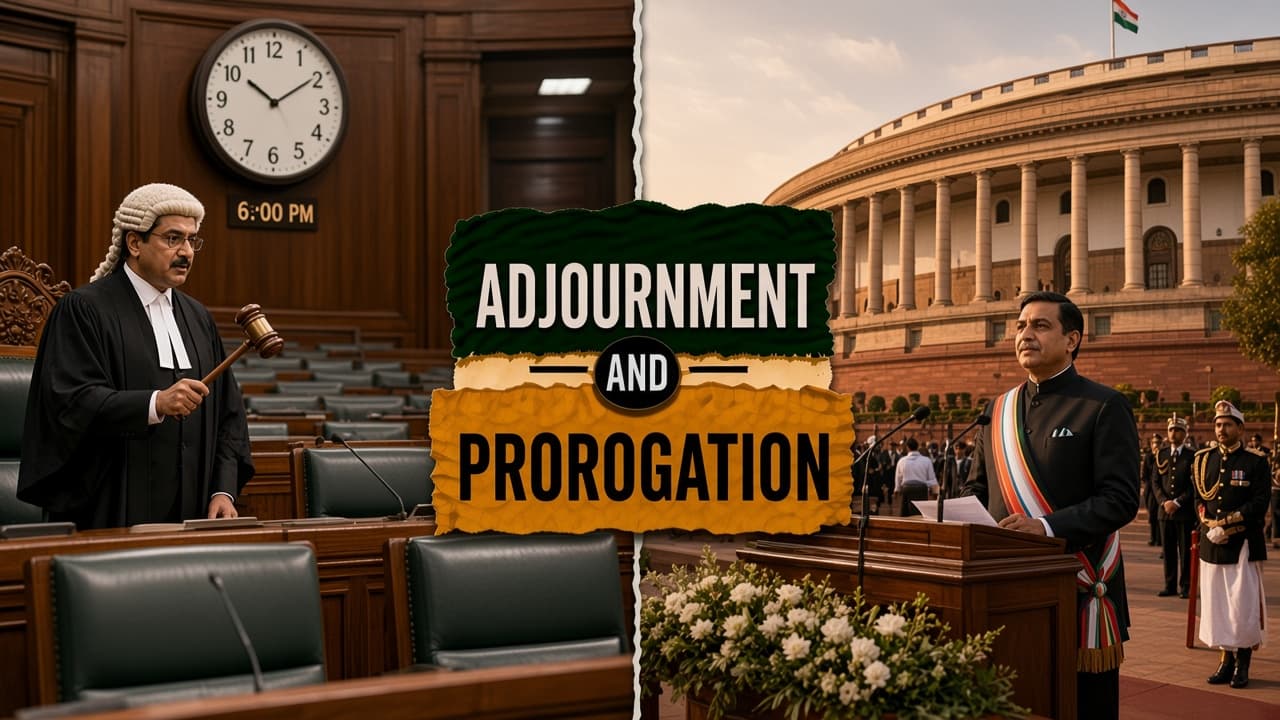
Adjournment suspends a sitting inside a session. The Speaker or the Chairman orders it. Prorogation ends the session. The President or a Governor orders it, on the advice of the executive. The year is organised into sessions, such as the Budget, Monsoon, and Winter sessions, and each session is divided into sittings. Dissolution, which applies to the Lok Sabha, ends the life of the house. Neither adjournment nor prorogation does that. An adjournment motion, which is a device to discuss an urgent matter, is a different thing from the Speaker pausing the sitting.
Difference between adjournment and prorogation
| Feature | Adjournment | Prorogation |
|---|---|---|
| Meaning | A pause in a sitting | The close of a session |
| Who | Speaker or Chairman | President or Governor, on advice |
| Session | The same session continues, including an adjournment sine die | The session is closed and the next one must be summoned |
| Bills | Pending business generally stays | Government bills may lapse unless the President notifies that a bill continues; private members' bills often lapse |
| Ordinance | A mere adjournment may leave the session alive, so the "not in session" test for an ordinance is not met by a pause alone | Prorogation means Parliament is not in session, which opens the ordinance route |
| House | Does not dissolve the house; the Speaker does not summon the next session | Does not dissolve the Lok Sabha; Article 85 requires the President to summon the next session |
At a glance
Effect
Pauses a sitting; the session continues
Ends the session
Ordered by
Speaker or Chairman
President or Governor, on executive advice
Pending bills
Generally continue
May lapse, in the case of government bills, unless they are saved
Frequency
Daily, and routine
Once, at the end of a session
Example
Winter session ends, Budget session begins
On 20 December the President prorogues Parliament. The Winter session is over. A government bill that has not been passed lapses unless the President notifies that it is to continue. On a noisy Tuesday the Speaker adjourns until 11 am the next day. The session is the same, the list of pending bills is the same, and members return and resume. Dissolution of the Lok Sabha would end the house. Adjournment and prorogation do not.
What this means for the exam
Adjournment pauses a sitting. Prorogation ends the session. Dissolution ends the life of the Lok Sabha.
Adjournment
The Speaker of the Lok Sabha or the Chairman of the Rajya Sabha adjourns a sitting. The session continues. Pending bills stay on the list. Committees keep working. Adjournment sine die is an indefinite pause inside the session. It is still not prorogation. Members come back without a fresh summons of a new session.
An adjournment motion is a separate parliamentary device. It is used to discuss an urgent public matter and can have vote implications. It is not the Speaker's procedural pause. Mixing the two is a standard trap. A noisy day that ends at the Speaker's word does not close the Budget, Monsoon, or Winter session.
Prorogation
The President prorogues Parliament on ministerial advice. A Governor does the same for a state legislature. The session ends. A new session needs a summons. Article 85 is the Union provision for summoning. Pending government bills typically lapse unless the President notifies that a particular bill should carry over. Private members' bills often lapse. Committees can be affected by the timing of the end of the session.
Prorogation is also the moment after which Parliament is not in session, which matters for an ordinance. The executive has used the timing around pending legislation and around that ordinance window. Prorogation does not dissolve the Lok Sabha. The Speaker does not prorogue. A statement that gives prorogation to the Speaker fails the division of jobs.
Key takeaway
Adjournment is the Speaker pausing a sitting. Prorogation is the President ending the session. Dissolution is the end of the Lok Sabha.
Difference between adjournment and prorogation FAQs
What is adjournment?
Adjournment is the Speaker or Chairman pausing a sitting. The session continues, and pending business generally continues with it.
What is prorogation?
Prorogation is the President or a Governor ending a session, on executive advice. The next session has to be summoned.
What is the main difference between adjournment and prorogation?
Adjournment pauses a sitting inside a living session. Prorogation ends the session. Neither dissolves the Lok Sabha.
Does the Speaker of the Lok Sabha prorogue Parliament?
No. The President prorogues Parliament, on advice. The Speaker adjourns sittings.
Does adjournment terminate the session?
No. Adjournment ends a sitting. Prorogation ends the session.
What is adjournment sine die?
It is an indefinite pause inside a session. It does not close the session. Prorogation does that.