
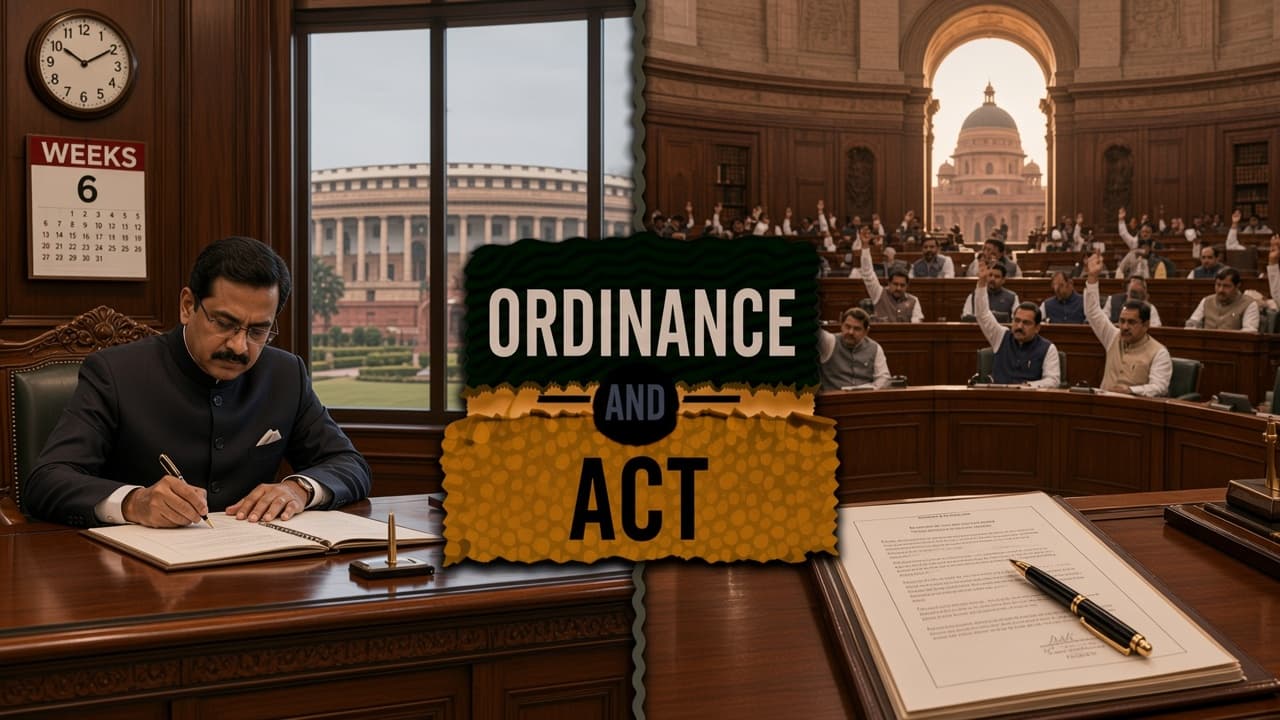
An ordinance is a temporary law made by the President or a Governor when the legislature is not in session. An Act is law passed through the full process in Parliament or a state legislature. Article 123 lets the President, on Cabinet advice, promulgate an ordinance with the force of an Act, for a limited time. Article 213 is the matching power of a Governor. The six-week clock starts when the legislature reassembles. D.C. Wadhwa in 1987 held that serial re-promulgation, used to avoid a legislative vote, is unconstitutional.
Difference between an ordinance and an Act
| Feature | Ordinance | Act |
|---|---|---|
| Meaning | Temporary law while the legislature is not sitting | Permanent law passed by the legislature |
| Law | Articles 123 and 213; force of an Act while it lasts | The legislative process in Articles 107 to 111, then assent |
| Time | Dies six weeks after reassembly unless approved; both houses can disapprove it sooner | Continues until repeal or invalidation |
| Who | President or Governor on the advice of the Cabinet, after being satisfied that immediate action is needed | The houses, followed by assent |
| Review | Courts can examine the satisfaction and a mala fide use; D.C. Wadhwa, 1987, barred re-promulgation meant to avoid a vote | Courts can review constitutionality |
| Effect | Primary law while valid, not a set of delegated rules; silence after reassembly does not make it permanent | May authorise later rules; an approved ordinance becomes an Act |
At a glance
Legal basis
Article 123 for the Union, Article 213 for a state
Articles 107 to 111, the ordinary legislative process
Duration
Six weeks from reassembly, unless approved
Until it is repealed or struck down
Who promulgates
President or Governor, on Cabinet advice
Parliament or the state legislature, after passage and assent
Debate
No debate before it is issued; later approval is required
Full debate in the houses
Example
Monsoon session delayed, land acquisition urgent
Parliament has adjourned in May, and a cyclone in June calls for quick compensation rules. The Cabinet advises the President to issue an ordinance. When members return in July they have six weeks to approve it. If they do not, it lapses. If a government reissues the same ordinance whenever a session ends, without a vote, as in the old Bihar land-reform pattern, the courts treat that as an evasion of the legislature. That is the lesson of Wadhwa.
What this means for the exam
An ordinance is a bridge for an emergency. It is not a second legislature. An Act is permanent law made by the full process.
Ordinance
Article 123 is the Union power and Article 213 is the state power. The President or Governor acts on Cabinet advice, and only when the legislature is not in session and circumstances appear to need immediate action. The text has the force of an Act while it is alive. The six weeks run from the day the legislature reassembles, not from the day the ordinance was issued. If both houses pass resolutions disapproving it, it can end earlier. Approval turns it into an Act.
D.C. Wadhwa versus the State of Bihar, in 1987, held that repeated re-promulgation, without placing the text before the legislature, is a fraud on the Constitution. The power is an emergency device. It is not a parallel track for avoiding a vote. Retroactive wording is possible if the text itself provides it. The ordinance route has been used in land reform, farm laws, and measures during COVID. The democratic question is whether the executive is bridging a gap or replacing the house.
Act
An Act is what remains after introduction, debate, passage, and assent under the ordinary process, Articles 107 to 111 at the Union. It lasts until repeal or a court's decision that it is void. It can authorise rules and regulations. That delegated layer is not what an ordinance is. While an ordinance is valid it is primary law.
Approval of an ordinance is the moment it becomes an Act. Failure to reject it is not approval. The original text lapses. A permanent result requires the houses to pass it. The President does not promulgate on a personal whim. Cabinet advice is required.
Key takeaway
An ordinance under Article 123 is temporary and lasts six weeks after the legislature reassembles unless it is approved. An Act is law made by the full process. Serial re-promulgation was rejected in D.C. Wadhwa.
Difference between an ordinance and an Act FAQs
What is an ordinance?
An ordinance is temporary law made by the President under Article 123, or by a Governor under Article 213, when the legislature is not in session. It has the force of an Act only for a limited time.
What is an Act?
An Act is law passed by Parliament or a state legislature through the full process, including debate and assent. It continues until it is repealed or struck down.
What is the main difference between an ordinance and an Act?
An ordinance is an executive bridge, limited to six weeks after the legislature reassembles, unless the houses approve it. An Act is the product of that full legislative process.
Does an ordinance become permanent if Parliament does not reject it within six weeks?
No. It lapses unless it is approved. Silence does not make it permanent. The six weeks run from reassembly.
Has re-promulgation of ordinances without legislative approval been held unconstitutional?
Yes. In D.C. Wadhwa, 1987, the Supreme Court treated serial re-promulgation as an abuse of Articles 123 and 213.
When does the six-week period start?
It starts when Parliament reassembles, not on the date the ordinance is issued.