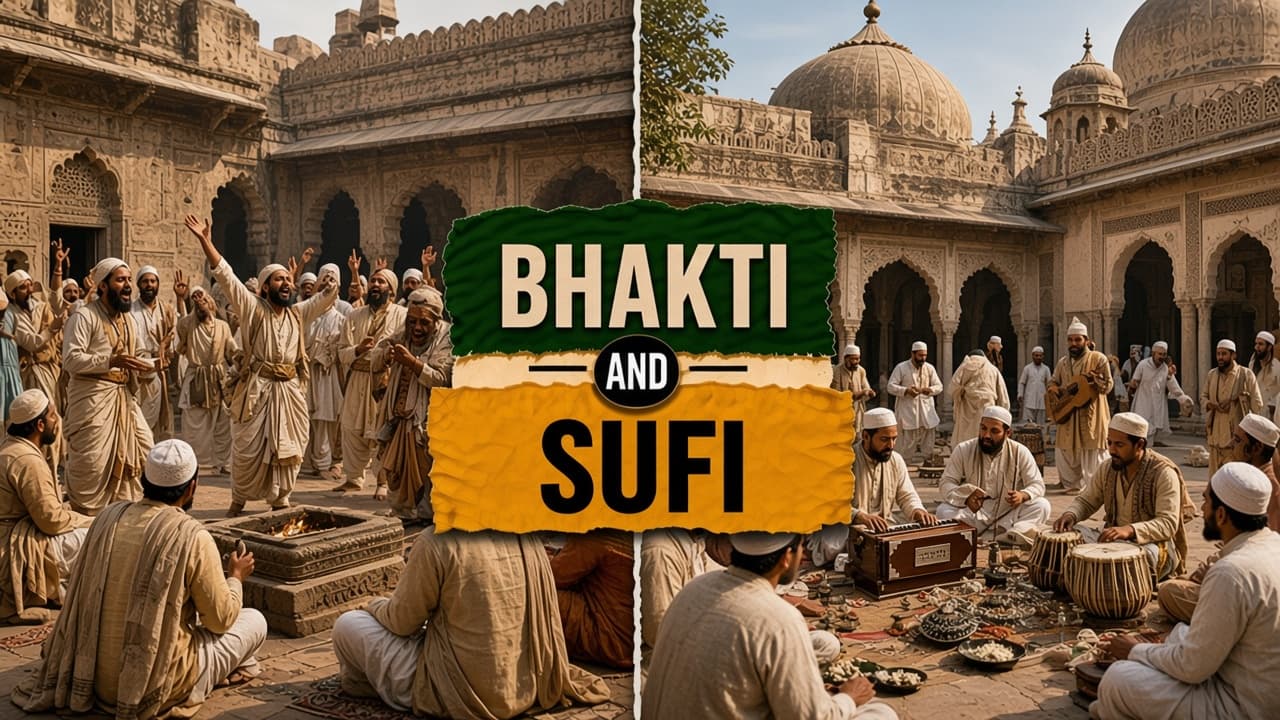
Difference between the Bhakti movement and the Sufi movement
The Bhakti movement was a Hindu stream of personal devotion, and the Sufi movement was Islamic mysticism organised in orders of teachers and disciples.
By UPSCYatra Editorial Team - Jun 1, 2026
Table of contents
The Bhakti movement is a Hindu devotional stream, roughly from the 8th to the 17th century, that taught personal love of God in vernacular languages. The Sufi movement is Islamic mysticism. Its orders pursued union with Allah through love, music, and the relationship of pir and murid, centred on khanqahs and dargahs. The two traditions met in medieval India. They did not share an origin.
Difference between the Bhakti movement and the Sufi movement
Feature
Bhakti Movement
Sufi Movement
Meaning
Personal devotion inside the Hindu tradition
Islamic mysticism organised in orders
When
About the 8th to the 17th century, from the Alvars and Nayanars onward
From the 12th century in India, in orders such as the Chishti and the Suhrawardi
Basavanna, Kabir, Mirabai, Tulsidas, and Shankaradeva
Sufi Movement
Khwaja Moinuddin Chishti, Nizamuddin Auliya, and Bulleh Shah
Example
Nizamuddin Auliya's langar vs Shankaradeva's sattras
At the dargah of Nizamuddin in Delhi, Chishti Sufis offered langar and qawwali, treating love of God as larger than formal observance alone. In Assam, Shankaradeva's Bhakti sattras used kirtan in Assamese and rejected empty ritual. Both made room for ordinary people. One was an Islamic mystic order. The other was a Vaishnava reform.
What this means for the exam
Bhakti is Hindu devotional reform in the languages people spoke. Sufism is Islamic mysticism. Both were popular, and both criticised rigid orthodoxy.
Bhakti movement
Bhakti taught a direct relationship with God, expressed in Tamil, Hindi, Bengali, Marathi, Assamese, and Rajasthani rather than in Sanskrit alone. The early south Indian stream includes the Alvars and the Nayanars. Later figures include Basavanna, Kabir, Mirabai, Tulsidas, and Shankaradeva. Andal is among the women saints, with Mirabai. Nirguna poets attacked empty ritual and caste hierarchy. Saguna devotion, as in Tulsidas and Mirabai's songs to Krishna, kept a personal form of God.
Institutions were the temple, the math, and, in Assam, the satra, where kirtan carried the teaching. Krishnadevaraya and other rulers patronised poets. Kabir belongs to Nirguna Bhakti and also shows Sufi influence, so a single label is a poor fit. Classifying him depends on what the question asks. The movement was not one political party. It had conservative wings and radical ones.
Sufi movement
Sufism is Islamic mysticism with roots in West Asia. It is not a branch of Bhakti inside Hinduism. In India, orders called silsilas, above all the Chishti and the Suhrawardi, organised the pir and the murid. Khwaja Moinuddin Chishti at Ajmer and Nizamuddin Auliya at Delhi are the names to remember, with Bulleh Shah in later Punjabi poetry. The Chishtis stressed poverty, love, music, and the community kitchen. Langar and qawwali reached people who did not read Persian. Sama and qawwali were debated inside orthodox Islam.
Some orders kept away from state power. Others had links at court, including Akbar and the Chishtis. Hindu devotees came to dargahs. The shared cultural ground with Bhakti shows up in Kabir's pairing of Ram and Allah and in Amir Khusro's mix of Persian and Hindavi. The traditions interacted. They remained distinct. A khanqah is a Sufi institution, not a Bhakti one.
Key takeaway
The Bhakti movement is Hindu devotion in the languages people spoke. The Sufi movement is Islamic mysticism in orders. Both shaped popular medieval culture.
Difference between the Bhakti movement and the Sufi movement FAQs
What was the Bhakti movement?
The Bhakti movement was a Hindu devotional stream, roughly from the 8th to the 17th century. It taught personal love of God in vernacular languages and often criticised caste ritual. Kabir, Mirabai, Tulsidas, and Shankaradeva are major figures.
What was the Sufi movement?
The Sufi movement is Islamic mysticism. In India its orders, especially the Chishti, taught love of Allah through the pir-murid bond, langar, and music at khanqahs and dargahs.
What is the main difference between the Bhakti movement and the Sufi movement?
Bhakti grew inside Hindu tradition and centred on devotion to Vishnu, Shiva, or Shakti. Sufism is Islamic mysticism organised in silsilas. They met in medieval India, but they have separate origins.
Did the Sufi movement begin as a branch of the Bhakti movement?
No. Sufism is Islamic mysticism with roots in West Asia. Bhakti belongs to the Hindu tradition. They influenced each other in India. They are not the same movement.
Did Chishti saints use langar and local languages?
Yes. The Chishti order stressed poverty, love, music, and community kitchens, and it reached people beyond a Persian-reading elite. Khwaja Moinuddin Chishti is associated with Ajmer.
Was Kabir only a Sufi or only a Bhakti saint?
He drew on both. He is placed in Nirguna Bhakti and he shows Sufi influence. The right label depends on what the question is testing.