
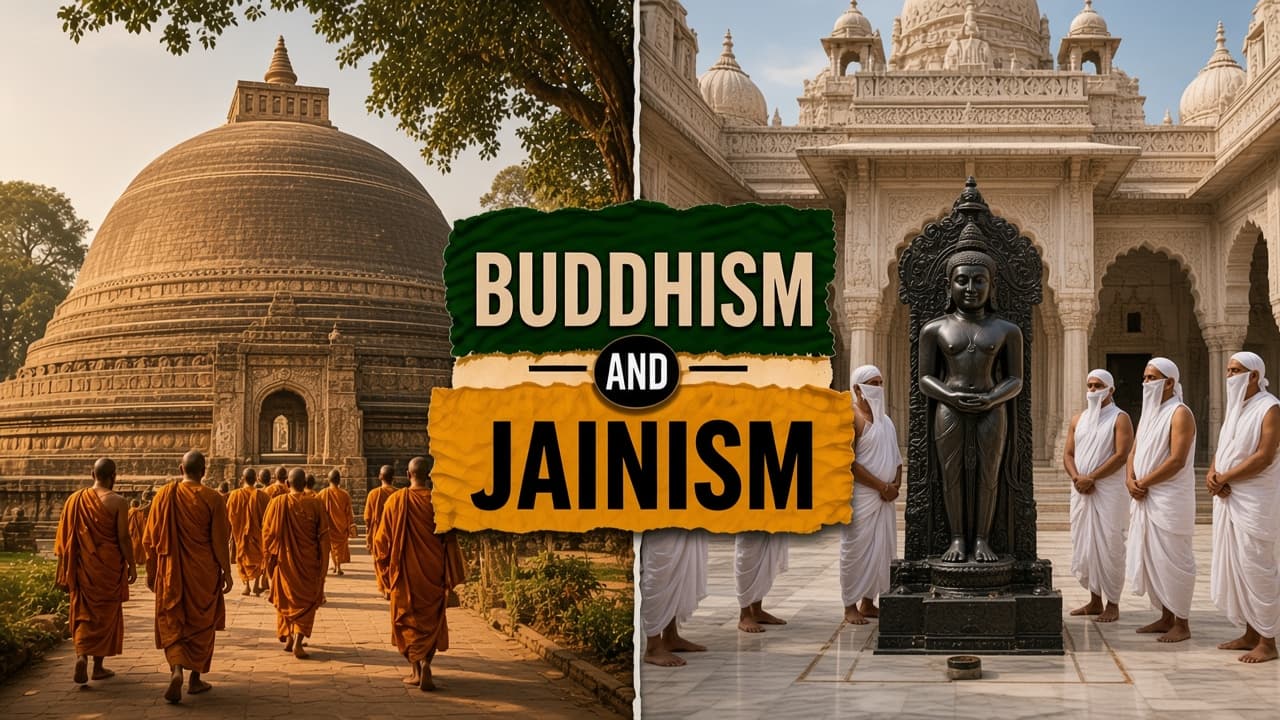
Buddhism is a Shramanic tradition founded by Gautama Buddha. It teaches the Middle Path, the Four Noble Truths, and anatta, the view that there is no permanent soul. Jainism is a parallel Shramanic path. Vardhamana Mahavira, regarded as the 24th Tirthankara, stressed absolute ahimsa, an eternal jiva, and hard asceticism. Both grew in the Gangetic plain in the 6th century BCE and both refused the authority of the Vedas.
Difference between Buddhism and Jainism
| Feature | Buddhism | Jainism |
|---|---|---|
| Meaning | Middle Path toward the end of suffering, without a permanent soul | Liberation of an eternal soul through strict ahimsa and asceticism |
| Who | Gautama Buddha; patrons include Bimbisara, Ajatashatru, Ashoka, Kanishka, and Harsha | Mahavira, the 24th Tirthankara; Parsvanatha came earlier; patrons include the legend of Chandragupta Maurya, the Rashtrakutas, and Gujarati trading communities |
| Texts | Tripitaka, the Pali Canon; Four Noble Truths, Eightfold Path, pratityasamutpada | Agamas, which differ between Digambara and Svetambara; syadvada and anekantavada |
| Ahimsa | Strong, with monastic rules that vary by school | Strictest: mask, broom, and, in some practice, avoidance of root vegetables |
| Councils | Four Buddhist councils, from Rajgriha to Kashmir | Jain councils at Pataliputra for compiling knowledge |
| Path | Eightfold Path and nirvana through insight; later spread to Sri Lanka, Central Asia, and Southeast Asia | Triratna and the mahavratas, and the kevala jnana of the Tirthankaras; Digambara and Svetambara split; stayed rooted in India |
At a glance
Founder
Gautama Buddha, Siddhartha
Vardhamana Mahavira, the 24th Tirthankara
Soul doctrine
Anatta: no permanent self
An eternal jiva in every being
Asceticism
Middle Path, which is moderate
Extreme penance and the five mahavratas
Geographic spread
Across Asia, including the missions of Ashoka
Mostly India, with a later diaspora
Example
Deer Park sermon vs Mahavira's kevala jnana
At Sarnath, the Buddha preached the Middle Path and asked followers to avoid both harsh austerity and luxury. Mahavira undertook 12 years of severe penance before kevala jnana at Pavapuri. The Digambara ideal includes renouncing clothes. A Jain monk may filter speech and sweep the path so as not to kill insects. A Buddhist monk in some schools may accept food that includes meat if the animal was not killed for him. The intensity of ahimsa is not the same.
What this means for the exam
Buddhism follows a middle path, denies a permanent soul, and spread widely in Asia. Jainism demands stricter ahimsa, holds the soul to be eternal, and remained centred in India.
Buddhism
The Buddha taught at Sarnath that the Middle Path avoids both luxury and extreme penance. The Four Noble Truths and the Eightfold Path are the core. Anatta means there is no permanent self, which is the opposite of the Jain jiva. The scriptures are the Tripitaka. Dependent origination, pratityasamutpada, explains how suffering arises. Four councils, from Rajgriha to Kashmir, organised the teaching. Kings such as Bimbisara and Ajatashatru gave early support. Ashoka's missions carried it to Sri Lanka and beyond. Kanishka and Harsha are later patrons.
Scholars explain the later decline in India through a Puranic revival, the loss of monastic wealth, Turkic attacks that destroyed universities such as Nalanda, and the absorption of the Buddha as an avatar of Vishnu. That sketch is simplified, and it is the framing used in mains answers. Ahimsa is strong, but it is less absolute than in Jain practice. Some schools allow a monk to accept meat if the animal was not killed for him.
Jainism
Jainism rejects Vedic sacrificial authority, as Buddhism does. It does not accept a middle path in the Buddhist sense. Mahavira is the 24th Tirthankara, not the founder in the sense of a first teacher. Parsvanatha came earlier. After 12 years of penance he attained kevala jnana at Pavapuri. The soul, jiva, is eternal and bound by karma. The path is the triratna together with the five mahavratas. Syadvada, the seven-fold logic, and anekantavada are the philosophical marks examiners look for. The canons are the Agamas, and Digambara and Svetambara collections differ.
Ahimsa is the strictest of the Shramanic traditions: a monk may wear a mask, carry a broom, and, in some practice, avoid root vegetables. Councils at Pataliputra compiled the teaching. Patronage is linked to the legend of Chandragupta Maurya, to the Rashtrakutas, and to merchant communities in Gujarat and Rajasthan. Large monastic universities were less central than in Buddhism, which helps explain why Jainism survived regionally in India while Buddhism's big centres were more exposed.
Key takeaway
Buddhism and Jainism both rejected Vedic authority. Buddhism teaches the Middle Path and no permanent soul, and it spread beyond India. Jainism teaches strict ahimsa and an eternal soul, and it stayed rooted in India.
Difference between Buddhism and Jainism FAQs
What is Buddhism?
Buddhism is the teaching of Gautama Buddha: the Middle Path, the Four Noble Truths, the Eightfold Path, and anatta, the denial of a permanent soul. Its scripture is the Tripitaka.
What is Jainism?
Jainism is the Shramanic tradition associated with Mahavira, the 24th Tirthankara. It teaches an eternal jiva, absolute ahimsa, the triratna, and the five mahavratas. Syadvada and anekantavada are its distinctive doctrines.
What is the main difference between Buddhism and Jainism?
Both reject Vedic authority. Buddhism teaches a middle path and no permanent soul, and it spread across Asia. Jainism teaches an eternal soul and a stricter ahimsa, and it remained centred in India.
Do Buddhism and Jainism accept the authority of the Vedas?
No. Both rejected Vedic sacrifice and the Brahmanical monopoly. That refusal is a core Shramana trait.
Does Jainism believe in an eternal soul?
Yes. Jainism holds that the jiva is eternal and bound by karma. Buddhism teaches anatta, the absence of a permanent self.
Did Mahavira found Jainism as its first teacher?
Mahavira is counted as the 24th Tirthankara. Parsvanatha preceded him. He attained kevala jnana at Pavapuri after 12 years of penance.
PYQ linkage
Which religion emphasises Anekantavada and Syadvada?