
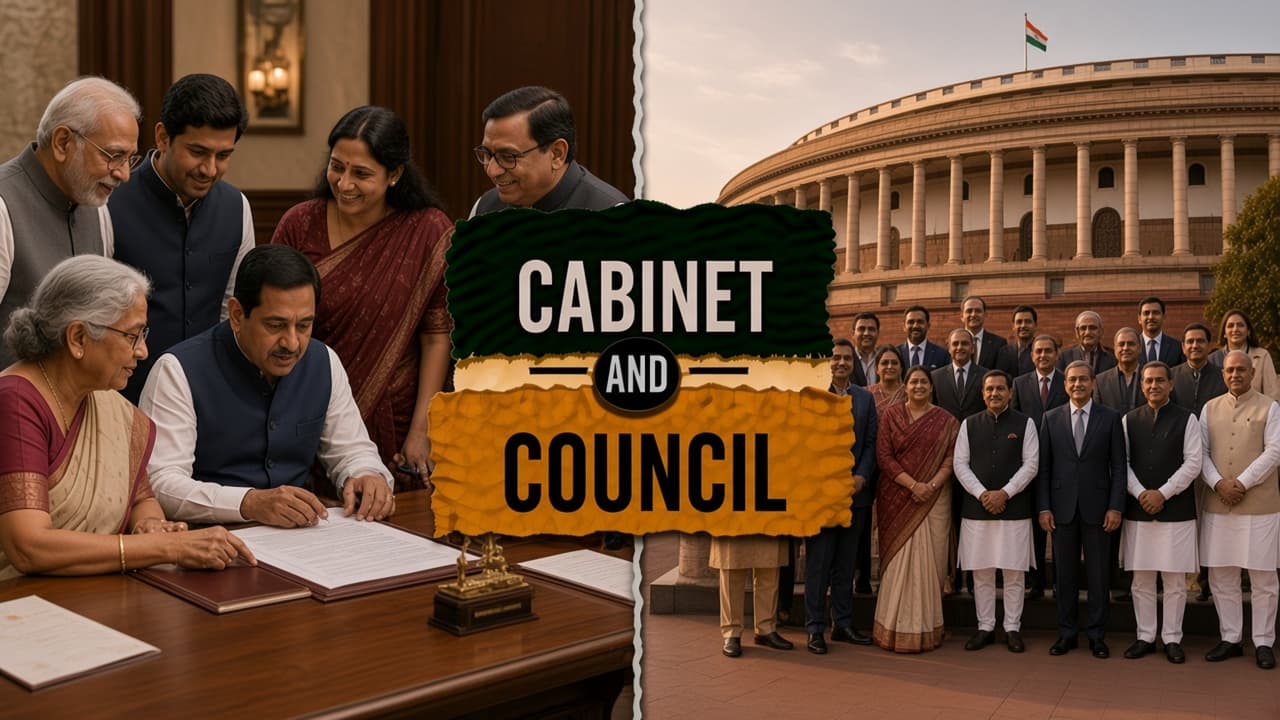
The Cabinet is the inner core of senior ministers. It meets, usually weekly, under the Prime Minister and decides policy. The Council of Ministers includes ministers of every rank: Cabinet ministers, ministers of state, and deputy ministers. Article 74 names the Council as the body that aids and advises the President. The Cabinet is the subset that takes the decisions. The Constitution does not define the word Cabinet. The idea is conventional, and the rules of business now recognise it. Collective responsibility applies to the whole Council. If the Prime Minister loses confidence, the Council goes.
Difference between the Cabinet and the Council of Ministers
| Feature | Cabinet | Council of Ministers |
|---|---|---|
| Meaning | Inner policy body of senior ministers | Every minister, of every rank |
| Law | Recognised by convention and the rules of business; not given its own article | Named in Articles 74 and 75 |
| Ranks | A minister of state is inside only if included; deputy ministers are not | Includes ministers of state, including those with independent charge, and deputy ministers |
| Duty | Cabinet solidarity in the decisions it takes | Article 75 binds the whole Council to collective responsibility |
| Size | No separate numerical cap | The 91st Amendment caps the Union Council at 15 percent of the strength of the Lok Sabha |
| Committees | Cabinet committees, such as the committee on political affairs and the committee on security, are drawn from the Cabinet | Ministers of state and deputy ministers are in the Council and are not, by that fact, on those committees |
At a glance
Composition
Senior ministers, about 20 to 30
All ministers of all ranks
Decision role
The core that formulates policy
Collective responsibility, with roles that differ by rank
Includes
Only Cabinet ministers
Cabinet ministers, ministers of state, and deputy ministers
Meetings
Cabinet meetings, chaired by the Prime Minister
No routine meeting of the full Council
Example
Union Budget decided in Cabinet Room
The finance minister, of Cabinet rank, puts budget proposals to a Cabinet meeting. The Prime Minister and the senior ministers debate them. A minister of state for finance may run a banking division every day and still not vote in Cabinet unless invited. Once the Cabinet agrees, the whole Council of Ministers owns the decision. If the Prime Minister falls, the entire Council resigns, including ministers who never sat in the Cabinet.
What this means for the exam
The Cabinet decides. The Council of Ministers is collectively responsible to the legislature. A minister of state does not automatically have a Cabinet seat.
Cabinet
The Cabinet is the small group that formulates policy. The Prime Minister chairs it. A typical size is about 20 to 30. There is no separate constitutional cap on that inner number. Cabinet committees, including the committee on political affairs and the committee on security, are smaller slices of the same circle. The Constitution never defined the word. Practice and the rules of business did.
A minister of state may attend if invited. Attendance is not automatic. Coalition governments often expand the wider Council to accommodate allies and keep this room smaller so that decisions can still be taken. The budget example is the standard one: Cabinet rank proposes, the Cabinet decides, and the Council then stands by the result.
Council of Ministers
Article 74 is about the Council, not about a defined Cabinet. Article 75 says ministers hold office during the pleasure of the President, which in politics means during the Prime Minister's confidence. Every rank is inside: Cabinet ministers, ministers of state with independent charge, other ministers of state, and deputy ministers. The 91st Amendment limits the Union Council to 15 percent of the Lok Sabha's strength. There is no routine meeting of this full list.
Collective responsibility covers all of them. A minister of state cannot publicly disown a Cabinet decision and remain in office. When the Prime Minister loses the house, the Council resigns as a whole. Students who think every minister sits in Cabinet have missed the subset.
Key takeaway
The Cabinet is the inner group that decides policy. The Council of Ministers includes every rank and is collectively responsible to the legislature.
Difference between the Cabinet and the Council of Ministers FAQs
What is the Cabinet?
The Cabinet is the inner group of senior ministers, chaired by the Prime Minister, that takes policy decisions. It is a subset of the Council of Ministers.
What is the Council of Ministers?
The Council of Ministers is every minister: Cabinet ministers, ministers of state, and deputy ministers. Article 74 names this Council as the body that advises the President.
What is the main difference between the Cabinet and the Council of Ministers?
The Cabinet is the smaller decision-making core. The Council includes all ranks and carries collective responsibility. All Cabinet ministers are in the Council. The reverse is not true.
Are all members of the Council of Ministers members of the Cabinet?
No. Ministers of state and deputy ministers are in the Council. They are in the Cabinet only if they are specifically included.
Does the Council of Ministers include ministers of state and deputy ministers?
Yes. The Council covers Cabinet ministers, ministers of state, and deputy ministers.
What size limit applies to the Council of Ministers?
The 91st Amendment caps the Union Council at 15 percent of the strength of the Lok Sabha. The Cabinet has no separate numerical cap in the Constitution.