
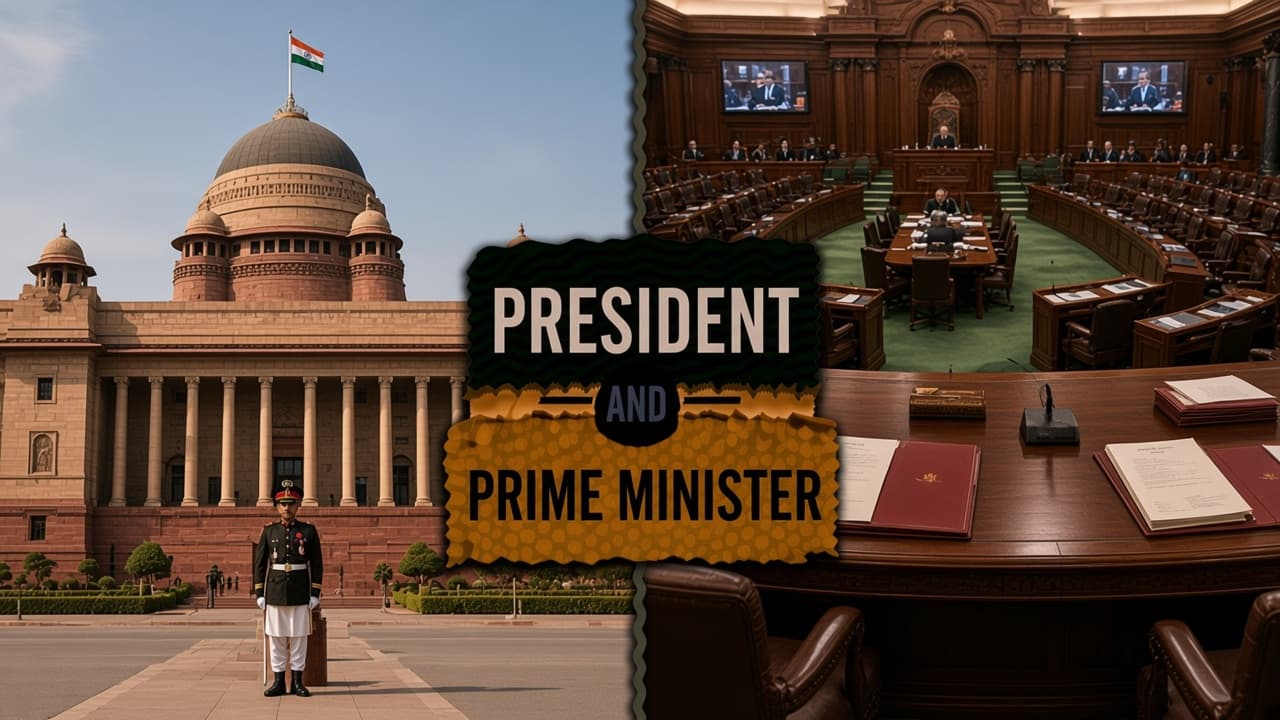
The President is the ceremonial Head of State and the nominal executive under Article 53. The Prime Minister is Head of Government and the real executive, leading the Council of Ministers. Article 74 ties formal presidential action to Cabinet advice. The 42nd Amendment made that advice binding, and the 44th Amendment allows the President to return advice once for reconsideration. The President appoints as Prime Minister the person who is usually the leader of the majority. The Prime Minister recommends the other ministers.
Difference between the President and the Prime Minister
| Feature | President | Prime Minister |
|---|---|---|
| Meaning | Nominal executive and Head of State | Real executive and head of the Council of Ministers |
| Law | Articles 53 and 74; advice is binding, and may be returned once under the 44th Amendment | Article 75; appointed by the President; ministers sit during the President's pleasure in form, and during Lok Sabha confidence in practice |
| Ministers | Appoints them on the Prime Minister's advice | Recommends them and allocates portfolios |
| Parliament | Summons and prorogues on advice, and addresses sessions | Leader of the Lok Sabha and answers in the house |
| Discretion | Narrow: choice of Prime Minister when no majority is clear | Daily political leadership |
| Emergency | Proclaims national, state, or financial emergency on written Cabinet advice; formal supreme command under Article 53 | Heads the Cabinet that frames that advice and defence policy; shapes bills before they reach the President |
At a glance
Role
Head of State, the nominal executive
Head of Government, the real executive
Article
Article 53: executive power is vested here
Article 75: the Prime Minister is appointed by the President
Election
Indirect, by an electoral college
Not directly elected; leader of the majority in the Lok Sabha
Tenure
Five years; impeachment under Article 61
So long as the Lok Sabha's confidence holds
Example
Republic Day parade chief guest invitation
The Prime Minister's office and the Ministry of External Affairs decide diplomatic priorities and recommend a chief guest. The President hosts the guest and takes the salute, as ceremonial Head of State. If the Cabinet advises a proclamation of emergency, the President signs it on that advice, not as a personal choice. A claim that the President runs departments day to day misstates the system. The Prime Minister and the Cabinet do that work.
What this means for the exam
The President is formal and ceremonial, and is bound by advice. The Prime Minister is the real executive, in charge of policy, administration, and the leadership of the Lok Sabha.
President
Article 53 vests the executive power of the Union in the President and gives formal supreme command of the defence forces. Article 74 requires a Council of Ministers, headed by the Prime Minister, to aid and advise. After the 42nd Amendment the President acts on that advice. The 44th Amendment allows the advice to be sent back once. There is no general discretion to veto ministerial decisions. Impeachment is Article 61, and the term is five years. Election is indirect, by an electoral college.
The remaining discretion is narrow: appointing a Prime Minister when no one has a clear majority, and crisis cases about a Council that has lost confidence. A bill may be withheld, which is the pocket-veto debate, but everyday government is not presidential. The Indian President is not the US President. The US office is both head of state and head of government, with its own executive power.
Prime Minister
The Prime Minister is appointed under Article 75 and is the real executive. The test is command of the Lok Sabha. The Prime Minister recommends ministers, allots portfolios, and leads the Cabinet that frames policy, including the advice on which an emergency proclamation rests. Questions in the Lok Sabha are answered under that leadership. Legislation is shaped before it is sent for assent.
In a hung house the President's choice of Prime Minister matters, and then the floor decides. Coalition politics sits in this relationship: the President is the formal appointing authority, and the Prime Minister is the person who can keep a majority. A statement that the President administers departments daily fails Article 74.
Key takeaway
The President under Article 53 is the nominal executive and acts on advice. The Prime Minister is the real executive, the head of the Council of Ministers, and depends on the confidence of the Lok Sabha.
Difference between the President and the Prime Minister FAQs
Who is the President in the Indian executive?
The President is Head of State and the nominal executive under Article 53. Formal powers are used on the advice of the Council of Ministers.
Who is the Prime Minister in the Indian executive?
The Prime Minister is Head of Government, appointed under Article 75, and leads the Council of Ministers. Real executive power sits here, while the Lok Sabha's confidence lasts.
What is the main difference between the President and the Prime Minister?
The President is the formal head, bound by Cabinet advice. The Prime Minister is the real head of government and the leader of that Cabinet.
Can the President exercise executive power independently of the Council of Ministers in all matters?
No. Article 74 binds the President to Cabinet advice, except for a narrow band of discretion such as appointing a Prime Minister when no majority is clear.
Is the Prime Minister the head of the Council of Ministers and the real executive?
Yes. Parliamentary convention and Articles 74 and 75 make the Prime Minister the effective head of the executive.
Is the Indian President the same kind of office as the US President?
No. The US President is both head of state and head of government. In India those roles are split, and the Prime Minister holds the real executive power.