
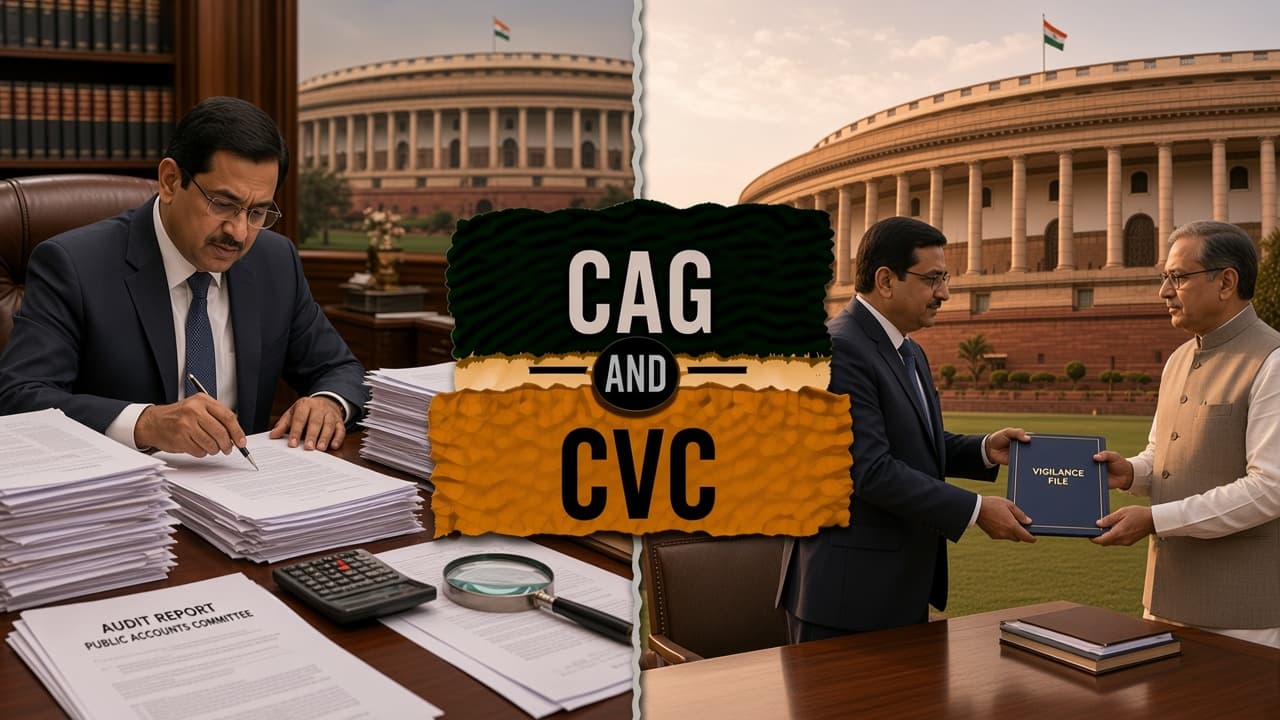
The Comptroller and Auditor General is India's supreme audit institution under Article 148. The Central Vigilance Commission is a statutory anti-corruption body under the CVC Act, 2003. The CAG asks whether public money was spent lawfully and efficiently. The CVC asks whether a public servant acted corruptly. Neither office prosecutes. The CBI and the prosecutors do that. The Vineet Narain judgment of 1997 raised the CVC's stature. The audit trail, from voucher to Parliament, remains the CAG's work.
Difference between the CAG and the CVC
| Feature | CAG | CVC |
|---|---|---|
| Meaning | Supreme audit of how public money was spent | Supervision of vigilance against corruption by public servants |
| Law | Article 148; removal under Article 148(4) on the lines of a Supreme Court judge; audit work under the CAG (DPC) Act, 1971 | CVC Act, 2003; removal on the same lines as a Supreme Court judge, by statute |
| Who | Appointed by the President; tenure of 6 years or age 65 | Appointed by the President on the recommendation of the Prime Minister, the Home Minister, and the Leader of the Opposition; tenure of 4 years or age 65 |
| Reports | Audit reports go to the Public Accounts Committee | Advises on vigilance clearance, chief vigilance officers, and the single transfer policy |
| Cases | 2G spectrum and coal-block performance audits of notional loss | Advice before a CBI inquiry, including in coal allocation cases |
| Effect | No prosecution and no FIR; an independent constitutional office with no parent ministry | No prosecution; administrative support from the Department of Personnel and Training |
At a glance
Constitutional basis
Article 148: a constitutional body
CVC Act, 2003: a statutory body
Primary function
Audit of Union and State accounts
Vigilance over corruption cases
Reports to
The President, and the reports are laid in Parliament
Parliament through an annual report; it also advises the government
Prosecution power
None. It audits and recommends
None. It refers cases to the CBI or to the disciplinary authority
Example
2G spectrum audit vs coal allocation vigilance
The CAG's performance audit put a figure on notional loss in the 2G allocation. The report went to the Public Accounts Committee and dominated the news. That was an audit, not a criminal investigation. When a senior IAS officer is suspected of taking bribes in a coal block case, the ministry seeks the CVC's advice before a CBI investigation. That is the vigilance protocol. The CAG shows a systemic loss. The CVC watches the integrity of individuals inside the system.
What this means for the exam
The CAG is the constitutional auditor of accounts and performance. The CVC is the statutory coordinator of anti-corruption vigilance.
CAG
The Comptroller and Auditor General is a constitutional office under Article 148. The job is the audit of Union and State accounts, including performance audit, under the CAG (DPC) Act, 1971. Reports go to the President and are laid before Parliament, where the Public Accounts Committee takes them up. A performance audit can quantify notional loss, as in 2G spectrum and the coal blocks, and that can shape public debate. It cannot register an FIR or grant sanction to prosecute.
Appointment is by the President. Tenure is 6 years or until the age of 65. Removal follows Article 148(4), on the grounds and procedure used for a Supreme Court judge. The office has no parent ministry. Students sometimes treat the CAG as a body that can remove corrupt officers. It recommends through its audit. Disciplinary action and prosecution stay with departments, the CBI, and the courts.
CVC
The Central Vigilance Commission is statutory. Authority comes from the CVC Act, 2003, not from a constitutional article. It supervises vigilance administration and advises on corruption cases involving Group A officers. It coordinates permissions for CBI inquiry and the network of chief vigilance officers. It does not file charges in court. The Vineet Narain case of 1997 is the judgment that raised its standing, while leaving the CAG's audit trail intact.
The President appoints the CVC on the recommendation of the Prime Minister, the Home Minister, and the Leader of the Opposition. Tenure is 4 years or age 65. Removal is given parity with a Supreme Court judge by the statute. The Department of Personnel and Training provides administrative support. In the coal example, the CVC's role was advice on vigilance clearance before investigation. The CAG's role in the same family of controversies was the audit report. The two offices are often confused because both touch misuse of public money.
Key takeaway
The CAG is the constitutional auditor. The CVC is the statutory vigilance body. Neither of them prosecutes.
Difference between the CAG and the CVC FAQs
What is the CAG?
The Comptroller and Auditor General is the constitutional auditor of Union and State accounts under Article 148. Reports go to Parliament through the President. The CAG does not prosecute.
What is the CVC?
The Central Vigilance Commission is a statutory body under the CVC Act, 2003. It supervises vigilance and advises on corruption cases. It does not file charges itself.
What is the main difference between the CAG and the CVC?
The CAG audits accounts and performance. The CVC coordinates vigilance against corruption by public servants. The CAG is constitutional. The CVC is statutory. Neither prosecutes.
Does the CAG investigate corruption cases and file charges in court?
No. The CAG audits accounts. Criminal investigation is for the CBI and other agencies, after the vigilance and sanction process.
Is the CVC a statutory body?
Yes. It draws authority from the Central Vigilance Commission Act, 2003, not directly from the Constitution.
Is the CAG removed by the same kind of procedure as a Supreme Court judge?
Yes. Article 148(4) provides removal on grounds and by a procedure analogous to that for a Supreme Court judge.
PYQ linkage
The Comptroller and Auditor General of India is appointed by: