
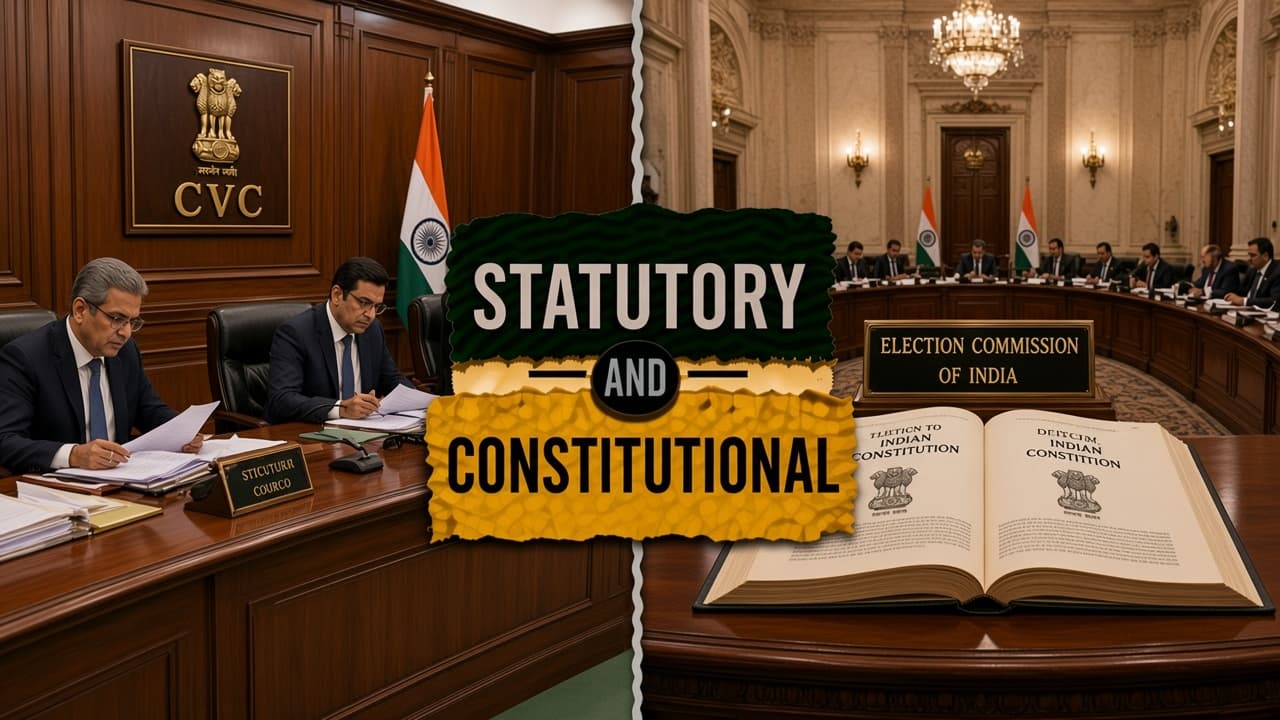
A constitutional body draws its existence and powers from the Constitution. A statutory body is created by an Act of Parliament and can be altered by ordinary legislation. The Election Commission is Article 324. The UPSC is Articles 315 to 323. The Finance Commission is Article 280. The GST Council is Article 279A. The CVC comes from the CVC Act, 2003, and the CIC from the RTI Act, 2005. NITI Aayog replaced the Planning Commission by a Cabinet resolution in 2015. It is not constitutional.
Difference between a statutory body and a constitutional body
| Feature | Difference Between Statutory Body and Constitutional Body |
|---|---|
| Meaning | An institution named and empowered in the Constitution |
| Law | Article 324 for the Election Commission; Articles 315 to 323 for the UPSC; Article 280 for the Finance Commission; Article 279A for the GST Council |
| Examples | Election Commission, UPSC and state commissions, Finance Commission, GST Council |
| Removal | The Chief Election Commissioner is removed by a process like that for a Supreme Court judge |
| Change | Ordinary law cannot casually erase the body |
| Effect | Protected tenure is the usual design for election, recruitment, and fiscal bodies |
At a glance
Source
The Constitution, in specific articles
Examples
Election Commission, UPSC, Finance Commission, GST Council
Alteration
A constitutional amendment is often required
Independence
Generally higher, with protected tenure
Example
Who can dissolve the Election Commission?
The Election Commission's powers come from Article 324. An executive memo cannot abolish it. That would need a constitutional amendment. NITI Aayog is the contrast: the government replaced the Planning Commission by a Cabinet resolution in 2015. The CIC exists because of the RTI Act, 2005, and Parliament can amend that Act. Matching a body to its birth certificate, the Constitution or an Act, is the exam skill.
What this means for the exam
A constitutional body is harder to dismantle and often has a protected removal, such as the Chief Election Commissioner on the pattern of a Supreme Court judge. A statutory body is a creature of Parliament and changes when its Act changes.
Constitutional body
The birth certificate is an article. Article 324 creates the Election Commission. Articles 315 to 323 create the Union and state public service commissions. Article 280 creates the Finance Commission. Article 279A creates the GST Council. The GST Council is constitutional, and it is not a commission in the Election Commission sense. Removal and tenure are often protected. The Chief Election Commissioner is removed by a process comparable to that for a Supreme Court judge.
Importance is not the test. A famous office can still be outside the Constitution. Calling every body with "commission" in its name constitutional fails. Article 280 is the Finance Commission, not NITI Aayog. A statement that parks NITI under Article 280 swaps the two.
Statutory body
A statutory body exists because an Act says so. The CVC Act, 2003, creates the Central Vigilance Commission. The RTI Act, 2005, creates the CIC. Parliament can amend the Act and change the body. The CVC is statutory, though the Constitution has a related insertion after Article 323B. That mention does not turn it into a body created by an article in the way Article 324 creates the Election Commission.
NITI Aayog is the executive case in the same cluster. It has no constitutional article. A Cabinet resolution in 2015 replaced the Planning Commission, which was itself extra-constitutional. The summary lists NITI with statutory examples because it is not constitutional. Its actual birth is an executive resolution, not an Act. The practical point is the same: ordinary law, or a later resolution, can reshape it more easily than an article can be rewritten.
Key takeaway
The Election Commission, the UPSC, the Finance Commission, and the GST Council are constitutional. The CVC and the CIC are statutory, and NITI Aayog was created by an executive resolution.
Difference between a statutory body and a constitutional body FAQs
What is a constitutional body?
A constitutional body is created by the Constitution. The Election Commission, the UPSC, the Finance Commission, and the GST Council are the standard examples, under Articles 324, 315 to 323, 280, and 279A.
What is a statutory body?
A statutory body is created by an Act of Parliament. The CVC under the 2003 Act and the CIC under the RTI Act, 2005, are examples. Parliament can amend the Act.
What is the main difference between a statutory body and a constitutional body?
A constitutional body needs a constitutional change to be abolished or recast. A statutory body changes when its Act changes. Tenure and removal are usually more protected on the constitutional side.
Is NITI Aayog a constitutional body under Article 280?
No. Article 280 creates the Finance Commission. NITI Aayog was created by an executive resolution in 2015.
Is the Central Vigilance Commission a statutory body?
Yes. It comes from the CVC Act, 2003. A related constitutional insertion after Article 323B does not make it a body created in the manner of the Election Commission.
Is the CIC a constitutional body because it is called a commission?
No. The CIC exists under the RTI Act, 2005. The word commission does not decide the status. The article or the Act does.