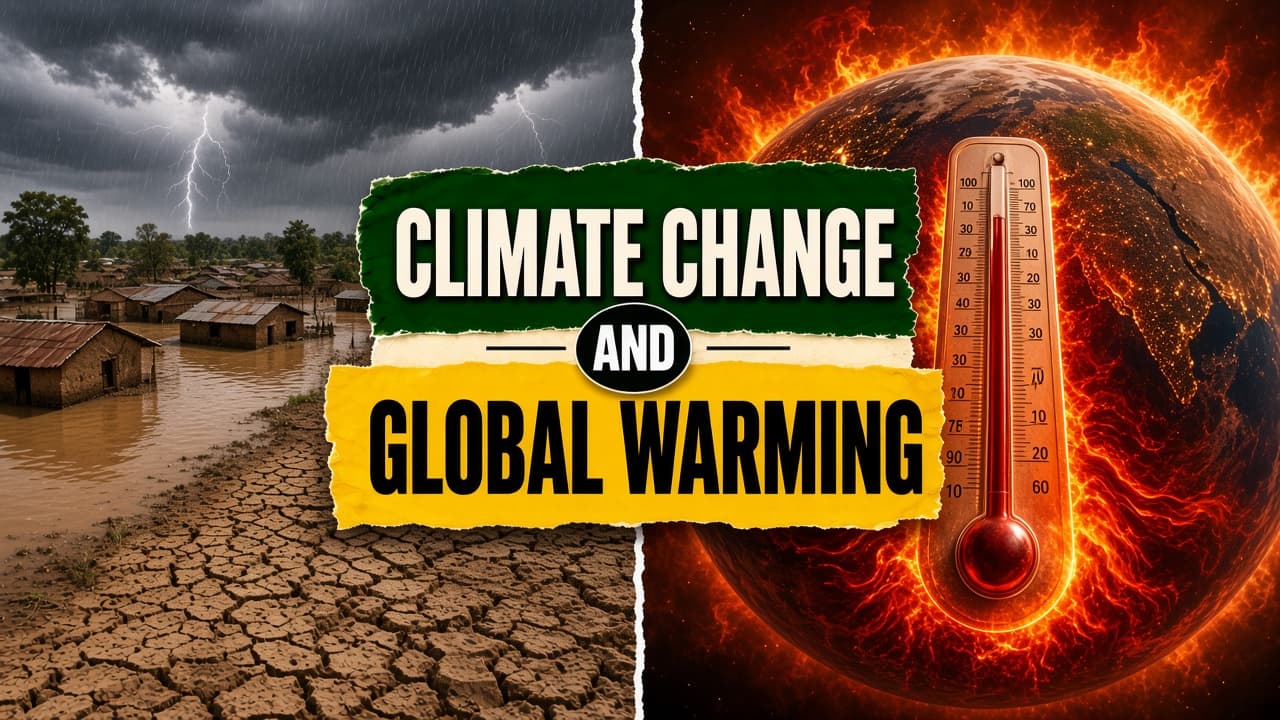
Difference between climate change and global warming
Global warming is the long-term rise in average temperature, and climate change is the wider shift in rainfall, extremes, sea level, and ecosystems.
By UPSCYatra Editorial Team - May 10, 2026
Table of contents
Global warming is the long-term rise in Earth's average surface temperature, driven mainly by greenhouse gases. Climate change is the wider shift in the climate system: altered precipitation, extreme weather, sea-level rise, ocean acidification, and disruption of ecosystems. IPCC reports treat warming as a measured trend in degrees Celsius since the pre-industrial period, about 1.1 degrees Celsius so far. Climate change is the umbrella used for impacts and regional vulnerability in Working Groups I, II, and III.
Difference between climate change and global warming
Feature
Climate Change
Global Warming
Meaning
Long-term rise in average surface temperature
Broader change in climate patterns and impacts
Cause
Greenhouse gases such as CO2, CH4, and N2O trapping heat
The same drivers plus feedbacks such as ice-albedo and permafrost
Measure
Global mean temperature; NASA GISS, HadCRUT, IPCC AR6; about 1.1 degrees Celsius since pre-industrial
IPCC Working Groups I, II, and III, plus IMD trend analysis
Examples
Urban heat islands and glacier retreat in India
Monsoon variability, cyclone intensity, and coastal erosion
Law
Paris Agreement Article 2: well below 2 degrees Celsius, pursue 1.5
UNFCCC, NDCs, and India's National Action Plan on Climate Change
Effect
Limits on the temperature rise from emission cuts
Emission cuts plus adaptation to changes already locked in
Upgrade for access and purchase our mains 27 pass.
Often since the pre-industrial period, around 1850
Global Warming
Past, present, and projected multi-decadal patterns
Policy framing
Climate Change
Paris 1.5 degree and 2 degree targets
Global Warming
UNFCCC, NAP, NDCs, loss and damage
Example
Hotter Delhi summers vs erratic monsoon
Delhi hitting 48 degrees Celsius more often is global warming, because the average heat is rising. Farmers in Marathwada facing three drought years followed by cloudbursts are living climate change. The timing and amount of rain have shifted, not just the thermometer. Warming intensifies the hydrological cycle. The farmer feels the combined package.
What this means for the exam
Warming is the temperature trend. Climate change is that warming together with rainfall shifts, extremes, sea-level rise, and effects on biodiversity.
Climate change
Climate change covers the full shift in the climate system, not the thermometer alone. It includes rainfall, extremes, sea level, ocean chemistry, and ecosystems. In India that shows up as monsoon variability, glacial lake outburst floods, and coastal erosion. Heat action plans deal with temperature. Crop insurance and the National Action Plan on Climate Change deal with the wider impacts.
Not every flood is a direct result of warming. Attribution science separates a long-term trend from ordinary variability. At climate talks, India argues for common but differentiated responsibilities: historical emitters drove the warming, while India faces impacts even with lower per-capita emissions. Policy, finance, and adaptation target those impacts.
Global warming
Global warming is the long-term increase in Earth's average surface temperature. IPCC assessments place the rise at about 1.1 degrees Celsius since the pre-industrial baseline, often dated around 1850. NASA GISS, HadCRUT, and IPCC AR6 are the usual measurement references. The Paris Agreement, Article 2, aims to hold warming well below 2 degrees Celsius and to pursue 1.5 degrees Celsius.
In a narrow sense, warming is defined by temperature, so it can be discussed without listing every change in rain. In practice, thermodynamics links a warmer atmosphere to a stronger hydrological cycle. Delhi recording 48 degrees Celsius more often is the temperature trend. It is one part of climate change, not the whole of it.
Key takeaway
Global warming is the long-term rise in average temperature. Climate change is that warming together with shifts in rain, extremes, seas, and ecosystems.
Difference between climate change and global warming FAQs
What is climate change?
Climate change is the broader shift in climate patterns. It includes warming, changes in rain, extreme events, sea-level rise, ocean acidification, and ecosystem disruption. IPCC Working Groups I, II, and III assess the physical science, impacts, and response.
What is global warming?
Global warming is the long-term increase in Earth's average surface temperature, mainly from greenhouse gases. IPCC figures put the rise at about 1.1 degrees Celsius since the pre-industrial period.
What is the main difference between climate change and global warming?
Global warming is the rise in average temperature. Climate change is that warming plus the wider changes in rainfall, extremes, seas, and ecosystems. Warming is one component of climate change.
Are climate change and global warming identical scientific terms?
No. Global warming refers to rising temperatures. Climate change covers broader shifts in the climate system.
Can global warming occur without any change in precipitation patterns?
In definition, yes. Warming is defined by temperature. In practice, a warmer atmosphere is linked to changes in the water cycle.
Does the Paris Agreement set a target to limit global warming?
Yes. Article 2 aims to hold warming well below 2 degrees Celsius above pre-industrial levels and to pursue 1.5 degrees Celsius. That is a warming metric, not a description of every climate impact.