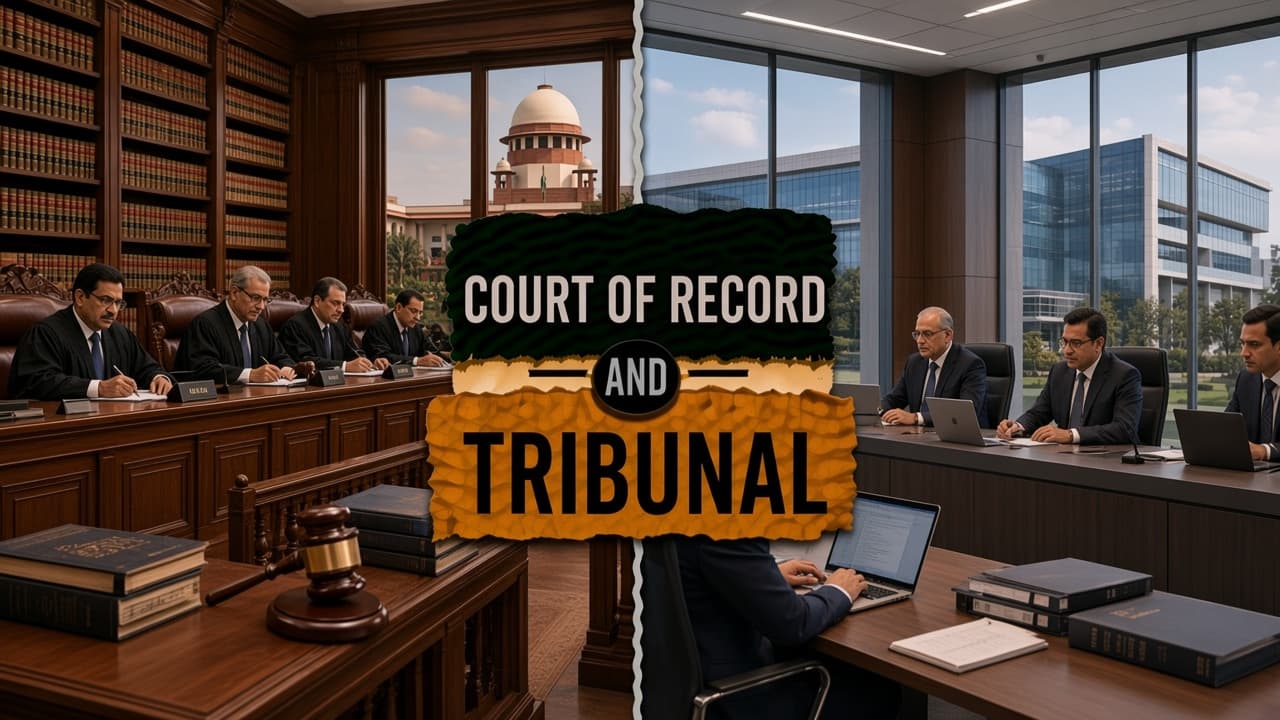
Difference between a court of record and a tribunal
A court of record is a constitutional court with a permanent record and contempt power, and a tribunal is a specialised statutory body whose orders stay open to review by those courts.
By UPSCYatra Editorial Team - Jun 5, 2026
Table of contents
A court of record keeps a permanent enrolment of its proceedings and can punish contempt of itself. Article 129 gives that status to the Supreme Court, and Article 215 gives it to the High Courts. A tribunal is a specialised body created by statute under Article 323A or Article 323B, for disputes such as service, tax, or company matters. The Central Administrative Tribunal, the Income Tax Appellate Tribunal, the NCLT, the NGT, and the Armed Forces Tribunal are the examples. They are not courts of record. L. Chandra Kumar in 1997 held that judicial review of their orders by the High Courts and the Supreme Court is part of the basic structure.
Difference between a court of record and a tribunal
Feature
Court of Record
Tribunal
Meaning
A constitutional court whose record is conclusive and which can punish contempt
A specialised quasi-judicial body for a defined class of disputes
Law
Articles 129 and 215; procedure also in the Contempt of Courts Act, 1971
Articles 323A and 323B and the Acts that create each tribunal
Examples
The Supreme Court and the 25 High Courts
CAT, ITAT, NCLT, NGT, and the Armed Forces Tribunal
Subjects
The ordinary constitutional jurisdiction of those courts
Article 323A covers service matters for a central law; Article 323B lists further matters, including tax, land, and elections, for Parliament or the states
Judges
Constitutional judges; Article 236's "district judge" is a different definition and excludes a tribunal member
Judicial and administrative members; the CAT, from 1985, uses both streams
Effect
Review of tribunal orders is basic structure after L. Chandra Kumar, 1997
They supplement the courts and cannot block a High Court writ; R. Gandhi, 2010, required independence and a real judicial element
Upgrade for access and purchase our mains 27 pass.
Articles 323A and 323B, plus the enabling statutes
Contempt power
Court of Record
Inherent, as a court of record
Tribunal
Only if a statute grants it; not the status in Articles 129 and 215
Judicial review of orders
Court of Record
Appeal or a writ to a higher constitutional court
Tribunal
High Court writ and supervisory jurisdiction remains, under L. Chandra Kumar
Membership
Court of Record
Judges appointed through the Collegium route
Tribunal
A mix of judicial and technical or administrative members, as in the CAT
Example
Newspaper scandalises HC judge vs tax appeal
A tabloid publishes a scurrilous attack on a High Court judge. The High Court, a court of record under Article 215, may start contempt proceedings, and its record of proceedings is authoritative. A business dispute about an income-tax assessment goes to the ITAT, a tribunal under statute. If the ITAT errs on jurisdiction, the assessee can still reach the High Court under Articles 226 and 227. The tribunal's order is not beyond constitutional review.
What this means for the exam
A court of record has constitutional status, contempt power, and a permanent record. A tribunal is a specialised statutory forum, and the High Court and the Supreme Court keep oversight.
Court of record
Two consequences follow. The court's acts and proceedings are enrolled for a permanent memory and stand as proof. The court can punish contempt of itself. The Contempt of Courts Act, 1971, sets procedure. The status itself comes from Articles 129 and 215. The Supreme Court and the High Courts, counted in this entry as 25, hold it. A tribunal may have penal clauses in its own Act. That is not this constitutional mantle.
Article 236 defines "district judge" to include offices such as a sessions judge. It expressly leaves out a tribunal judge, which is the point of the 1996 question. Calling the NCLT or the NGT a High Court equivalent misses the chapter of the Constitution that creates courts of record. Only the Supreme Court and the High Courts have that status.
Tribunal
Articles 323A and 323B allow Parliament, and in the case of 323B the states as well, to create tribunals for listed subjects: services, tax, land reforms, foreign exchange, and further matters including elections. The CAT, the ITAT, the NCLT, the NGT, and the Armed Forces Tribunal are the working examples. They were meant to be expert and quicker. The CAT dates from 1985. It was not set up in Lal Bahadur Shastri's tenure. Its members come from the judicial stream and the administrative stream, which is the true half of the 2009 question.
L. Chandra Kumar in 1997 held that cutting out the High Court's writ jurisdiction over tribunal orders would breach the basic structure. Tribunals are valid. They cannot oust that review. R. Gandhi in 2010 added that adjudicatory tribunals need independence and an adequate judicial presence. They remain quasi-judicial bodies. They are not a substitute for Articles 129 and 215.
Key takeaway
The Supreme Court and the High Courts are courts of record under Articles 129 and 215, with contempt power and a permanent record. A tribunal is a specialised statutory body, and High Court review of its orders remains.
Difference between a court of record and a tribunal FAQs
What is a court of record?
A court of record has proceedings that are permanently enrolled and stand as evidence, and it can punish contempt of itself. The Supreme Court has this status under Article 129. High Courts have it under Article 215.
What is a tribunal?
A tribunal is a specialised body created by law under Article 323A or 323B. The CAT, ITAT, NCLT, NGT, and Armed Forces Tribunal are examples. They decide defined disputes and are not courts of record.
What is the main difference between a court of record and a tribunal?
A court of record is a constitutional court with inherent contempt power. A tribunal is a statutory specialist. Its orders stay open to High Court and Supreme Court review.
Do administrative tribunals under Article 323A remove the High Court's power of judicial review?
No. L. Chandra Kumar holds that High Court writ jurisdiction over tribunal orders is part of the basic structure. Tribunals cannot oust it.
Does the constitutional term "district judge" include a tribunal judge?
No. Article 236 excludes a tribunal judge from that definition. The 1996 question asks this directly.
Was the Central Administrative Tribunal set up while Lal Bahadur Shastri was Prime Minister?
No. The CAT dates from 1985. Its members are drawn from the judicial and administrative streams, which is the accurate half of the usual paired statement.
PYQ linkage
1996 · Prelims
According to the Constitution, the term 'district judge' shall not include:
2009 · Prelims
CAT set up during Shastri PM tenure / CAT members from judicial and administrative streams — correct?