
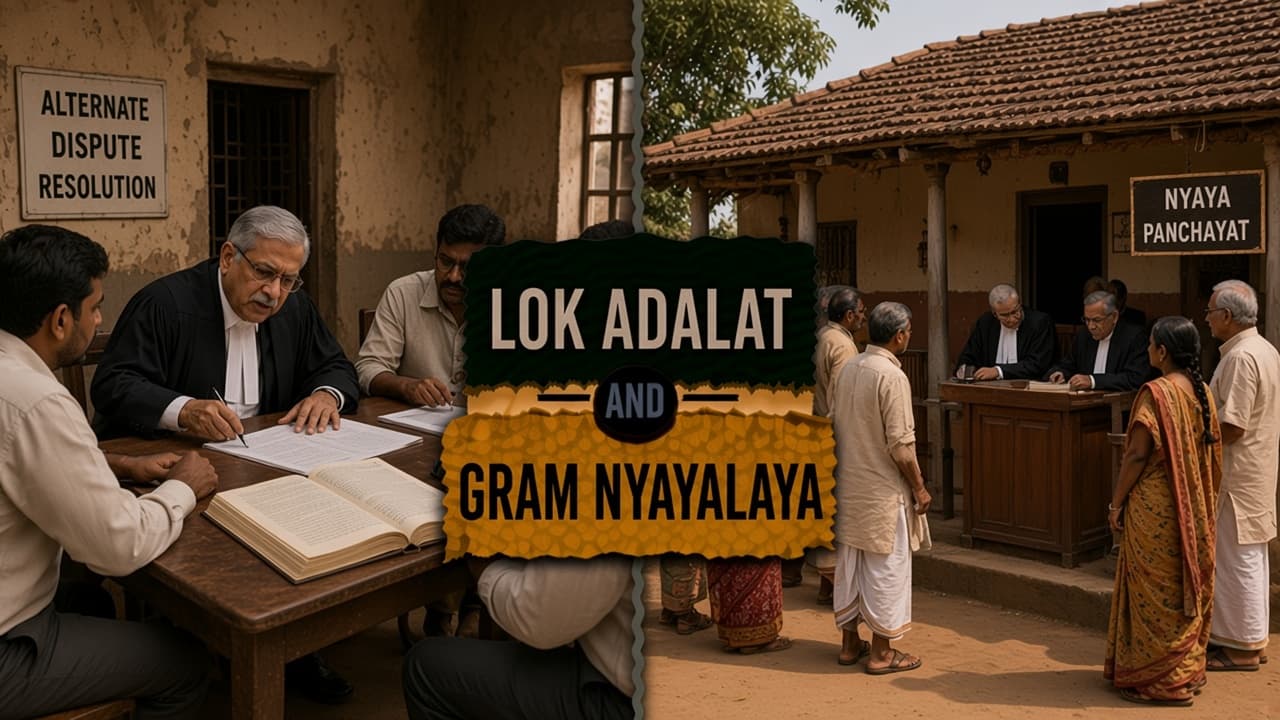
A Lok Adalat settles cases by compromise under the Legal Services Authorities Act, 1987. An award made with the parties' consent is deemed a decree of a civil court, and there is no appeal against that accepted award. A Gram Nyayalaya is a court under the Gram Nyayalaya Act, 2008, at the intermediate panchayat level, with trial powers and appeals under the criminal and civil procedure codes. The presiding officer is a Nyayadhikari. Nyaya Panchayats under state laws are a third, informal idea, and they are not Gram Nyayalayas. Permanent Lok Adalats for public utility services are a special kind of Lok Adalat. They are still not criminal courts.
Difference between a Lok Adalat and a Gram Nyayalaya
| Feature | Lok Adalat | Gram Nyayalaya |
|---|---|---|
| Meaning | A compromise forum under the legal-services system | A rural court with trial powers |
| Law | Legal Services Authorities Act, 1987; NALSA organises sittings | Gram Nyayalaya Act, 2008 |
| Cases | Matters already in court, and pre-litigation disputes; Permanent Lok Adalats cover public utility services | Specified civil and criminal matters in the schedule, not every offence |
| Result | An agreed award is a civil decree; no court fee, and a fee already paid on a pending case is refunded | A judgment or order of a court; mobile sittings in villages |
| Place | Sittings that are organised; not always a permanent bench | Established at the intermediate panchayat; many states have been slow to notify them |
| Supervision | Not a constitutional court; it works in the NALSA framework | A subordinate court under the High Court's superintendence in Article 227 |
At a glance
Nature
A forum for alternative dispute resolution and conciliation
A formal court created by statute
Legal basis
Legal Services Authorities Act, 1987
Gram Nyayalaya Act, 2008
Presiding
Benches that can include retired judges, lawyers, and social workers, under the composition rules
A Nyayadhikari, who is legally qualified
Appeal
No appeal against an accepted award
Appeals to higher courts under the criminal and civil procedure codes
Example
Village land boundary dispute vs theft case
Two farmers disagree about a boundary. Legal aid organises a Lok Adalat, including on National Legal Services Day. They compromise, the award is signed, and it has the status of a civil decree. There is no appeal from an accepted award. A bicycle theft is different. A Gram Nyayalaya can try specified summary offences under its schedule, with a Nyayadhikari presiding. A conviction can be appealed on the ordinary criminal track. One forum settles by agreement. The other applies the law.
What this means for the exam
A Lok Adalat is compromise. There is no appeal from an award the parties have accepted. A Gram Nyayalaya is a court, with trials and appeals.
Lok Adalat
The Legal Services Authorities Act, 1987, is the statute. NALSA and the state authorities organise the sittings, including the sittings associated with National Legal Services Day. The bench can include retired judges, lawyers, and social workers. The method is conciliation. If the parties agree, the award is a decree of a civil court and there is no appeal. There is no court fee. If the case was already pending, the fee is refunded. The forum is widely used.
A Permanent Lok Adalat is the variant for public utility services such as telecom, transport, and hospitals. It handles pre-litigation disputes and, unlike an ordinary Lok Adalat, can pass a binding award even when the parties do not fully agree. It is still alternative dispute resolution. It is not a Gram Nyayalaya trying a criminal case.
Gram Nyayalaya
The Gram Nyayalaya Act, 2008, requires these courts in the districts, at the intermediate panchayat, with a legally qualified Nyayadhikari. Procedure is simplified. The court can sit as a mobile court in villages. Jurisdiction is the civil and criminal list in the schedule. Major offences are excluded. A decision is a judgment, and appeal lies under the criminal and civil codes. The court is subordinate to the High Court under Article 227.
Many states have been slow to notify and establish them. They are not Nyaya Panchayats, which are informal bodies under state laws. They are also not Lok Adalats. A statement that they only conciliate fails the 2008 Act. They try cases. The panchayat justice they complement is a different institution.
Key takeaway
A Lok Adalat is alternative dispute resolution by compromise, and an accepted award is not appealed. A Gram Nyayalaya is a rural court, with trials and appeals.
Difference between a Lok Adalat and a Gram Nyayalaya FAQs
What is a Lok Adalat?
A Lok Adalat is a conciliation forum under the Legal Services Authorities Act, 1987. If the parties agree, the award is a decree of a civil court and cannot be appealed.
What is a Gram Nyayalaya?
A Gram Nyayalaya is a rural court under the Gram Nyayalaya Act, 2008. A Nyayadhikari tries specified civil and criminal cases at the intermediate panchayat level, and appeals lie to higher courts.
What is the main difference between a Lok Adalat and a Gram Nyayalaya?
A Lok Adalat settles by compromise. A Gram Nyayalaya adjudicates. One produces an agreed award. The other produces a judgment that can be appealed.
Do Gram Nyayalayas work as Lok Adalats, using the same conciliation procedure?
No. Gram Nyayalayas have trial powers. Lok Adalats prioritise settlement.
Is a Lok Adalat award, made with the parties' consent, a civil decree?
Yes. The Legal Services Authorities Act gives that award the status of a decree. There is no appeal.
Are Nyaya Panchayats the same as Gram Nyayalayas?
No. Nyaya Panchayats are informal bodies under state laws. Gram Nyayalayas are courts under the central Act of 2008.