
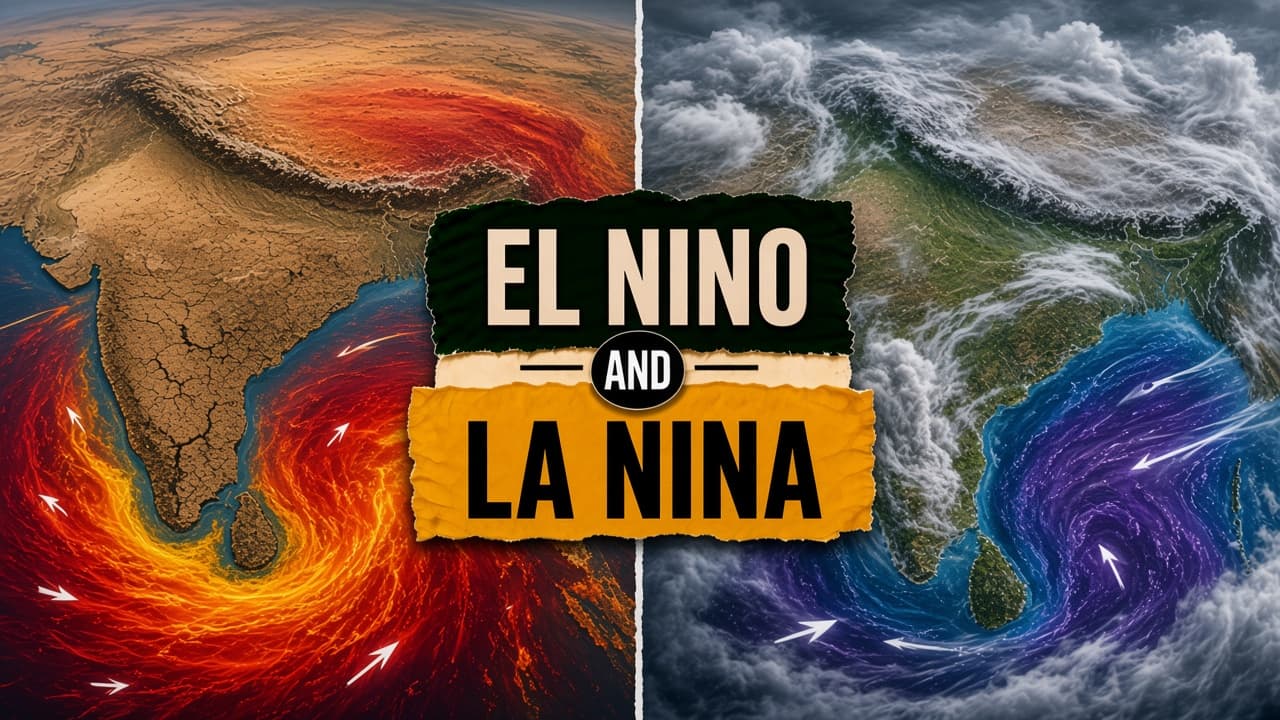
El Niño is the warm phase of ENSO. Sea-surface temperatures rise above normal in the central and eastern equatorial Pacific, and the trade winds weaken. La Niña is the cool phase. The eastern Pacific cools, the trades strengthen, and warm water piles up farther west. Under ordinary conditions the warm pool sits near Indonesia and Australia, and cold water upwells off Peru. El Niño shifts that warm pool east. La Niña exaggerates the ordinary pattern.
Difference between El Niño and La Niña
| Feature | El Niño | La Niña |
|---|---|---|
| Meaning | Warm phase of ENSO in the equatorial Pacific | Cool phase of ENSO in the equatorial Pacific |
| Ocean | Central and eastern Pacific warmer than normal | Eastern Pacific cooler; western Pacific relatively warmer |
| Winds | Trade winds weaken or reverse; Walker circulation weakens; SOI often negative | Trade winds strengthen; Walker cell strengthens; SOI often positive |
| Fisheries | Warm water off Peru suppresses upwelling, so fish decline | Strong upwelling off Peru supports good fisheries |
| India | Often a below-normal monsoon; a positive Indian Ocean Dipole can offset a weak monsoon | Often above-normal rain; other oscillations still matter |
| Time | Often 9 to 12 months; a multi-year event is possible | Often 1 to 3 years, and it can last across seasons |
At a glance
Sea surface temp.
Warmer than normal in the eastern Pacific
Cooler than normal in the eastern Pacific
Trade winds
Weakened or reversed
Strengthened
Walker circulation
Weakened
Strengthened
India monsoon tendency
Often below normal
Often above normal
Example
2015 El Niño and worried farmers in Maharashtra
In a strong El Niño year, the IMD often flags a higher chance of a deficient southwest monsoon. Farmers in Maharashtra may delay sowing of kharif soybean until the rainfall signal is clearer. A La Niña year, as in the 2020 context, may bring heavier rain, and with it a flood risk in some basins. The exam tests the association. It does not claim a perfect forecast for every district in every year.
What this means for the exam
El Niño raises the statistical risk of a deficit monsoon for India. La Niña often supports better rainfall. Neither phase guarantees the result in every district.
El Niño
El Niño is named from Peruvian fishermen and the Christ child. It is a Pacific-wide shift with global links, not a weather system confined to one country. Trade winds weaken, the Walker circulation weakens, and the Southern Oscillation Index is often negative. The warm pool moves east. Upwelling off Peru fails, and fisheries decline. Drought tendencies appear in Australia and Indonesia, while parts of the Americas see heavier rain.
For India, the usual link is a higher chance of a deficient southwest monsoon, as the IMD flagged in strong years such as 2015. That is not a guarantee of drought in every district, and it is not a pattern of universal floods. Neutral ENSO years still vary because of the Indian Ocean Dipole, the Madden-Julian Oscillation, and local factors. A positive IOD can offset a weak monsoon. Food prices and disaster plans use the outlook; they do not treat it as a fixed local forecast.
La Niña
La Niña strengthens the trade winds and the Walker circulation. Warm water piles up farther west, the eastern Pacific stays cool, and upwelling off Peru supports fisheries. The Southern Oscillation Index is often positive. Rainfall anomalies in many regions run opposite to the El Niño pattern. Events often last 1 to 3 years and can cross seasons.
Indian monsoon rainfall is often above normal in La Niña years. The 2020 context is the example used for heavier rain, including flood risk in some basins. The phase is one influence among others. It does not, by itself, set the rain in every basin. Agriculture planning still reads the ENSO outlook inside the IMD long-range forecast, alongside the other oscillations.
Key takeaway
El Niño warms the eastern Pacific, weakens the trades, and often raises monsoon risk for India. La Niña cools the east, strengthens the trades, and often supports better monsoon rain.
Difference between El Niño and La Niña FAQs
What is El Niño?
El Niño is the warm phase of ENSO. The central and eastern equatorial Pacific becomes warmer than normal, trade winds weaken, and the Walker circulation weakens.
What is La Niña?
La Niña is the cool phase of ENSO. The eastern Pacific cools, trade winds strengthen, and warm water builds up farther west.
What is the main difference between El Niño and La Niña?
El Niño warms the eastern Pacific and often raises the risk of a weak Indian monsoon. La Niña cools the eastern Pacific, strengthens the trades, and often supports better monsoon rain.
Does El Niño always cause floods in India?
No. El Niño is more often linked with a deficient monsoon in India, not with floods across the country.
Does La Niña strengthen trade winds in the equatorial Pacific?
Yes. Stronger trades push warm water toward the western Pacific during La Niña.
Does every year have to be either El Niño or La Niña?
No. Neutral ENSO years are common. Monsoon rain can still vary because of the Indian Ocean Dipole, the Madden-Julian Oscillation, and local factors.