
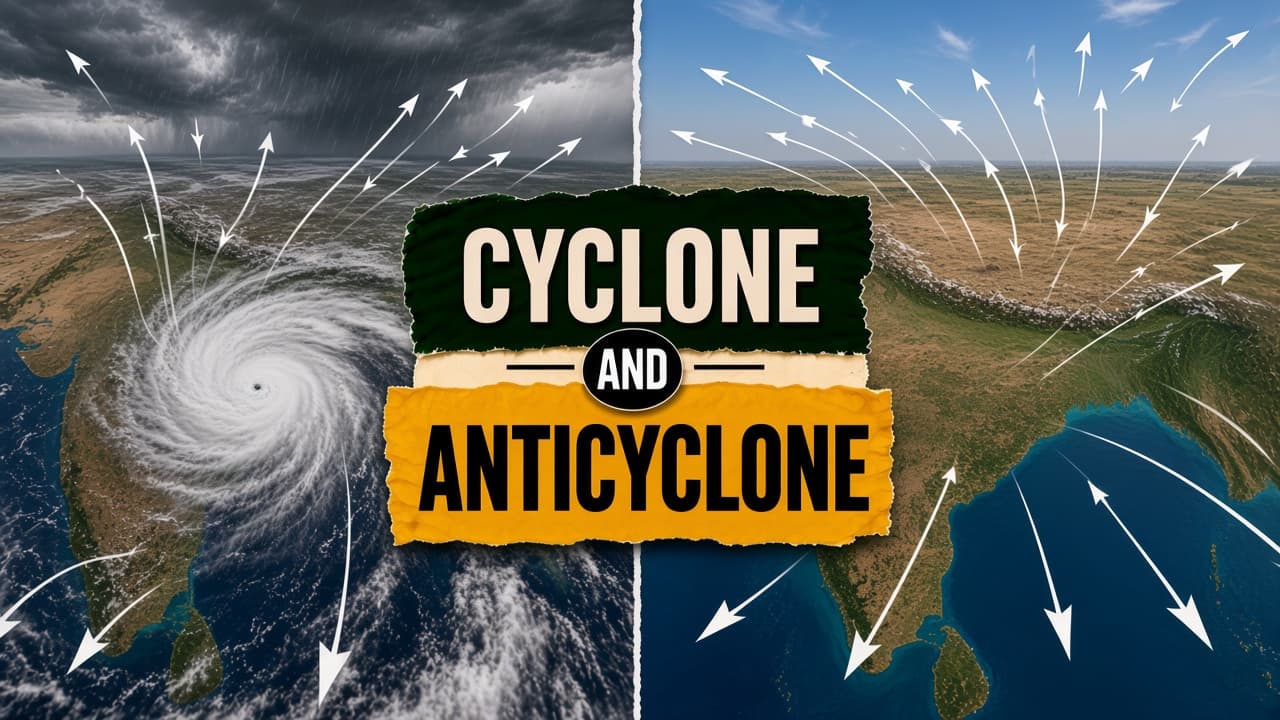
A cyclone is a low-pressure system. Surface air converges, rises, cools, and condenses, producing clouds, rain, and storms. An anticyclone is a high-pressure system. Air sinks, warms, and spreads outward, which brings stable, clear, and generally dry weather. In the Northern Hemisphere a cyclone spins counter-clockwise and an anticyclone spins clockwise.
Difference between a cyclone and an anticyclone
| Feature | Cyclone | Anticyclone |
|---|---|---|
| Meaning | Low-pressure cell with rising air | High-pressure cell with sinking air |
| Motion | Surface convergence and uplift; counter-clockwise in the Northern Hemisphere | Surface divergence and subsidence; clockwise in the Northern Hemisphere |
| Weather | Clouds, rain, and storms | Clear and dry weather; winter fog if an inversion forms |
| Examples | Bay of Bengal cyclones such as Amphan and Fani; western disturbances as temperate lows | Siberian high in winter over North India; subtropical highs of the horse latitudes |
| India | October to December on the east coast, and the pre-monsoon Arabian Sea | Winter high over the north-west plains, and clear skies after the monsoon |
| Effect | Unstable air sustains convection; tropical cyclones need sea surface warmer than about 26 to 27 degrees Celsius and low wind shear | Stable sinking air can form an inversion and suppress rain |
At a glance
Pressure centre
Low (L)
High (H)
Air motion
Convergence at the surface, then uplift
Divergence at the surface, then subsidence
Weather
Cloudy, rainy, and stormy
Clear, stable, and dry, except winter fog under an inversion
NH wind circulation
Counter-clockwise, cyclonic
Clockwise, anticyclonic
Example
Bay of Bengal cyclone vs January Delhi high
A Bay of Bengal cyclone, a low, pulls moist air inward in a spiral. Odisha's coast then faces heavy rain and a storm surge. In January, an extension of the Siberian anticyclone brings cold, dry high pressure over North India. Skies are clear, nights are cold, and fog forms in the Indo-Gangetic plain.
What this means for the exam
A low means convergence and rain. A high means air spreading out and sinking, with dry and often clear weather.
Cyclone
A cyclone is any low-pressure cell. Indian news often uses the word only for a tropical storm. Air flows in at the surface, rises, cools, and condenses. Clouds and rain follow. In the Northern Hemisphere the Coriolis effect turns the winds counter-clockwise. Tropical cyclones such as Amphan and Fani form over warm seas, needing surface water warmer than about 26 to 27 degrees Celsius and low vertical wind shear. They hit the Bay of Bengal from October to December and also form over the Arabian Sea before the monsoon.
Temperate cyclones are a different genesis. They form on frontal zones in the mid-latitudes. Western disturbances are temperate cyclones embedded in the westerlies, and they are still lows. IMD tracking and coastal disaster plans deal with the tropical kind. A statement that an anticyclone produces rainy uplift has the vertical motion backwards.
Anticyclone
An anticyclone is a high-pressure system. Air sinks, warms, and diverges at the surface. Rain is suppressed. In the Northern Hemisphere the winds blow clockwise, not counter-clockwise. The January extension of the Siberian high over North India brings clear skies, cold nights, and fog in the Indo-Gangetic plain when an inversion forms. Subtropical highs over the oceans, the horse latitudes, are the other familiar case.
The system can be a cold or a warm anticyclone, depending on where the air came from. Stable subsidence is the shared feature. Winter in the north-west plains, and clear skies after the monsoon, are the Indian seasons to associate with highs. The name is the opposite of a cyclone in both pressure and spin.
Key takeaway
A cyclone is a low: air converges, rises, and rain forms. An anticyclone is a high: air spreads out, sinks, and skies are often clear.
Difference between a cyclone and an anticyclone FAQs
What is a cyclone?
A cyclone is a low-pressure system in which air converges and rises, forming clouds and rain. In the Northern Hemisphere the winds spin counter-clockwise.
What is an anticyclone?
An anticyclone is a high-pressure system in which air sinks and spreads outward. Weather is usually clear and dry. In the Northern Hemisphere the winds spin clockwise.
What is the main difference between a cyclone and an anticyclone?
A cyclone is a low with rising, rainy air. An anticyclone is a high with sinking, clearer air. Their spins in the Northern Hemisphere are opposite.
Do winds around an anticyclone blow counter-clockwise in the Northern Hemisphere?
No. Anticyclones spin clockwise in the Northern Hemisphere. Cyclones spin counter-clockwise.
Are cyclones associated with rising air and clouds?
Yes. Air rises in a cyclone, cools, and condenses, which produces cloud and precipitation.
Is every cyclone a tropical storm?
No. In geography a cyclone is any low-pressure cell. Tropical cyclones need warm seas. Temperate cyclones, including western disturbances, form on mid-latitude fronts.
PYQ linkage
Anticyclonic conditions in the Northern Hemisphere are characterised by: