
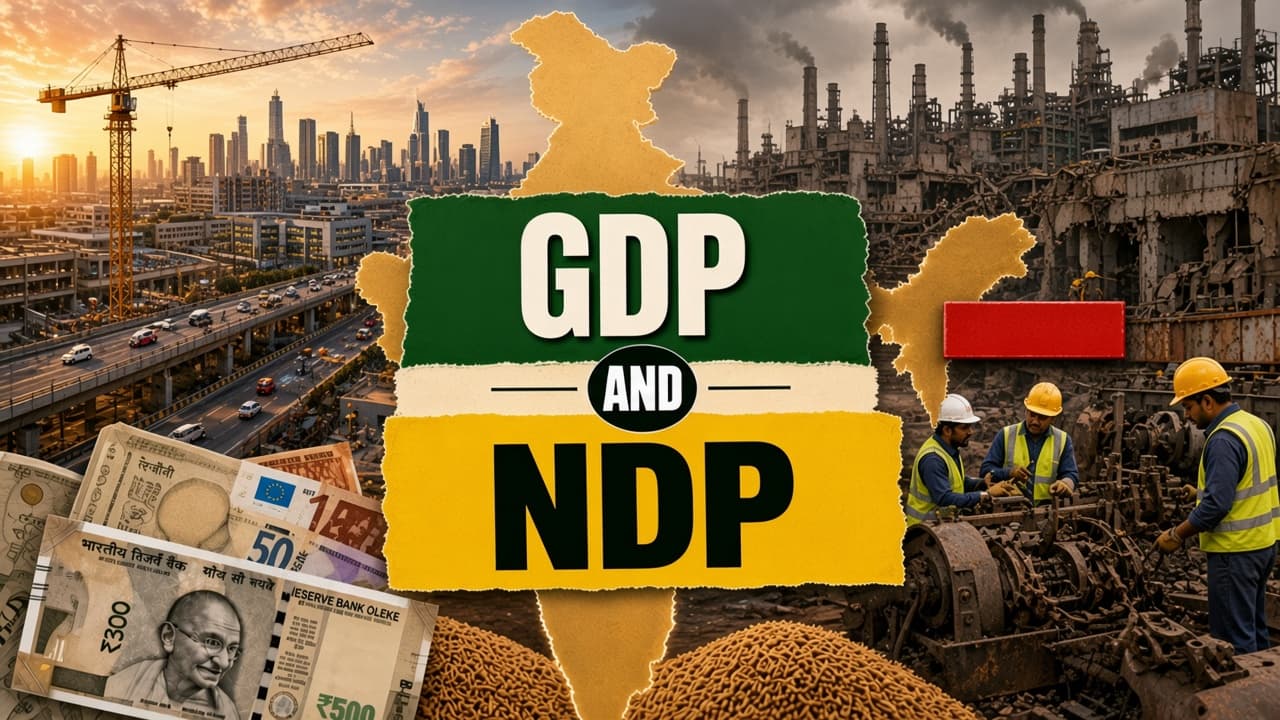
Gross Domestic Product (GDP) is the money value of final goods and services produced within India's borders. Net Domestic Product (NDP) is that total minus depreciation, the wear and tear of the capital used to produce it. GDP can look strong when old machines are run hard. NDP takes that wear off the total, so the figure shows the net addition to productive capacity. The expenditure formula for GDP is consumption plus investment plus government spending plus net exports. NDP is GDP minus depreciation.
Difference between GDP and NDP
| Feature | Difference Between GDP and NDP |
|---|---|
| Income | The starting domestic total |
| Prices | Real GDP uses base-year prices |
| Per head | GDP per capita is the figure most often cited |
| Publisher | NSO, Ministry of Statistics and Programme Implementation, quarterly and annual |
| Order | GDP is at least as large as NDP, because depreciation is positive |
| Welfare | The headline growth indicator |
At a glance
Depreciation
Left in the total
Measures
Gross production within the borders
Formula
C + I + G + (X - M)
Policy use
Headline growth and international comparison
Example
Tata Steel plant in Jamshedpur
The plant produces ₹10,000 crore of steel in a year, and that output counts in GDP. Furnaces, cranes, and trucks lose ₹1,200 crore of value through wear and tear. That loss is depreciation. NDP is ₹8,800 crore. A reader who stops at GDP overstates how much fresh productive capacity the economy added. For long-run growth, NDP, and then NNP, are the figures that net out this wear.
What this means for the exam
GDP is gross domestic output. NDP is GDP minus depreciation. The depreciation charge is capital consumed in production, and it is not a factor income paid to someone.
GDP
GDP is the gross measure. New government capital spending, such as a fresh highway, adds to it. NSO publishes the quarterly and annual estimates, and the per capita version is the one international comparisons usually quote. The expenditure side is consumption, investment, government spending, and net exports.
A decent GDP can sit next to a weaker NDP where infrastructure is ageing and replacement investment lags depreciation. The gross number still counts the old stock as if the wear had not happened. GDP at market prices is also the usual start of the domestic chain that later reaches national income.
NDP
NDP equals GDP minus depreciation, and depreciation here means consumption of fixed capital. It is always smaller than GDP, because the wear is a positive amount. NDP is never larger. Real NDP is real GDP minus depreciation measured at constant prices. NDP at factor cost is treated as close to the national income of residents on the domestic measure, and NDP per capita is the better comparison of welfare across years.
Depreciation of a road already built is a different entry from capital spending on a new one. Treating replacement of worn assets as expansion overstates net growth. NDP is the step that separates maintaining the capital stock from adding to it. The word depreciation in these accounts is accounting wear. It is a different idea from a fall in the rupee.
Key takeaway
NDP equals GDP minus depreciation, the consumption of fixed capital. It is the net domestic output that remains after that wear.
Difference between GDP and NDP FAQs
What is GDP?
GDP is the value of final goods and services produced inside India's borders. NSO publishes it quarterly and annually. Depreciation is left in the total, so the figure is gross.
What is NDP?
NDP is GDP minus depreciation, the consumption of fixed capital. It is the net output left after machines, roads, and other fixed capital have been allowed for.
What is the main difference between GDP and NDP?
GDP counts gross domestic production. NDP deducts depreciation. NDP is smaller than GDP whenever depreciation is positive, which it is in ordinary accounts.
Is NDP greater than GDP because it accounts for depreciation?
No. NDP equals GDP minus depreciation, so NDP is smaller than GDP. Depreciation is a positive charge for wear on fixed capital.
What does depreciation mean in national accounts?
It is the consumption of fixed capital during production, the wear and tear of machines and structures. It is an accounting entry, and it is a different idea from a fall in the currency.
Why look at NDP if GDP is the headline?
GDP can rise while old capital is wearing out. NDP shows the net addition to capacity. Where replacement investment lags depreciation, the gap between the two is a sustainability problem.
PYQ linkage
National Income at factor cost is equivalent to NNP at factor cost — correct?