
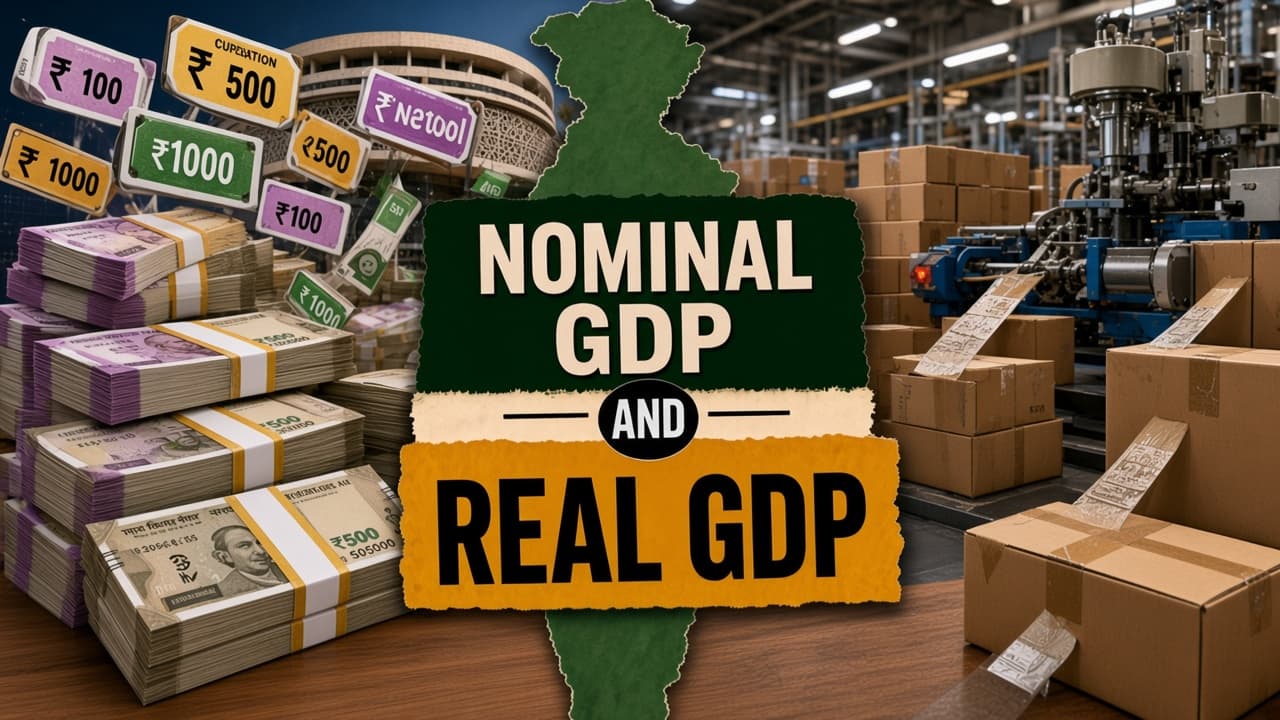
Nominal GDP is the value of final output counted at current market prices. Real GDP is the same output measured at the prices of a fixed base year, so inflation is taken out. The link between the two is the GDP deflator. If prices rise 10% and the number of cars and bags of wheat stays the same, nominal GDP rises and real GDP does not.
Difference between Nominal and Real GDP
| Feature | Nominal | Real GDP |
|---|---|---|
| Formula | The numerator of the GDP deflator | Real GDP equals nominal GDP divided by the GDP deflator, times 100 |
| Prices | Current-year market prices | Fixed base-year prices, the 2011-12 series in India |
| Inflation | Rises with prices even if output is flat | Separates quantity growth from inflation |
| Growth | Can overstate growth in a year of rising prices | The preferred figure for a year-on-year comparison of output |
| Purpose | The headline size of the economy | Growth targets and productivity |
| Publisher | NSO, Ministry of Statistics and Programme Implementation, quarterly and annual | NSO, Ministry of Statistics and Programme Implementation, derived with the GDP deflator |
At a glance
Prices used
Current year prices
Fixed base-year prices
Inflation
Left in the number
Removed through the GDP deflator
Use
Current size of the economy
A comparison of output over the years
Example
10 lakh widgets at ₹100, then ₹110
Last year the economy produced 10 lakh units at ₹100 each, so nominal GDP was ₹100 crore. This year it still produces 10 lakh units, and the price is ₹110, so nominal GDP is ₹110 crore. Real GDP, using the base-year price of ₹100, still counts ₹100 crore of output. The volume of production is unchanged. The 10% rise is only in money terms.
What this means for the exam
Nominal GDP can rise from inflation alone. Real GDP isolates the growth in quantity, using the GDP deflator.
Nominal GDP
Nominal GDP adds up final output at the prices of the year in question. It is the numerator of the GDP deflator. NSO publishes it quarterly and annually. Markets and the Budget use it as the current rupee size of the economy. A year of rising prices lifts the number even when factories and farms produce the same quantities.
Government and the RBI look to real growth for jobs and welfare, and they still watch nominal GDP for the rupee scale of the economy. In a developing economy that is usually inflating, nominal GDP is at least as large as real GDP. Real GDP above nominal GDP would suggest deflation, which is rare in India.
Real GDP
Real GDP values output at base-year prices. In the current Indian series the base is 2011-12. The working identity is real GDP equals nominal GDP divided by the GDP deflator, multiplied by 100. NSO derives the figure. Because prices are held constant, the growth rate tracks quantity, which is why it is used for growth targets and productivity.
Real GDP uses one country's own base-year prices. Purchasing power parity is a different comparison, across countries. Reading a rise in nominal GDP as a rise in production skips the deflator.
Key takeaway
Real GDP equals nominal GDP divided by the GDP deflator, multiplied by 100. It measures the growth in output after prices are held constant.
Difference between Nominal and Real GDP FAQs
What is nominal GDP?
Nominal GDP is the value of final output at current market prices. A rise in prices raises it even when the volume of production is unchanged. NSO publishes it quarterly and annually.
What is real GDP?
Real GDP is output measured at the prices of a fixed base year, 2011-12 in the current Indian series. Inflation is removed with the GDP deflator, so the figure tracks the volume of production.
What is the main difference between nominal GDP and real GDP?
Nominal GDP uses this year's prices and mixes price change with quantity change. Real GDP uses constant prices and shows whether production itself grew.
How is real GDP calculated from nominal GDP?
Real GDP equals nominal GDP divided by the GDP deflator, multiplied by 100. That is the standard national accounts identity.
Does real GDP above nominal GDP mean high inflation?
No. When prices are rising, nominal GDP is normally at least as large as real GDP. Real GDP above nominal GDP suggests deflation, which is rare in India.
Is real GDP the same as GDP at purchasing power parity?
No. Purchasing power parity compares countries. Real GDP uses a domestic base-year price to strip inflation out of one country's output.
PYQ linkage
Economic growth in India is usually accompanied by: