
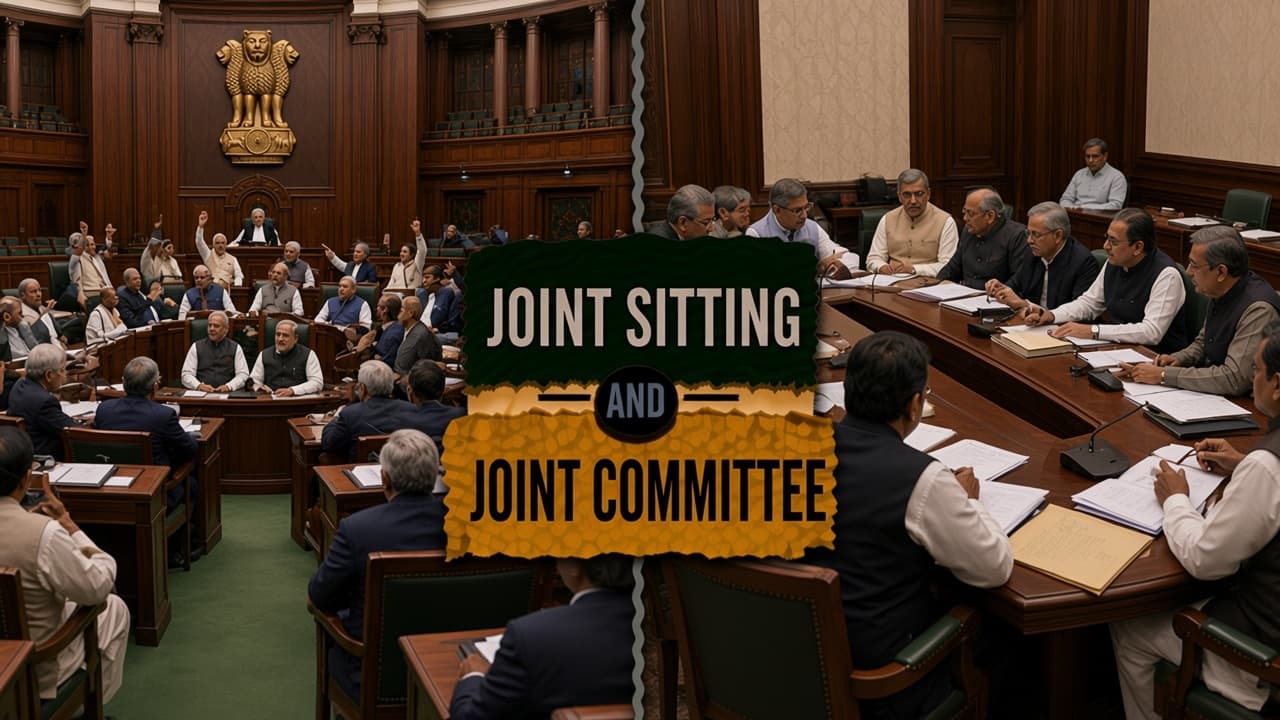
A joint sitting under Article 108 is a vote of both houses together, used to resolve a deadlock on an ordinary bill. The President summons it, and the Speaker usually presides. A joint committee is a body of members from both houses, set up under the rules or by a resolution, to scrutinise a bill or to investigate. A Joint Parliamentary Committee on 2G is an inquiry. It reports. It does not pass an Act. Money Bills and constitutional amendments cannot be rescued by a joint sitting. The President's address to both houses is a ceremonial joint session, not an Article 108 vote.
Difference between a joint sitting and a joint committee
| Feature | Joint Sitting | Joint Committee |
|---|---|---|
| Meaning | A combined vote of both houses on a deadlocked ordinary bill | A bicameral committee for scrutiny or inquiry |
| Law | Article 108; not available for Money Bills or constitutional amendments | Rules of Parliament and resolutions; no power to enact |
| Who | Usually the Speaker; otherwise the Deputy Speaker or the Deputy Chairman of the Rajya Sabha | A chair nominated from either house |
| Vote | Simple majority of the members at the sitting, subject to quorum | The committee votes on its report, not on national law |
| Examples | Dowry Prohibition Act, 1961, and POTA, 2002 | The Joint Parliamentary Committee on 2G, and scrutiny of a Waqf bill |
| Effect | Rare; the deadlock conditions must be met, including rejection or failure to return the bill | Common, both standing and ad hoc; reports are tabled, and the houses still have to act |
At a glance
Purpose
Break a bicameral deadlock on a bill
Examine a bill or investigate an issue
Constitutional basis
Article 108
Rules of the houses, or a resolution
Outcome
The bill may become law if it is passed
A report or a set of recommendations only
Money Bills
Not available
Not a route for passing a bill
Example
RS blocks a labour reform bill twice
The Lok Sabha passes a bill. The Rajya Sabha rejects it, or does not return it for six months, and the deadlock conditions of Article 108 are met. The government advises the President to summon a joint sitting. The combined membership votes, and a simple majority at that sitting can pass the bill. A Joint Parliamentary Committee on a telecom controversy is different. Members from both houses question witnesses and table a report. No vote in that committee turns the report into an Act.
What this means for the exam
A joint sitting is a legislative tie-breaker under Article 108. A joint committee investigates or scrutinises. It has no power of assent.
Joint sitting
Article 108 is available when the houses disagree on an ordinary bill in the ways the article describes, including rejection or a failure to return the bill within six months, and the disagreement has to meet the double-occasion conditions. The President summons the sitting. The Speaker normally presides. A simple majority of those voting at the sitting can pass the bill. The Dowry Prohibition Act, 1961, and POTA, 2002, are the historical examples. The device is rare.
Money Bills have no joint sitting. After 14 days the Lok Sabha prevails. A constitutional amendment must pass each house separately. Not every objection in the Rajya Sabha opens Article 108. The President's address to both houses is a joint session in the ceremonial sense. It is not this deadlock vote.
Joint committee
A joint committee draws members from both houses, often in a proportion that reflects the houses' strength. It may be standing or ad hoc. A Joint Parliamentary Committee gathers evidence, can summon officials, and tables a report. The 2G committee is the usual illustration. Scrutiny of a bill, including a Waqf bill, is the legislative-examination version. The report does not become law.
Action after a report depends on the government and on the houses. The committee has no power of assent. Calling every meeting of both houses a joint sitting flattens Article 108 into a slogan. Committees advise. The houses, or a joint sitting where it is allowed, enact.
Key takeaway
A joint sitting under Article 108 is a vote that can pass a deadlocked ordinary bill. A joint committee investigates or scrutinises, and it does not make law.
Difference between a joint sitting and a joint committee FAQs
What is a joint sitting?
A joint sitting under Article 108 is a meeting of both houses, summoned by the President, to vote on an ordinary bill that has deadlocked. A simple majority at the sitting can pass the bill.
What is a joint committee?
A joint committee is a parliamentary body with members from both houses. It scrutinises a bill or investigates an issue and tables a report. It does not enact law.
What is the main difference between a joint sitting and a joint committee?
A joint sitting can pass a deadlocked ordinary bill. A joint committee can only recommend. Article 108 is a vote. A committee is an inquiry or a scrutiny.
Can a joint sitting be used to pass a Money Bill that the Rajya Sabha has blocked?
No. There is no joint sitting for a Money Bill. The Lok Sabha prevails after 14 days.
Can a Joint Parliamentary Committee pass a bill into law without the houses?
No. A committee recommends. Only the houses, or a joint sitting where Article 108 allows it, enact a law.
Is the President's address to both houses an Article 108 joint sitting?
No. That address is ceremonial. An Article 108 sitting is a vote on a deadlocked ordinary bill.