
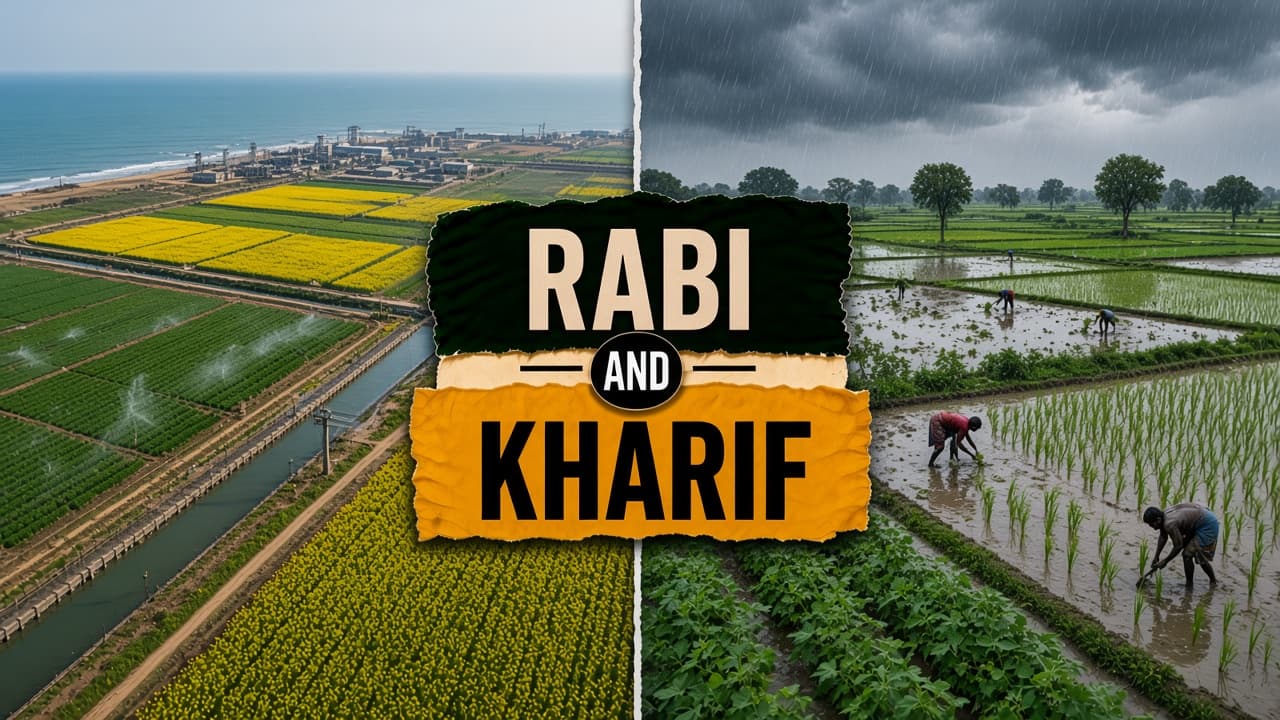
Kharif crops are sown with the southwest monsoon, in June and July, and harvested in autumn. Rice, cotton, and maize are the usual examples. Rabi crops are sown in winter, from October to December, and harvested in spring. Wheat, mustard, and gram rely on irrigation and on moisture left in the soil after the rains. Kharif is the rainy-season cycle. Rabi is the winter cycle.
Difference between Rabi crops and Kharif crops
| Feature | Rabi Crops | Kharif Crops |
|---|---|---|
| Meaning | Monsoon-season crop cycle, sown with the rains | Winter-season crop cycle, sown after the rains |
| When | Sown June to July; harvested September to October | Sown October to December; harvested March to April |
| Crops | Rice, maize, cotton, jowar, soyabean, groundnut | Wheat, barley, mustard, gram, peas |
| Water | A delayed or weak monsoon hits sowing directly | Depends on reservoir recharge, canals, and residual moisture |
| Where | Eastern UP and Bihar rice; Gujarat cotton | Punjab-Haryana wheat belt; mustard in Rajasthan |
| Policy | Monsoon forecast and kharif MSP for paddy, cotton, and similar crops | Rabi MSP for wheat and chana; canal water is a priority |
At a glance
Sowing period
June to July, with the monsoon
October to December, after the monsoon
Harvest
September to October
March to April
Water source
Rainfall is the main source
Irrigation plus residual soil moisture
Major crops
Rice, maize, cotton, jowar, groundnut
Wheat, barley, mustard, gram, peas
Example
Punjab farmer’s calendar
In June, after the monsoon begins, a Punjab farmer may sow cotton or rice. Those are Kharif crops. After the harvest in October, the same fields are prepared for wheat sown in November. Wheat is a classic Rabi crop, watered from canals and tubewells. One piece of land carries two seasons and two crop groups, tied to when water is available.
What this means for the exam
Kharif is the monsoon-fed season. Rabi is the winter season, and it often depends on irrigation.
Kharif crops
Kharif crops go into the ground with the southwest monsoon. Sowing is in June and July, and harvest runs through September and October. Rice, maize, cotton, jowar, soyabean, and groundnut belong here. A late or failed monsoon hits this season directly. Eastern Uttar Pradesh and Bihar are rice tracts. Gujarat is a cotton example. MSP for the kharif marketing season covers crops such as paddy and cotton.
The word kharif is associated with the autumn crop, but the sowing date follows the June and July rains. Food security and drought relief treat a failed Kharif as a shock to rice and to several pulses, which is a different problem from a Rabi wheat shortfall. Zaid, the short summer season of watermelon, cucumber, and moong on irrigated plots, sits between Rabi harvest and the next Kharif sowing. It is a third season, not part of either main cycle.
Rabi crops
Rabi crops are sown from October to December and harvested from March to April. Wheat, barley, mustard, gram, and peas are the set to remember. They use water left in the soil and water from canals and tubewells. A Punjab farmer who harvests rice or cotton in October and then sows wheat in November is moving from Kharif to Rabi on the same land. The Green Revolution's wheat focus sits in this winter cycle, while rice dominates eastern Kharif belts.
The link to the monsoon is indirect. Reservoirs have to have been filled. Winter cold waves and a short canal supply both hurt the crop. Rabi MSP covers wheat and chana. Wheat is not a Kharif crop in India. Rice on the Gangetic plain is not treated as Rabi for exam purposes.
Key takeaway
Kharif crops are the monsoon-season crops, including rice and cotton. Rabi crops are the winter crops, including wheat and mustard.
Difference between Rabi crops and Kharif crops FAQs
What are Rabi crops?
Rabi crops are sown in winter, from October to December, and harvested in spring, from March to April. Wheat, barley, mustard, and gram are the main examples. They depend on irrigation and residual soil moisture.
What are Kharif crops?
Kharif crops are sown with the southwest monsoon, in June and July, and harvested in autumn. Rice, maize, cotton, and soyabean are typical. Rainfall is the main water source.
What is the main difference between Rabi crops and Kharif crops?
Kharif is the monsoon season and Rabi is the winter season. Rice and cotton are Kharif. Wheat and mustard are Rabi. Water, sowing dates, and the MSP calendar follow that split.
Is wheat a Kharif crop in India?
No. Wheat is the flagship Rabi crop. It is sown in winter and harvested in spring.
Are Kharif crops sown with the southwest monsoon?
Yes. Kharif sowing lines up with the June and July rains. The season name is linked to the autumn harvest.
What is the Zaid season?
Zaid is the short summer season between Rabi harvest and Kharif sowing. Farmers grow crops such as watermelon, cucumber, and moong on irrigated plots.
PYQ linkage
Which of the following are Rabi crops? Wheat, Rice, Mustard, Cotton