
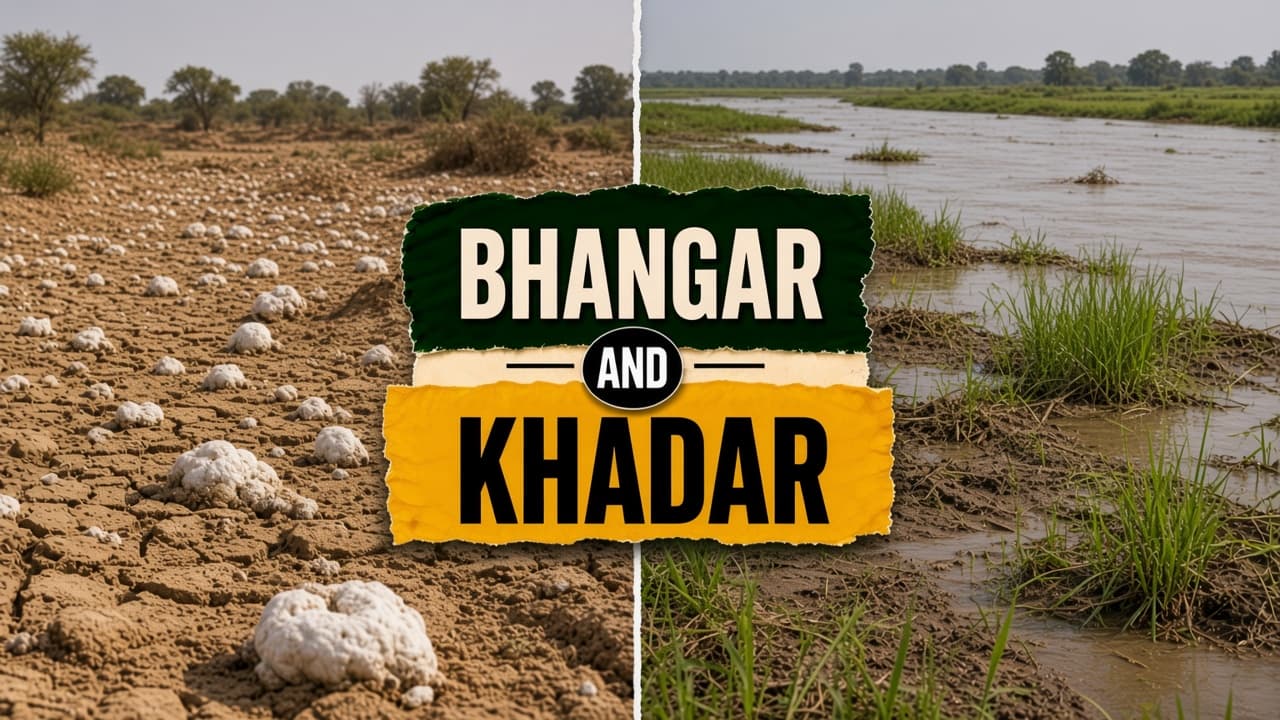
Bhangar is older alluvium on the uplands between rivers, away from the active channel, and it often contains calcareous kankar nodules. Khadar is newer floodplain alluvium that rivers deposit in each flood season, renewing the silt along the banks. The Indo-Gangetic plain is divided into these two tracts: the older terrace and the younger floodplain.
Difference between Bhangar and Khadar
| Feature | Bhangar | Khadar |
|---|---|---|
| Meaning | Older alluvium on river terraces | Newer alluvium on the active floodplain |
| Where | Interfluves, away from the channel; UP and Bihar uplands | Banks of the Ganga, Brahmaputra, and similar rivers |
| Soil | Clay with kankar nodules, less uniform | Fine silt, sand, and clay, well sorted by floods |
| Farming | Wheat and millets with irrigation; kankar can block roots | Intensive rice, wheat, sugarcane, and vegetables |
| Floods | Lower flood risk; better natural drainage on the upland | Higher flood risk; poor drainage in the low floodplain |
| Effect | Older towns sit on slightly higher ground | Settlements often run in a line along the river; silt renews fertility each flood |
At a glance
Age of alluvium
Older, from the Pleistocene into the older Holocene
Newer deposits on the active floodplain
Location
Interfluve uplands, away from the channel
Along river banks, on the active floodplain
Fertility
Lower; kankar, or calcrete, is common
Higher; fresh silt arrives each flood season
Flood risk
Lower
Higher, because annual inundation is possible
Example
Yamuna belt near Delhi
Villages on the raised land between the Yamuna and the Hindon sit on Bhangar. The soil is older, farmers irrigate with tubewells, and kankar layers are common. Along the active Yamuna channel, Khadar fields receive fresh silt in each monsoon flood. That silt suits vegetables and wheat, and the same fields can go under water.
What this means for the exam
Khadar is young, fertile, and exposed to floods. Bhangar is older upland alluvium, often rich in kankar.
Bhangar
Bhangar is the older alluvial terrace. Its age runs from the Pleistocene into the older Holocene. It lies on the interfluve, away from the channel that is shifting now. Clay and calcareous kankar are typical. Kankar limits how water moves through the soil and can block roots, so farmers break the pans or depend on tubewells. Fertility is lower than on the young floodplain.
Bhangar plains of Uttar Pradesh and the Bihar uplands are the regional examples. Near Delhi, villages between the Yamuna and the Hindon sit on this older soil. Flood risk is lower, and drainage on the upland is better. Land revenue history and tubewell expansion under the Green Revolution mapped onto these blocks in a different way from the riverine belts.
Khadar
Khadar is newer floodplain alluvium. It is not an older deposit from before the Pleistocene. Each flood brings fresh silt, which is why these tracts stay fertile. Fine silt, sand, and clay are well sorted. Rice, wheat, sugarcane, and vegetables are grown intensively along the Ganga and the Brahmaputra. The same renewal brings inundation.
A memory aid used in class is that khadar sits on the river bank, the khad, where new silt lands. Thick kankar layers are absent, so root penetration is easier than on Bhangar, even though the flood hazard is higher. Settlements tend to follow the river. Flood zoning has to treat these belts as land that the river still rebuilds.
Key takeaway
Bhangar is older upland alluvium, often with kankar. Khadar is newer floodplain silt, and it is more fertile.
Difference between Bhangar and Khadar FAQs
What is Bhangar?
Bhangar is older alluvium on the uplands between rivers. It often contains kankar, calcareous nodules, and it is less fertile than the active floodplain.
What is Khadar?
Khadar is newer alluvium on the active floodplain. Rivers renew it with fresh silt in each flood, which keeps it fertile and also flood-prone.
What is the main difference between Bhangar and Khadar?
Bhangar is the older upland deposit, often with kankar. Khadar is the younger floodplain deposit, renewed by silt. Khadar is more fertile and more exposed to floods.
Is Khadar made of older alluvium deposited before the Pleistocene?
No. Khadar is newer floodplain alluvium. Bhangar is the older upland deposit.
Are Khadar soils renewed by floods?
Yes. Periodic floods bring fresh silt to Khadar tracts, which is why they stay fertile.
What is kankar, and where is it found?
Kankar is a calcareous concretion, or calcrete, common in Bhangar. It can limit drainage and root growth. Khadar lacks thick kankar layers.
PYQ linkage
Khadar lands in North India are characterised by: