
Rupee depreciation against the dollar comes from dollar strength, oil and gold imports, and capital outflows — RBI can smooth, not reverse, the slide.
(Editorial Team)
UPSCYatra’s editorial team researches and publishes syllabus guides, exam trends, previous years' questions analysis, and conceptual deep-dives for serious UPSC aspirants.
Valid till Mains 2027
You check your phone and the notification says: rupee hits new low against the dollar.
If you are not travelling abroad, you might wonder why it matters. You earn in rupees. You shop in rupees. The dollar feels like someone else's problem.
But within weeks, that number shows up elsewhere — imported gadget prices, petrol at the pump, the EMI on anything tied to global costs, even the inflation print. India buys a huge share of what it consumes from abroad, and almost all of it is priced in dollars.
So when the rupee falls — when it takes more rupees to buy one US dollar — it is not just a forex-trader headline. It is an everyday economy story.
In one line
Rupee depreciation means it takes more rupees to buy one dollar — usually because of a strong US dollar, a heavy import bill for oil and gold, or foreign capital leaving, while RBI can only smooth the fall.
The is simply a price. USD/INR = 94 means one US dollar costs ninety-four rupees.
When that number rises — from 84 to 94 — the rupee has (weakened). When it falls — from 94 to 84 — the rupee has (strengthened).
India follows a system. The rate is set mainly by supply and demand in the forex market, but the RBI can step in to dampen violent swings. It is neither a fixed rupee peg of the 1960s nor a completely hands-off float.
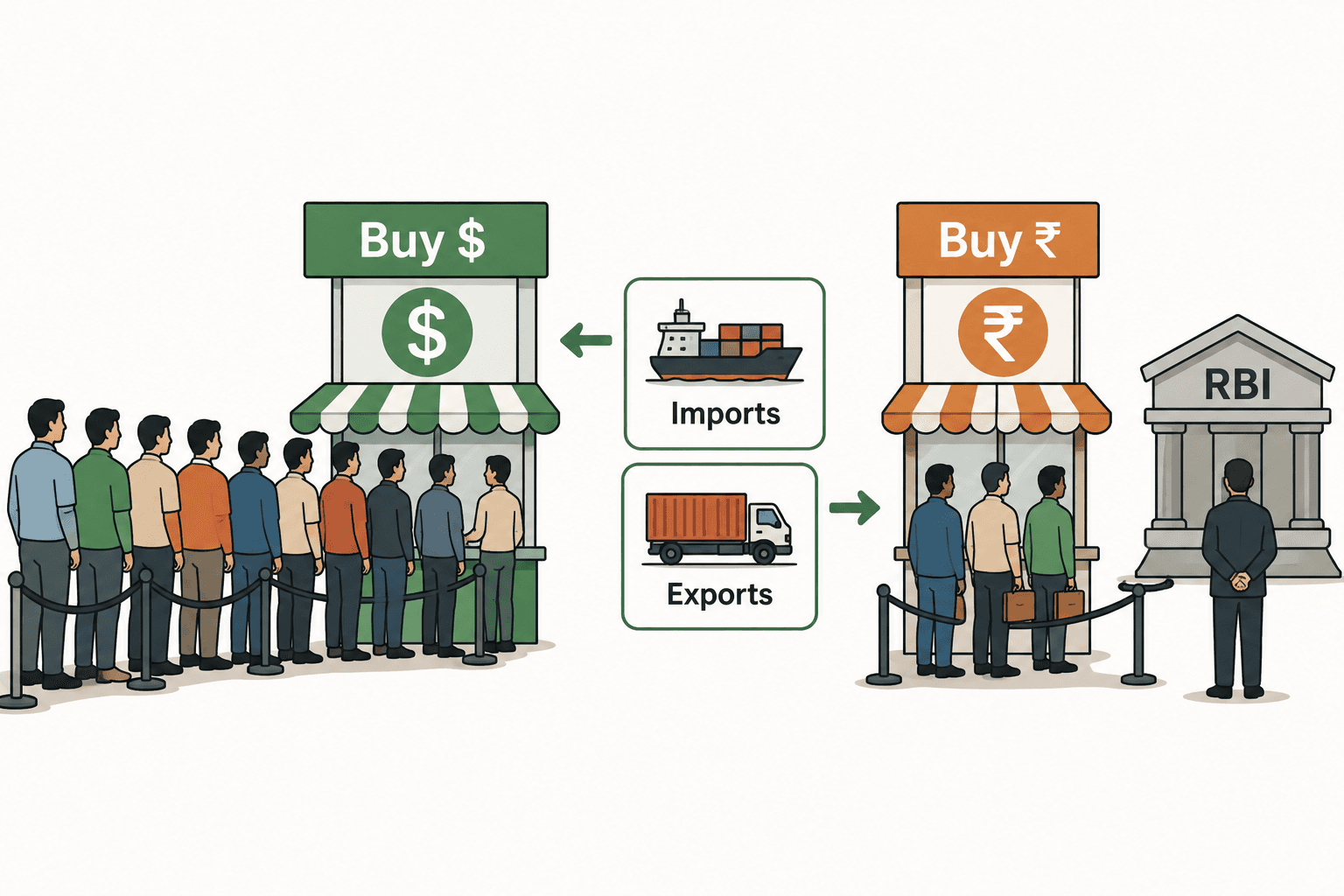
Think of dollars and rupees like two currencies at a busy market stall. If more people queue to buy dollars than to buy rupees, the dollar's price in rupees goes up. The rupee "falls."
That queue length changes every day — with oil shipments, export orders, foreign investment flows, and global risk sentiment.
The chart below shows the long drift: after hovering near ₹65–70 in the late 2010s, the rupee crossed ₹80 in 2022–2023, averaged about ₹87 in 2025, and has pushed toward ₹93+ (year-to-date) by mid-2026.
Annual average USD/INR exchange rates (2026 = year-to-date through May), rounded for illustration. Intra-year highs and lows can differ; RBI reference rates are the official benchmark. Source: FRED AEXINUS / RBI.
There were brief periods of stability — even mild appreciation — when the dollar weakened or capital inflows were strong. But the broad direction since 2020 has been more rupees per dollar, not fewer.
Not every rupee move is Made in India. Often the rupee weakens because the US dollar itself is strengthening against almost every currency.
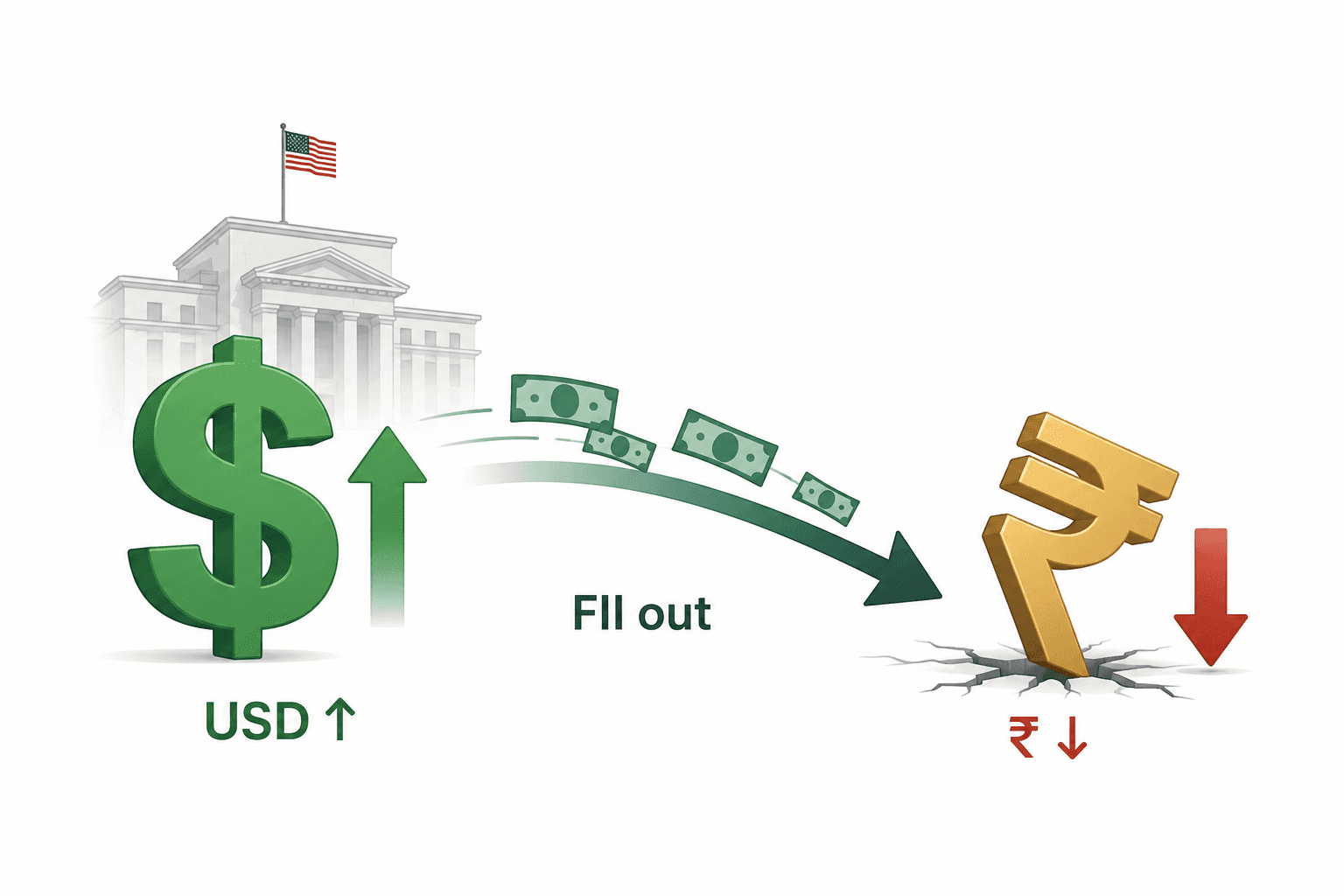
When the US Federal Reserve keeps interest rates high, US government bonds offer solid returns with low perceived risk. Global investors sell assets in emerging markets — including India — and park money in dollar assets.
That triggers outflows: foreign institutional investors (FIIs/FPIs) sell Indian stocks and bonds, convert rupees to dollars, and repatriate funds. Each conversion adds selling pressure on the rupee.
Geopolitical shocks and safe-haven demand can produce the same pattern even without a rate hike — money flees to the dollar as the world's default reserve currency.
The Dollar Index (DXY) — the dollar measured against a basket of major currencies — is the quick global pulse. When DXY rises, the rupee often struggles even if India's own fundamentals have not changed much.
India runs a structural — it imports more goods than it exports. That gap must be paid in foreign exchange, mostly dollars.
Every import order works the same way at the margin: an Indian refiner, jeweller, or phone assembler needs dollars to pay the foreign supplier. They sell rupees in the forex market to buy those dollars. Heavy import months mean heavy dollar demand — and a weaker rupee.
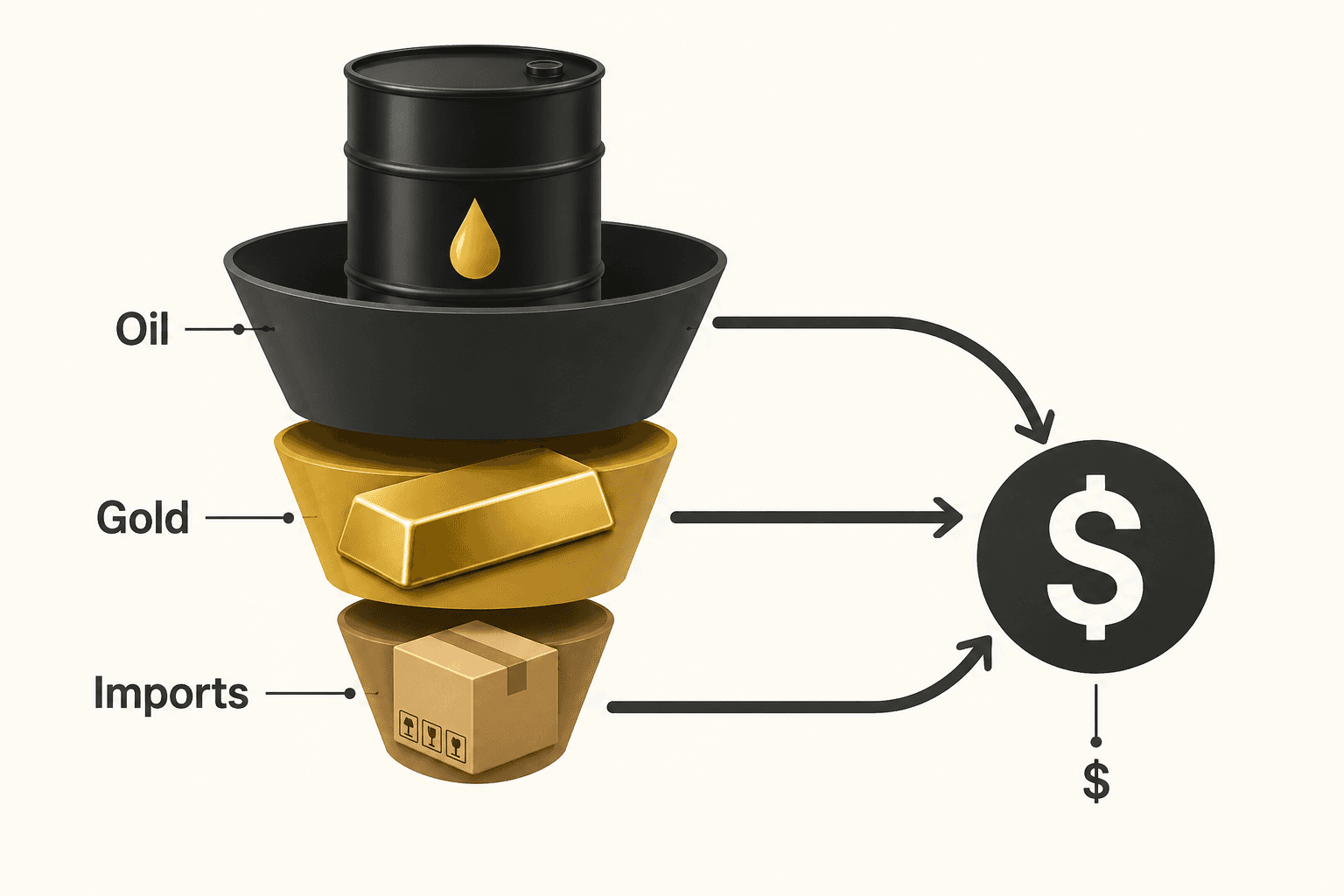
The is not one line item. It is the sum of everything India buys abroad — and two categories dominate the conversation.
is India's largest import by value. We import roughly 80% of our petroleum needs. Oil is priced in dollars on global markets.
When crude prices rise — or when India imports larger volumes — the dollar bill swells. Importers scramble for dollars; the rupee comes under pressure. This is why geopolitical tension in the Middle East or OPEC supply cuts can move the rupee within days.
Petrol and diesel prices at your local pump are only partly insulated by government policy; the underlying dollar-and-crude math still flows through eventually.
Gold is typically India's second-largest import. As we explain in why gold prices are rising to record highs, record global bullion prices mean each tonne imported costs more dollars — even if volumes stay flat.
Wedding-season demand and festival buying concentrate imports in a few weeks, creating sharp seasonal dollar demand. Gold and oil together are the twin engines of India's merchandise import bill.
A persistent trade deficit feeds into the broader when net services earnings and remittances do not fully offset the goods gap. A country running a current account deficit needs continuous dollar inflows — from exports, investment, or loans — or it must draw down .
The other side of the ledger supports the rupee.
When Tata Steel ships to Europe, Infosys bills a US client, or a Surat diamond merchant exports to Dubai, payment arrives in dollars (or gets converted to dollars). Exporters sell those dollars for rupees — adding rupee demand and dollar supply.
India's services exports — IT, business process outsourcing, consulting — are a structural strength. They bring in tens of billions of dollars annually and partly balance the goods deficit.
Strong export growth can stabilise or strengthen the rupee even when oil is expensive. Weak export months — or a global recession that kills orders — remove that support.
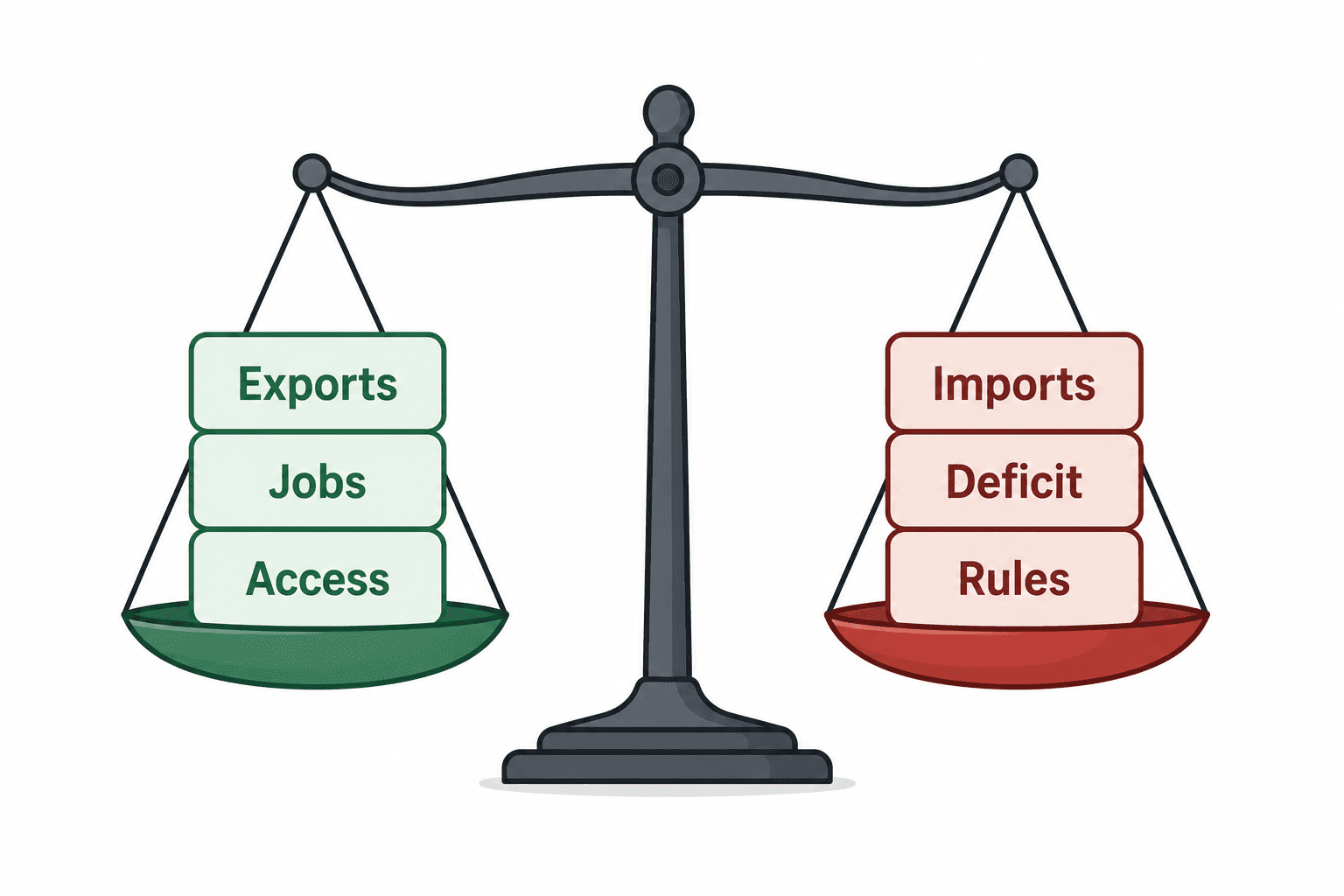
This is also why the government's FTA push matters: cheaper access to foreign markets helps exporters earn more dollars, which indirectly defends the rupee.
When the rupee slides too fast, the Reserve Bank of India enters the forex market — not to fix a permanent rate, but to reduce disorderly volatility.
The mechanics are straightforward: RBI sells dollars from its reserves and buys rupees. That extra dollar supply in the market eases upward pressure on USD/INR — the rupee stops free-falling, at least temporarily.
RBI also uses forward-market operations — commitments to deliver dollars later — to signal stability without immediately draining reserves.
India holds $600 billion-plus in (foreign currency assets, gold, SDRs, IMF position). That buffer is large by historical standards, but it is finite. Every intervention shrinks it. RBI cannot sell dollars forever without rebuilding them through export earnings or fresh inflows.
Other RBI tools include special deposit schemes for NRIs (historically FCNR-B) that attract dollar deposits during stress, and monetary policy signalling — rate decisions that influence whether foreign capital finds India attractive.
Beyond your checklist, these channels often decide whether the rupee stabilises or keeps slipping.
FII/FPI flows. Portfolio money is hot — it enters fast in risk-on years and leaves fast when global fear rises. A single month of heavy FII selling can outweigh weeks of steady export earnings.
FDI vs portfolio flows. Foreign direct investment (factories, long-term stakes) is stickier and more rupee-friendly than portfolio flows, but it moves slowly.
NRI remittances. India is the world's largest remittance recipient. Dollars sent home by workers abroad support the rupee — a quiet but powerful stabiliser, especially for Kerala and other remittance-heavy states.
Inflation differential. If Indian inflation runs hotter than US inflation for years, the rupee tends to lose purchasing power in real terms — even if the nominal rate looks stable.
(NEER). The rupee–dollar rate is headline news, but RBI also tracks the rupee against a basket of trading-partner currencies. A stable NEER with a rising dollar can mean the rupee is actually holding up well against euros, yen, and pounds — even as USD/INR climbs.
Imported inflation pass-through. A weaker rupee makes every dollar-priced import costlier in rupee terms — which can feed CPI inflation, especially for fuel and imported components. That is why RBI watches forex and inflation together.
Map this story to syllabus blocks you already study.
External sector — balance of payments, current account, capital account, trade deficit, exchange rate regimes (fixed, floating, managed float).
Forex reserves — composition, adequacy ratios (import cover months), RBI's role as custodian.
Monetary policy — repo rate, interest-rate differential with the US Fed, inflation targeting, and how rate hikes can attract capital to support the rupee.
International trade — import dependence (oil, gold, electronics), export promotion, FTAs as a dollar-earning strategy.
Institutions — RBI, Ministry of Finance, FEDAI (interbank forex reference rates).
Contemporary issues — rupee depreciation and study-abroad costs, imported inflation, FII flow data in business newspapers, and India's push for rupee trade settlement with select partners (rupee invoicing) to reduce dollar dependence.
A crisp Prelims-ready distinction: depreciation is market-driven under a float; devaluation is a policy decision under a fixed regime. India today experiences depreciation, not official devaluation.
A strong US dollar, large dollar demand for oil and gold imports, weaker export earnings, and foreign portfolio outflows are the usual drivers. Together they raise USD/INR — meaning the rupee has depreciated.
It means the exchange rate (USD/INR) has risen — you need more rupees to buy one US dollar. Economists call this rupee depreciation. Imports priced in dollars become costlier in rupee terms; exporters who earn in dollars benefit.
When the dollar strengthens globally — often due to high US interest rates or safe-haven demand — investors move money into US assets. They sell emerging-market holdings, convert local currencies to dollars, and the rupee faces selling pressure even if India's domestic economy is stable.
India imports most of its oil in dollars. When crude prices rise or import volumes increase, Indian refiners need more dollars to pay suppliers. Higher dollar demand in the forex market tends to weaken the rupee.
Gold is a major dollar-denominated import for India. When global gold prices hit record highs or festival-season demand surges, the dollar outflow for bullion imports rises — adding pressure on the rupee, similar to the oil channel.
RBI intervenes in the forex market by selling US dollars from its foreign exchange reserves and buying rupees. This adds dollar supply and can slow rupee depreciation. RBI may also use forward-market operations and NRI deposit schemes during stress.
No. RBI can smooth excessive volatility and build confidence, but it cannot permanently fight global dollar strength or a structural current account deficit without exhausting reserves. Sustainable rupee stability requires export growth, capital inflows, or lower import dependence.
It connects GS-III Economy topics: exchange rate regimes, balance of payments, forex reserves, trade deficit, monetary policy, capital flows (FII/FDI), imported inflation, and RBI's role. Questions often test depreciation vs devaluation, NEER/REER, or the impact of oil prices on the external sector.