
Rainbow formation needs refraction, dispersion, and internal reflection in raindrops — and the sun behind you facing the rain. Diagrams for UPSC geography.
(Editorial Team)
UPSCYatra’s editorial team researches and publishes syllabus guides, exam trends, previous years' questions analysis, and conceptual deep-dives for serious UPSC aspirants.
Valid till Mains 2027

You have probably seen it a hundred times without asking the question. The rain eases. The sun peeks out. And suddenly there is a glowing arc of colour hanging in the sky.
But here is the odd part. You never see that arc when you are facing the sun. You see it when the sun is at your back, and the rain is still hanging in the air in front of you.
So why does a rainbow insist on this exact arrangement? Why not when you look toward the bright sun? Why not on a clear afternoon with no rain at all?
Rainbow formation happens when raindrops refract, disperse, and internally reflect sunlight back to your eyes — so you only see the arc when the sun is behind you and the rain is ahead.
That is really the whole secret. Everything else is just that one idea playing out. Sunlight enters a drop. The drop bends it. The drop reflects it. And your eye catches the colours only when you stand with your back to the sun.
Let's walk through it step by step.
In one line
Rainbow formation needs refraction, dispersion, and internal reflection in raindrops — and you only see the arc when the sun is behind you and rain is ahead.
A is a curved band of colours you see in the sky when sunlight hits falling raindrops at the right angle. It is not a solid thing. You cannot fly up and touch it. Move a few steps, and the rainbow you see is made by a slightly different set of drops.
Think of it as a private light show. The raindrops act like tiny glass beads. Each drop catches white sunlight, splits it into colours, and sends a little of that colour back toward whoever is standing in the right spot.
You will notice a few things every time one shows up:
In India, you will spot this after monsoon showers, after a Kalbaisakhi evening storm clears, or when the sun breaks through during a light afternoon rain over the plains. Basically anywhere sunlight and raindrops share the sky for a few minutes.
And this is not the same as the colourful rings you sometimes see around the sun or moon in thin ice-cloud. A rainbow is made by liquid raindrops close to the ground. The light has to travel through those drops and bounce back to you.
If you have watched an evening thunderstorm fade at dusk, you already know the setup: wet air in front, softer sunlight behind. That is rainbow weather.
You see a rainbow only with the sun behind you because sunlight must reach the raindrops, turn around inside them, and travel back to your eyes. That bounce-back path lines up when the sun is at your back, the rain is ahead, and you stand in the middle.
Think of a raindrop as a tiny mirror-ball for light.
Light travels in straight lines until something bends or bounces it. For you to see a rainbow, sunlight must reach the drop, turn around inside it, and come back toward your eyes. That return trip only works if the sun is behind you.
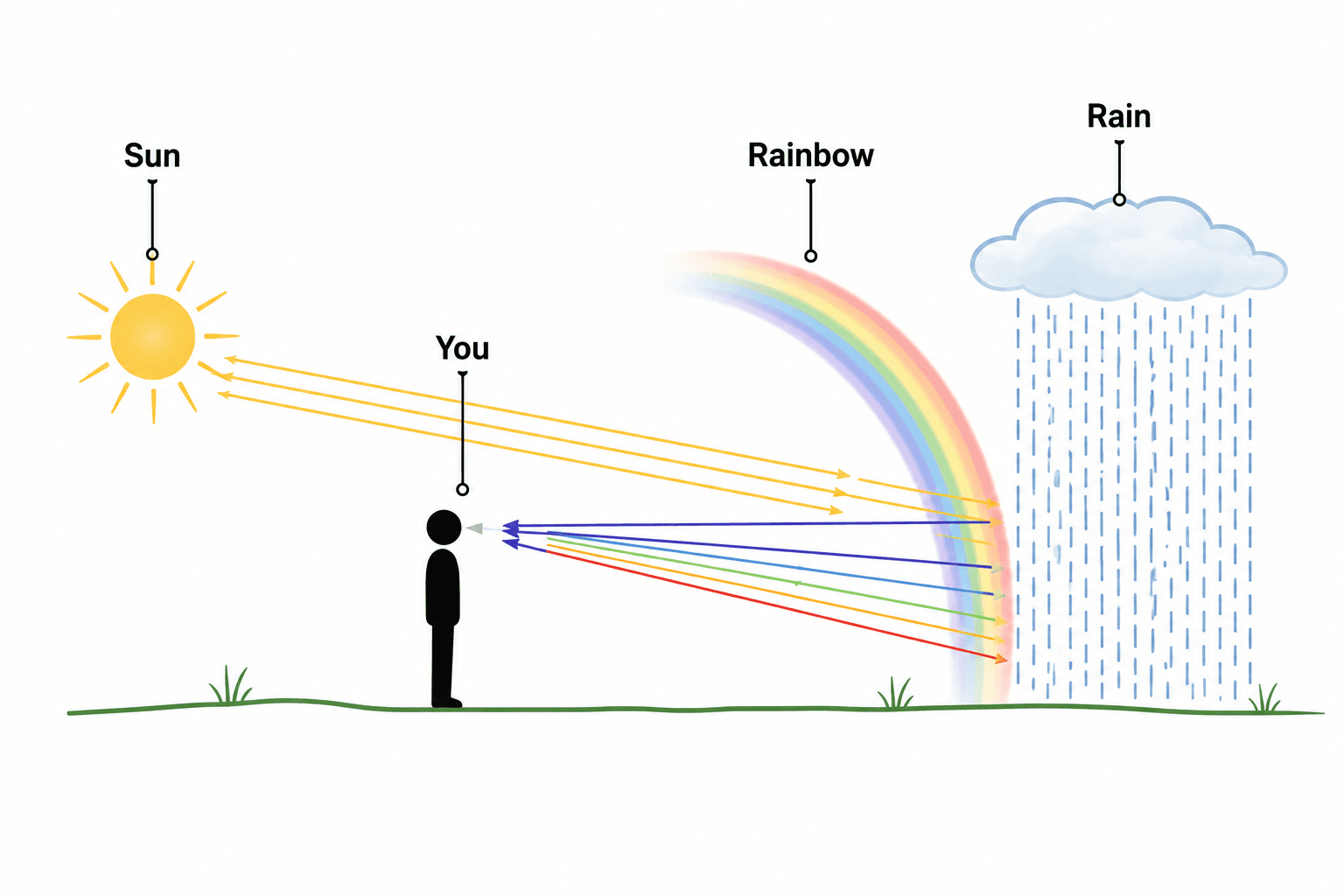
Here is the lineup:
If you turn around and look toward the sun, you are staring at the light source itself. The raindrops behind you are not bouncing that light into your face as a neat coloured arc. You might see glare, clouds, or even a bright sky — but not the classic rainbow.
Three things make the geometry even clearer:
Scientists talk about the and a roughly 42-degree viewing angle for the main rainbow, but you do not need the number to picture it. Stand with your back to the sun, face the rain, and you are already in the right theatre seat.
Rainbow formation is due to three linked steps inside each raindrop: , , and . Light bends as it enters water, splits into colours, bounces off the back of the drop, then bends again as it leaves — and different colours bend by slightly different amounts.
Sunlight looks white, but it is really a mix of many colours packed together. A raindrop sorts them out.
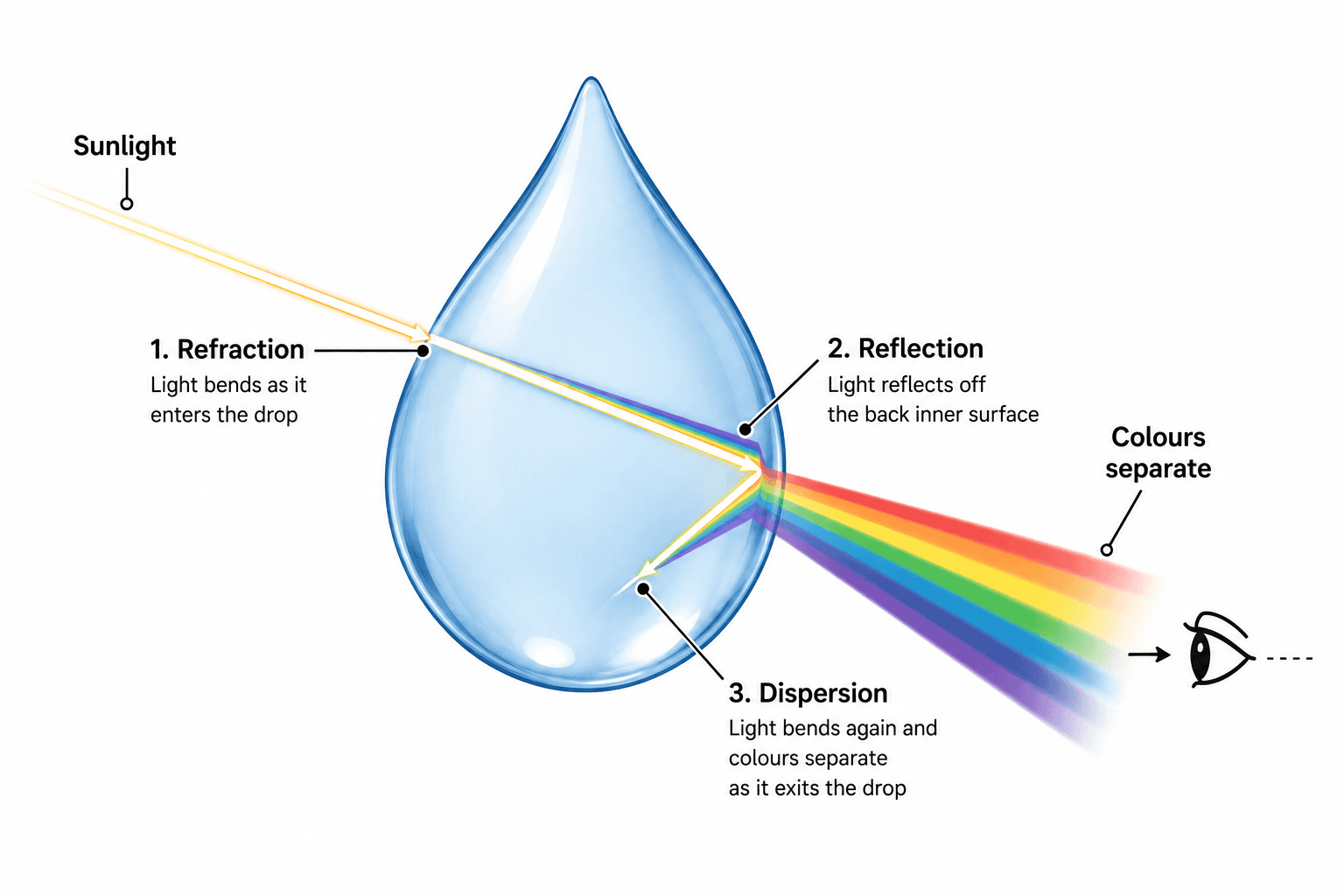
Here is what happens inside one drop, one step at a time:
By the time the light reaches your eye, the colours that started together have been pulled apart into the familiar band: red, orange, yellow, green, blue, indigo, violet.
You already know a simpler version of this. When sunlight hits a glass prism or a CD, you see coloured streaks for the same reason: white light is a mixture, and different colours take slightly different paths when they bend.
The fancy name for sunlight splitting into its colours is . The everyday name is: the drop is sorting the light.
A rainbow looks like an arc from the ground because every raindrop that can send colour to your eye sits on a cone of directions around the line from the sun through your head — and the ground usually hides the lower half of that cone.
Every raindrop that can send colour to your eye sits on a cone of directions around the line from the sun through your head. From the ground, you usually see only the top half of that cone — so the rainbow looks like an arch.
The ground cuts off the bottom. If you were high enough, say in an aeroplane looking down on rain with the sun behind you, you could sometimes see a full circle. From a field or a terrace, you get the familiar half-circle resting on the horizon.
That is also why the rainbow seems to move when you move. It is not attached to a hill or a tree. It is a set of directions relative to you and the sun. Change your place, and a new set of drops plays the same trick.
Rainbow formation needs two ingredients at once: sunlight and raindrops. That combination is commonest when the sun is low enough in the sky — morning or late afternoon — and a shower is ending or still falling nearby. The observer must stand with the sun behind and the rain ahead.
| Situation | What you usually get |
|---|---|
| Rain ahead, sun behind, late afternoon | Bright primary rainbow |
| Clear sky, no rain | No rainbow |
| Facing the sun into heavy rain | Glare and wet sky, not the classic arc |
| Midday sun almost overhead | Rare — the geometry is awkward from the ground |
In India, the monsoon months are rich in these moments. A cell of rain passes. The western sky opens. Light floods in from behind you. The eastern sky is still wet. And the arc appears.
The same timing often follows an evening thunderstorm: the heat-built storm breaks, the cloud thins, and for a few minutes sunlight and leftover rain share the air. That is why a rainbow after a storm feels like a quiet ending to a noisy afternoon.
The is the bright inner arc (usually one reflection inside the drop, red outside). The is the fainter outer arc (two reflections, colours reversed). Both still need the sun behind you and rain ahead.
Sometimes you see that second, fainter arc outside the first one after a heavy shower.
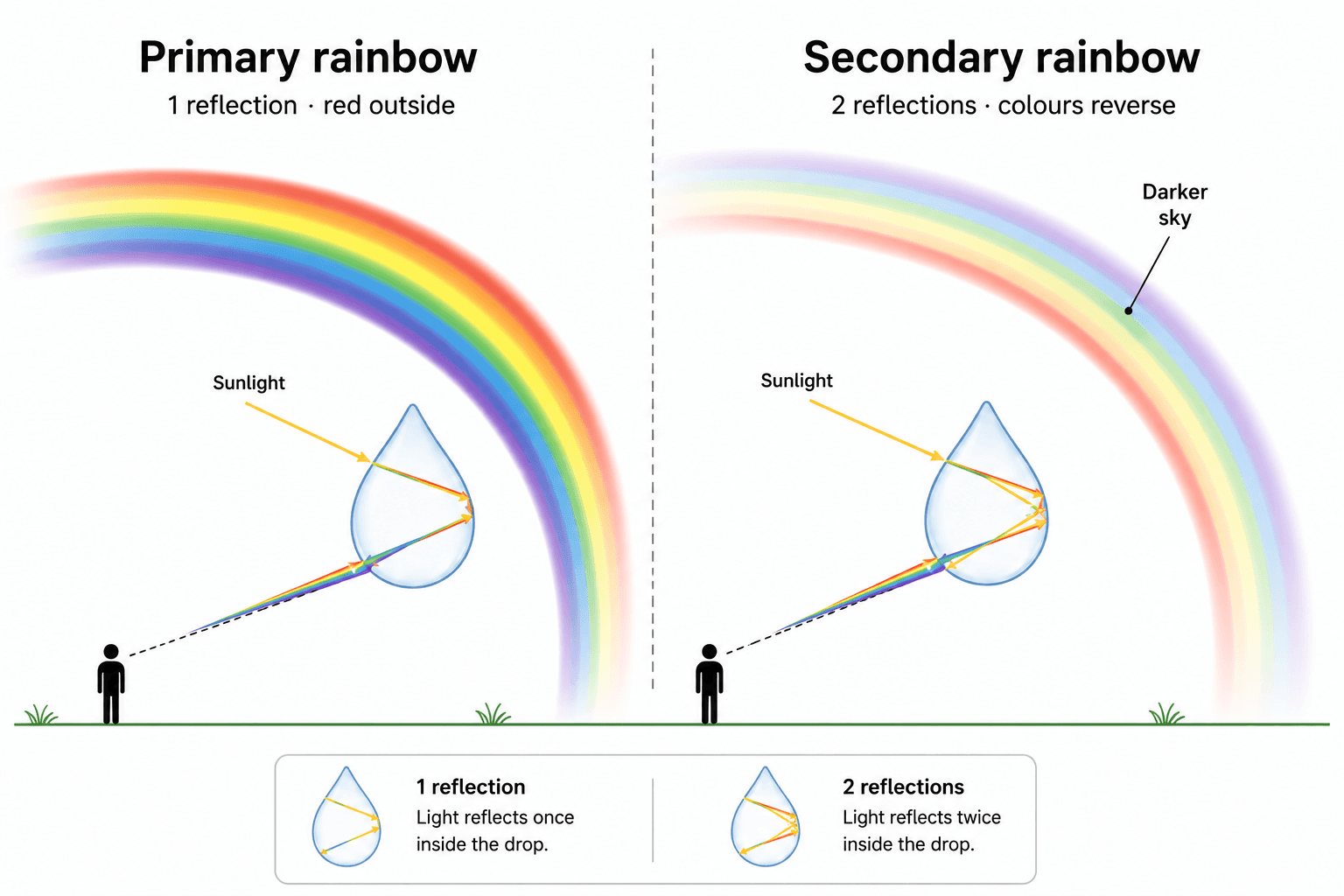
The main arc — the bright one — is the primary rainbow. Light usually reflects once inside the drop before coming back to you. Red sits on the outer edge; violet on the inner edge.
The fainter outer arc is the secondary rainbow. Light reflects twice inside the drop before escaping. That extra bounce flips the colour order: red ends up on the inside of the secondary arc, violet toward the outside. It is dimmer because more light is lost in the second reflection.
Between the two arcs, the sky often looks a little darker. People sometimes call that darker band Alexander's dark band, but you can just notice it as the quieter strip between the bright bow and the faint one.
So if you ever spot two arcs after a heavy shower, you are not imagining it. Same raindrops, same sun — just two different bounce paths.
Both moments involve sun and wet air. The difference is where you are standing.
| Where you look | What you usually see |
|---|---|
| Sun behind you, rain ahead | Classic rainbow arc |
| Facing the sun after rain | Glare, bright cloud edges, sometimes a — not the ground-level rainbow |
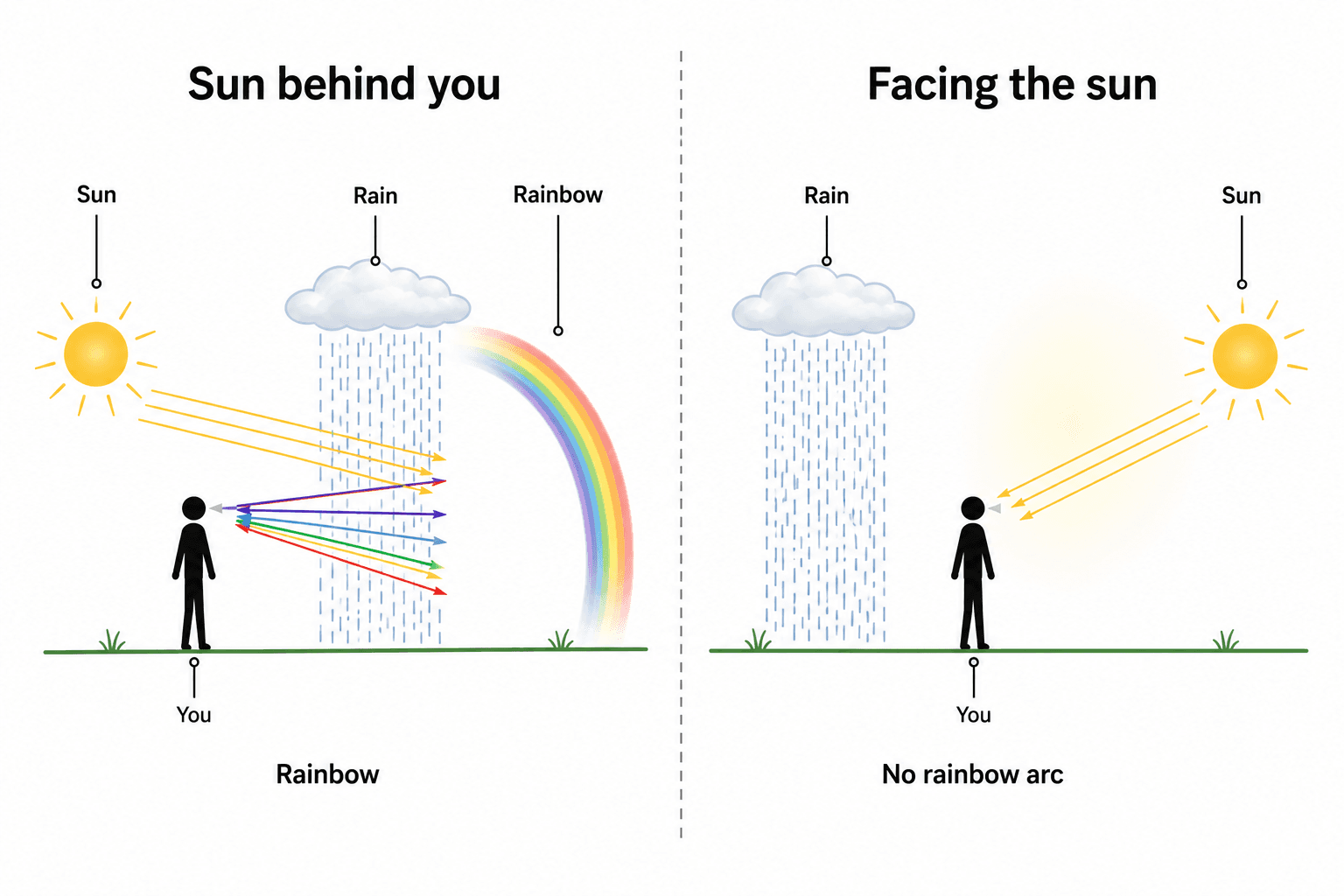
When the sun is behind you and rain is ahead, raindrops can send bent, sorted light back into your eyes. You get the arc.
When you face the sun, you are looking toward the lamp, not toward the bounced light. The drops in front of you are lit from your side of the sky in a different way. You may see sparkling rain, a bright cloud edge, or a halo in thin ice clouds high above — but not the classic ground-level rainbow made by raindrops returning light from behind you.
Same ingredients. Different seating arrangement.
A rainbow forms when sunlight hits raindrops and undergoes refraction, dispersion, and internal reflection. The drop bends white light, splits it into colours, reflects some of that light inside, then sends the coloured rays back toward an observer standing with the sun behind them.
Dispersion, refraction, and internal reflection — all three. Refraction bends the light at the air–water boundary, dispersion separates the colours, and internal reflection turns the light back toward your eyes so the arc is visible.
Because a rainbow is sunlight that raindrops bend and bounce back toward your eyes. That return path only works when the sun is behind you and the rain curtain is in front of you. Facing the sun puts you looking at the light source, not at the bounced colours.
The sun remains behind us and we face the raindrops. That is the geometry that lets internally reflected, dispersed light reach the eye as a coloured arc.
White sunlight is a mix of colours. When light enters a raindrop, different colours bend by slightly different amounts (dispersion). Red bends less than violet, so in the bright primary rainbow red ends up on the outer edge and violet on the inner edge.
Yes, but rarely from the ground. The rainbow is really a circle around the line from the sun through your eye. The ground usually hides the lower half, so you see an arc. From a high viewpoint, such as an aircraft above rain with the sun behind you, a full circle is sometimes visible.
The primary rainbow is the bright inner arc, usually made by one reflection inside the raindrop, with red outside. The secondary rainbow is the fainter outer arc, made by two reflections, with the colour order reversed. Both need the sun behind you and rain ahead.
The sun needs to be low enough in the sky for the bounce-back geometry to work from the ground. Near midday, when the sun is almost overhead, that arrangement is much harder to get, even if it is raining.
No. A rainbow is made by liquid raindrops near the ground and appears opposite the sun, with your back to the light. A halo is a ring around the sun or moon made by ice crystals in high clouds. Same sky, different physics.
You need water droplets in the air that can bend and bounce sunlight — rain, drizzle, mist, or spray from a waterfall or hose can all work. Clear dry air with no droplets will not make a rainbow, no matter how bright the sun is.