
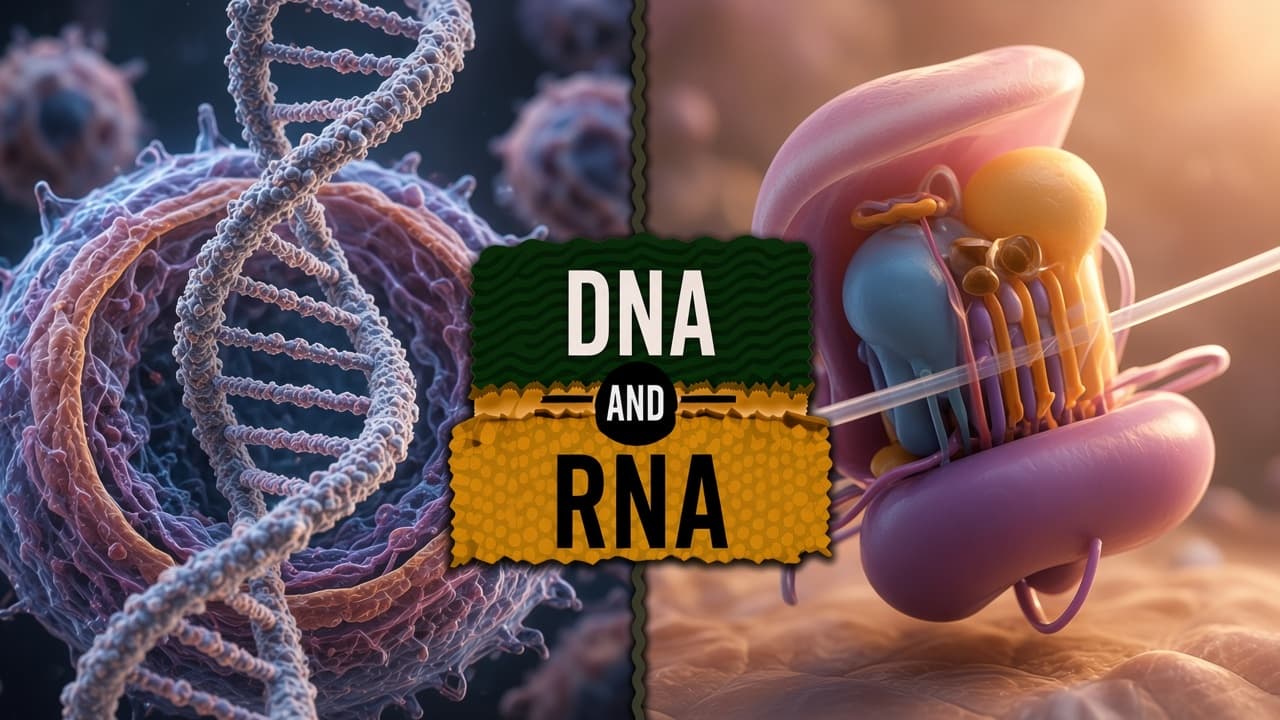
DNA, deoxyribonucleic acid, is the double-stranded genetic blueprint stored in the nucleus. Its sugar is deoxyribose, and one of its bases is thymine. RNA, ribonucleic acid, is usually a single strand, built on ribose, with uracil instead of thymine. It carries genetic instructions to the ribosomes for protein synthesis. Some viruses, including SARS-CoV-2, use RNA as their genetic material.
Difference between DNA and RNA
| Feature | DNA | RNA |
|---|---|---|
| Meaning | Long-term archive of genetic information | Working copy used to build proteins, or the genome of some viruses |
| Where | Nucleus, mitochondria, and chloroplast | Made in the nucleus; works in the cytoplasm and on ribosomes |
| Bases | Deoxyribose; thymine; usually two strands; more stable, with repair | Ribose; uracil; usually one strand; mRNA is short-lived |
| Types | Nuclear DNA and mitochondrial DNA | mRNA, tRNA, rRNA, and miRNA, among others |
| Making | Copies itself by semiconservative replication, using DNA polymerase | Made from a DNA template by RNA polymerase, in transcription |
| Use | Forensic profiling and the genetic archive | mRNA vaccines deliver a coding sequence; HIV uses reverse transcription from RNA to DNA |
At a glance
Sugar
Deoxyribose
Ribose
Strands
Usually double-stranded
Usually single-stranded
Pyrimidine base
Thymine (T)
Uracil (U) in place of thymine
Primary role
Long-term genetic storage
Protein synthesis; the genome of some viruses
Example
Recipe book vs kitchen note
DNA is the master recipe book, kept in the nucleus, and the cell does not cook from the book itself. RNA copies one recipe by transcription and carries it to the ribosome, where translation builds a protein. Messenger RNA, transfer RNA, and ribosomal RNA do different jobs on that path. An mRNA vaccine skips the book and delivers the note directly.
What this means for the exam
DNA is the long-term store of genetic information. RNA is the working copy used in protein synthesis, in the forms mRNA, tRNA, and rRNA.
DNA
DNA is deoxyribonucleic acid. The double helix, the sugar deoxyribose, and the base thymine are the marks to remember. It is more stable than RNA, in part because deoxyribose lacks the hydroxyl group that ribose carries, and because cells repair it. Most of it sits in the nucleus. Mitochondria and chloroplasts have their own DNA. It replicates in a semiconservative way, with DNA polymerase.
In the usual path, DNA is transcribed into RNA and RNA is translated into protein. That is the central dogma. DNA is not the molecule put straight into a standard vaccine. A statement that RNA is a double helix containing thymine mixes the two molecules.
RNA
RNA uses ribose and uracil. It is usually single-stranded, though some viruses carry double-stranded RNA. Messenger RNA carries the code, transfer RNA brings amino acids, and ribosomal RNA helps form the ribosome. MicroRNA is another form. The strands are less stable, and mRNA in particular is short-lived. RNA polymerase makes RNA from a DNA template.
Viruses such as SARS-CoV-2 use RNA as genetic material. Retroviruses such as HIV reverse the usual direction and make DNA from RNA. mRNA vaccines use the cell's translation machinery and do not alter host DNA. A memory line used in class is that RNA uses uracil. Thymine belongs to DNA.
Key takeaway
DNA is usually double-stranded, uses deoxyribose and thymine, and stores genetic information. RNA is usually single-stranded, uses ribose and uracil, and takes part in protein synthesis.
Difference between DNA and RNA FAQs
What is DNA?
DNA is deoxyribonucleic acid, usually a double strand that stores genetic information. Its sugar is deoxyribose, and it contains thymine. It is found in the nucleus, and also in mitochondria and chloroplasts.
What is RNA?
RNA is ribonucleic acid, usually a single strand used in protein synthesis. Its sugar is ribose, and it contains uracil instead of thymine. mRNA, tRNA, and rRNA are the main working forms.
What is the main difference between DNA and RNA?
DNA stores genetic information in a double strand with thymine and deoxyribose. RNA is usually a single strand with uracil and ribose, and it carries the instructions that build proteins.
Does RNA contain thymine?
No. RNA has uracil instead of thymine. Thymine is a base in DNA.
Is DNA typically double-stranded and RNA typically single-stranded?
Yes. That is the standard distinction. Some viruses are exceptions and carry double-stranded RNA.
Which base is present in RNA and absent from DNA?
Uracil. DNA uses thymine in the place where RNA uses uracil.
PYQ linkage
Which nitrogenous base is present in RNA but not in DNA?