
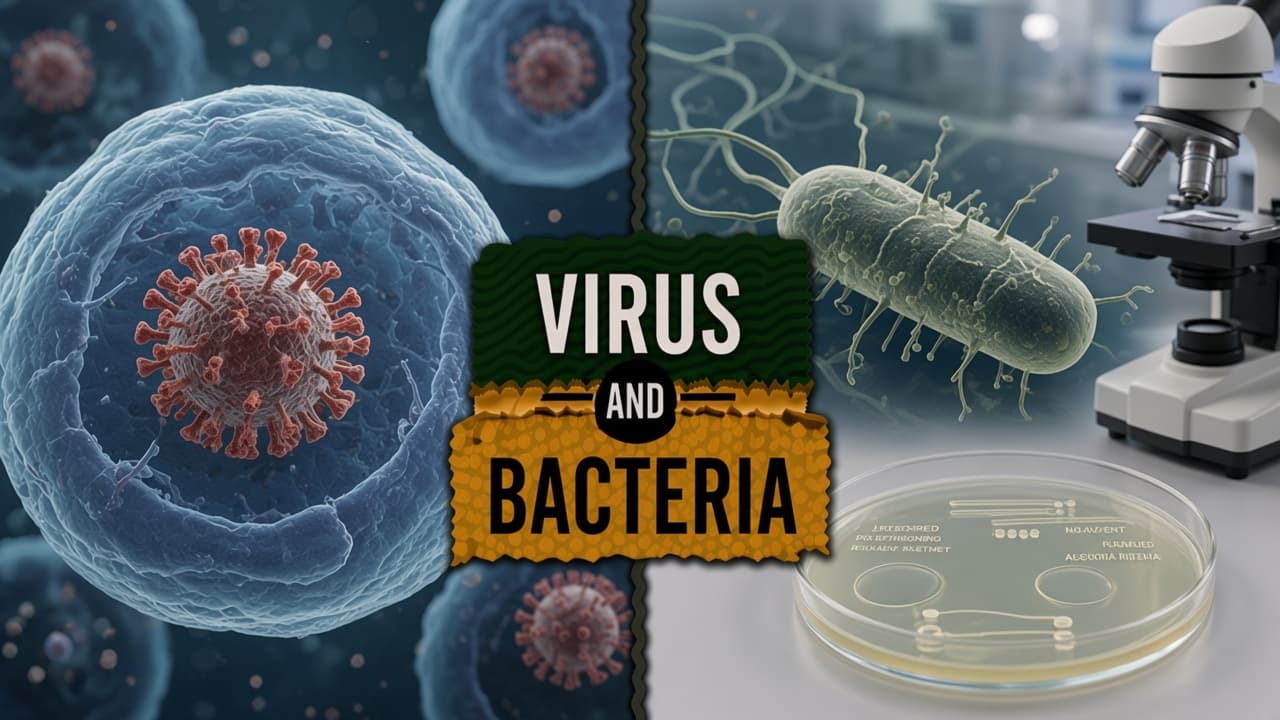
A virus is a non-cellular obligate parasite. A protein coat surrounds a core of DNA or RNA, and the virus replicates only inside a host cell. A bacterium is a living unicellular prokaryote, with a cell wall, ribosomes, and its own metabolism. It reproduces by binary fission. Antibiotics act on bacteria. They do not act on viruses. Influenza is a virus. Tuberculosis is a bacterial disease.
Difference between a virus and bacteria
| Feature | Virus | Bacteria |
|---|---|---|
| Meaning | Non-cellular parasite that replicates only in a host | Living single-celled prokaryote |
| Structure | Protein capsid, sometimes an envelope; no cell wall; DNA or RNA, usually not both | Cell wall of peptidoglycan, used in Gram classification; circular DNA chromosome |
| Examples | HIV, COVID-19, influenza, rabies, rhinovirus | Tuberculosis (Mycobacterium), cholera, typhoid, plague, Streptococcus |
| Size | About 20 to 300 nanometres; they pass filters that hold back bacteria, as Beijerinck showed | About 0.5 to 5 micrometres; retained on bacterial filters |
| Role | No essential role in the human gut; phage therapy is an emerging idea | Gut flora, nitrogen fixation, and curd-making by Lactobacillus |
| Tests | PCR and antigen rapid tests; antivirals and vaccines | Culture, Gram stain, and sensitivity testing; antibiotics |
At a glance
Cell structure
Acellular: no nucleus and no ribosomes
Prokaryotic cell with wall, membrane, and ribosomes
Reproduction
Hijacks a host cell
Binary fission, which is independent
Size
About 20 to 300 nm
About 0.5 to 5 micrometres, and larger than viruses
Treatment
Vaccines and antivirals; antibiotics do not work
Antibiotics where indicated; vaccines exist for some, such as BCG
Example
Common cold vs strep throat
A common cold is usually a rhinovirus. Antibiotics do not help. Rest and the immune response do. Strep throat is caused by Streptococcus bacteria. A penicillin-class antibiotic may be needed to prevent rheumatic fever. Using the wrong drug wastes medicine and selects for resistance.
What this means for the exam
Viral illness is met with antivirals or vaccines, where those exist. Bacterial illness, when treatment is indicated, is met with antibiotics.
Virus
A virus has no independent metabolism. It must enter a living cell to replicate. That is why it is an obligate parasite. The particle is acellular: a protein capsid, sometimes a lipid envelope, and a genome of DNA or RNA, usually not both. Sizes run from about 20 to 300 nanometres, small enough to pass filters that stop bacteria. HIV, the virus behind COVID-19, influenza, rabies, and rhinovirus are the examples. Influenza is not treated with antibiotics.
Viruses mutate quickly. Antigenic drift and shift in influenza are why vaccines are updated. There is no essential community of viruses in the human gut. Phage therapy, using viruses that attack bacteria, is a newer idea and is separate from ordinary human viral disease. Public messages that treat every germ as a bacterium lead to antibiotics being given for a viral fever.
Bacteria
Bacteria are prokaryotic cells. They have a membrane, ribosomes, and a cell wall that often contains peptidoglycan, which is the basis of Gram classification. They reproduce by binary fission. Tuberculosis, cholera, typhoid, and plague are bacterial diseases. Streptococcus is the organism behind strep throat. Size is about 0.5 to 5 micrometres, larger than a virus, so they are held back by bacterial filters.
Many bacteria are useful: gut flora, nitrogen-fixing species, and Lactobacillus in curd. Antibiotics target bacterial processes such as cell-wall building. Overuse selects resistant strains. Antimicrobial resistance is treated as a global health threat and is linked to One Health in mains answers. Diagnosis uses culture, the Gram stain, and sensitivity testing. BCG is an example of a vaccine against a bacterium.
Key takeaway
A virus depends on a host cell and is not treated with antibiotics. Bacteria are cellular organisms, and antibiotics can act on them.
Difference between a virus and bacteria FAQs
What is a virus?
A virus is a non-cellular particle with a protein coat and a DNA or RNA genome. It can replicate only inside a living host cell. Influenza, HIV, and rabies are examples.
What is a bacterium?
A bacterium is a living single-celled prokaryote with a cell wall and ribosomes. It reproduces by binary fission. Tuberculosis, cholera, and typhoid are bacterial diseases.
What is the main difference between a virus and bacteria?
A virus cannot reproduce on its own and is not a cell. A bacterium is a cell that can reproduce by binary fission. Antibiotics work on bacteria and do not work on viruses.
Are antibiotics effective against viral infections such as influenza?
No. Antibiotics target bacterial cell processes. They do not act on viruses such as influenza.
Can viruses reproduce only inside living host cells?
Yes. Viruses lack independent metabolism. They are obligate parasites of host cells.
Is tuberculosis a bacterial disease?
Yes. Tuberculosis is caused by Mycobacterium, a bacterium. It is not a viral infection.
PYQ linkage
Which of the following is a bacterial disease?