
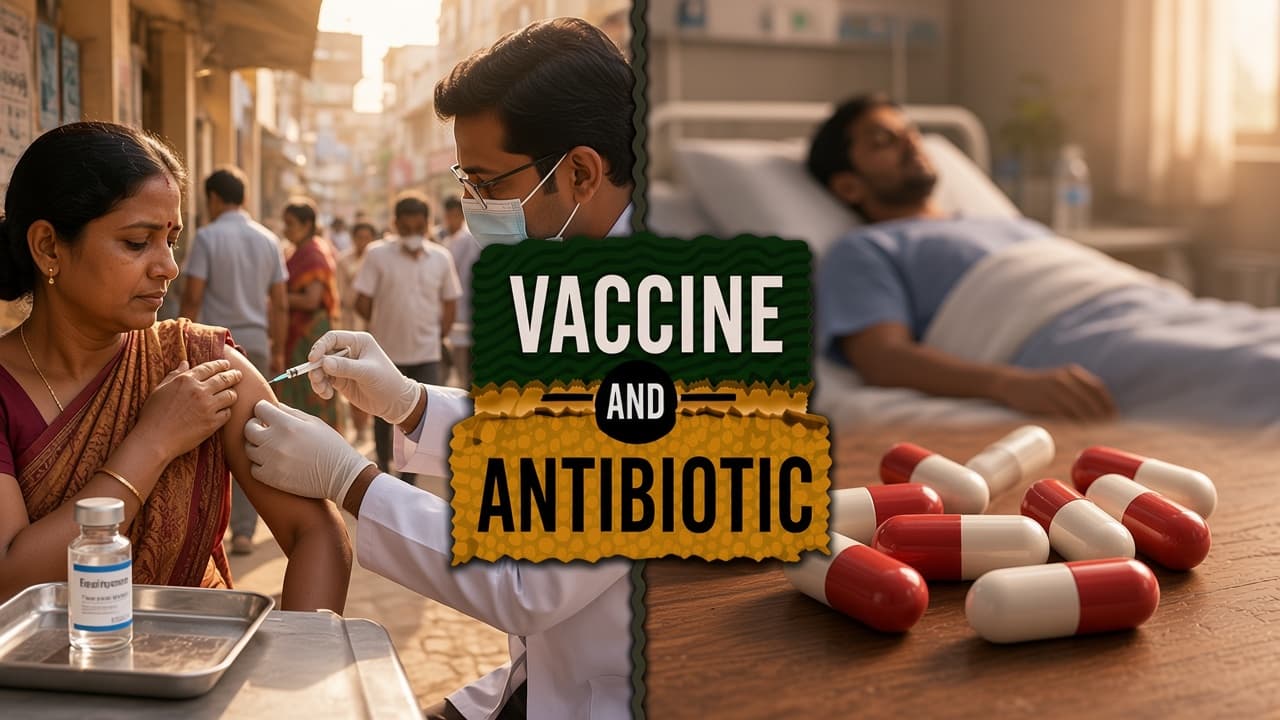
A vaccine is a preventive tool. It presents an antigen so the immune system learns to recognise a pathogen before full disease, or soon after exposure. An antibiotic is a drug that kills bacteria or stops them growing once an infection is established. It has no effect on viruses. Schedules such as BCG, DPT, polio, and COVID build memory cells. Drugs such as penicillin and azithromycin act on the bacterial cell wall, on protein synthesis, or on DNA replication.
Difference between a vaccine and an antibiotic
| Feature | Vaccine | Antibiotic |
|---|---|---|
| Meaning | Training of the immune system to prevent disease | A drug that kills bacteria or stops their growth |
| How | Active immunity in most schedules; passive immunity from antibodies already made | Bactericidal or bacteriostatic action on wall, protein synthesis, or DNA replication |
| Examples | BCG, MMR, COVID mRNA, rabies, DPT, polio, typhoid vaccine | Penicillin, tetracycline, ciprofloxacin, azithromycin, ceftriaxone |
| Scope | Viral and bacterial vaccines both exist | Bacteria only; useless against a virus unless a secondary bacterial infection is present |
| Programmes | Universal Immunisation Programme; cold chain for many live vaccines | AWaRe classification for stewardship of antibiotics |
| Risk | Hesitancy, and antigenic drift that forces vaccine updates | Antimicrobial resistance from overuse; prescription for oral or injectable use |
At a glance
Purpose
Prevent disease by immunisation
Treat a bacterial infection
Target
The immune system, through antigen presentation
Bacteria, through their cell processes
Pathogen scope
Vaccines exist for viruses and for bacteria
Bacteria only, not viruses
Timing
Before exposure, or soon after it
During an established infection
Example
Childhood schedule vs typhoid treatment
A child receives a typhoid vaccine before travel. The immune system learns Salmonella antigens without going through the full disease. Another child, with confirmed typhoid fever, receives an antibiotic such as ceftriaxone to kill the bacteria that are already multiplying. The vaccine is meant to prevent. The antibiotic is meant to treat. The jobs are different.
What this means for the exam
A vaccine prevents disease by building immunity. An antibiotic treats a bacterial infection that is already under way.
Vaccine
Most vaccines in a schedule give active immunity. The body makes its own memory B cells and T cells. Passive immunity is different: antibodies arrive ready-made, as in breast milk or in antiserum, and the protection is short-lived. Types tested in exams include live attenuated, inactivated, and mRNA vaccines. BCG, DPT, polio, MMR, COVID mRNA, and rabies are the names already in use here. The Universal Immunisation Programme is the Indian delivery frame. Many live vaccines need a cold chain.
A vaccine does not cure an established bacterial infection. That job belongs to antibiotics. Hesitancy and cold-chain failure are practical problems. Viruses that drift antigenically, such as influenza, need updated vaccines. The prophylactic role is the point of the comparison.
Antibiotic
Antibiotics are curative against bacteria. Penicillin, tetracycline, ciprofloxacin, azithromycin, and ceftriaxone are examples. They may be bactericidal or bacteriostatic, hitting the cell wall, protein synthesis, or DNA replication. They do not confer immunity. After the bacteria are cleared, the immune system may still have learned from the infection itself, but that is not a property of the drug. They do not treat viral diseases such as influenza, unless a bacterial infection has followed.
Giving antibiotics for a viral fever drives resistance without benefit. The AWaRe classification is the stewardship tool. Antimicrobial resistance is the national-policy problem paired with this comparison. Confirmed typhoid is the case for a drug such as ceftriaxone. Prevention of typhoid, by contrast, is the vaccine given before travel.
Key takeaway
A vaccine prevents disease by building immunity. An antibiotic treats bacteria, and it does not treat viruses.
Difference between a vaccine and an antibiotic FAQs
What is a vaccine?
A vaccine trains the immune system to recognise a pathogen so that disease is prevented or limited. BCG, MMR, polio, and COVID mRNA vaccines are examples. Most schedules produce active immunity.
What is an antibiotic?
An antibiotic is a drug that kills bacteria or stops them growing during an infection. Penicillin, tetracycline, and ciprofloxacin are examples. It does not work on viruses.
What is the main difference between a vaccine and an antibiotic?
A vaccine prevents disease by building immunity, against viruses or bacteria. An antibiotic treats an infection that bacteria have already established.
Can vaccines cure an established bacterial infection without antibiotics?
No. Vaccines prevent. An established bacterial infection needs antibiotics or another antimicrobial.
Are antibiotics ineffective against viral diseases?
Yes. Antibiotics do not act on viruses. They may be used if a bacterial infection follows the viral illness.
Do vaccines provide acquired immunity?
Yes. A vaccine is meant to produce acquired immunity, usually active immunity. An antibiotic clears bacteria. It does not train the immune system.
PYQ linkage
Consider statements on vaccines and antibiotics. Antibiotics work on viruses / Vaccines provide acquired immunity. Which is correct?