
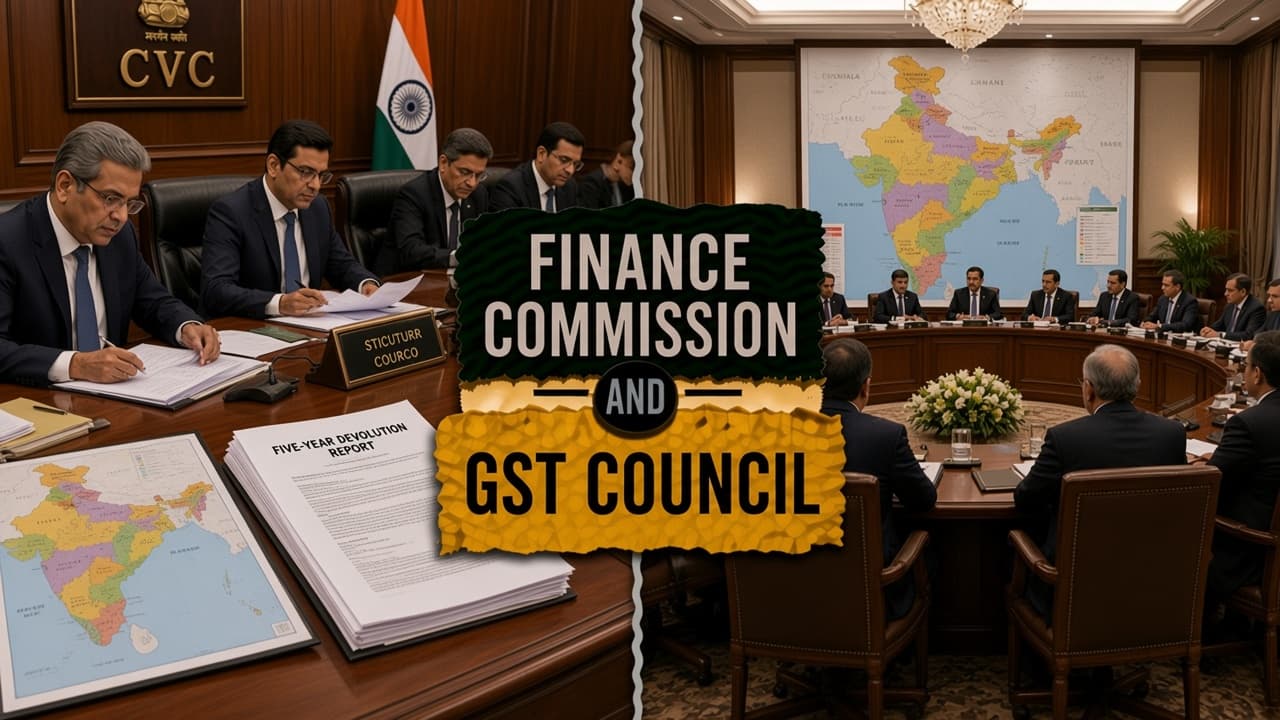
The Finance Commission is a constitutional body under Article 280. It recommends how central taxes and grants-in-aid are shared between the Union and the states. The GST Council is a constitutional body under Article 279A, inserted by the 101st Amendment. It harmonises GST rates, exemptions, and the resolution of disputes. One body answers how large a share of central taxes the states receive. The other answers what rate applies to a particular good. NITI Aayog may advise on policy. Only the Finance Commission recommends the fiscal shares.
Difference between the Finance Commission and the GST Council
| Feature | Finance Commission | GST Council |
|---|---|---|
| Meaning | Advice on sharing central taxes and grants | Decisions on how GST is designed and run |
| Law | Article 280; constituted every five years, or earlier by presidential order | Article 279A; the 101st Amendment; Article 279A(9) on the 75 percent weighted majority |
| Who | Chairman and four members, appointed by the President | Union Finance Minister as chair, with state finance ministers; others may be invited |
| Force | Recommendations, which Parliament and the executive usually accept | Decisions that bind the Centre and the states |
| Shares | The Fifteenth Finance Commission recommended 41 percent, down from 42 percent, with cesses kept outside the divisible pool | Rate changes such as soap moving from 28 percent to 18 percent; compensation cess |
| Effect | Classical fiscal federalism; meets for an award each cycle | Cooperative federalism under one indirect tax; a permanent council that often meets quarterly |
At a glance
Article
Article 280
Article 279A, from the 101st Amendment
Primary output
Devolution percentage, grants, and a fiscal road map
GST rates, slabs, exemptions, and procedural rules
Chairperson
A chairman appointed by the President
The Union Finance Minister
Voting
Recommendations, with no Council-style vote
The Centre has one-third of the weight, the states two-thirds, and a 75 percent majority is required
Example
42% devolution vs 18% GST on soap
A Finance Commission award may recommend that 42 percent of the divisible tax pool go to the states, which changes every state budget. When soap moved from the 28 percent GST slab to 18 percent, the GST Council voted after bargaining between the Centre and the states. The Finance Commission did not set that rate. A Kerala finance minister watches both: the size of the Commission's share, and the Council's vote on a rate cut.
What this means for the exam
The Finance Commission divides taxes between the Union and the states, and among the states. The GST Council makes indirect-tax policy for the whole country.
Finance Commission
Article 280 requires the President to constitute a Finance Commission every five years, or earlier. The body has a chairman and four members. Its output is a recommendation on the divisible pool, grants-in-aid, and fiscal consolidation. It does not set GST rates. The Fifteenth Finance Commission recommended devolution of 41 percent, down from 42 percent, while cesses stayed outside the pool. Those recommendations are not a Council vote. Parliament and the executive have usually accepted the award.
GST did not replace this body. States still need untied money from the divisible pool after many state taxes were subsumed. NITI Aayog is a different institution. It advises on policy and does not divide the pool. A question that gives the GST Council the job of fixing the states' share of central taxes has swapped the mandates.
GST Council
Article 279A created the GST Council. The Union Finance Minister chairs it. State finance ministers are members. Decisions bind both levels of government. The Centre holds one-third of the vote weight and the states together hold two-thirds. A decision needs a three-fourths majority of the weighted votes, which is Article 279A(9). That weight gives the Centre a structural block on radical changes, and it also stops the Centre from setting rates alone.
The Council manages slabs, exemptions, and procedure. Moving soap from 28 percent to 18 percent is its kind of decision. The compensation cess, and the strain when that cess arrangement ended in 2022, showed state anxiety about revenue. The Council does not recommend the share of central taxes in the divisible pool. That remains Article 280. The two bodies answer different fiscal questions, and they can be in tension at the same time.
Key takeaway
The Finance Commission, under Article 280, recommends how taxes are shared. The GST Council, under Article 279A, runs GST, and its decisions need a 75 percent weighted majority.
Difference between the Finance Commission and the GST Council FAQs
What is the Finance Commission?
The Finance Commission is a constitutional body under Article 280. Every five years it recommends how central taxes and grants-in-aid are shared with the states.
What is the GST Council?
The GST Council is a constitutional body under Article 279A. The Union Finance Minister chairs it. It decides GST rates, exemptions, and related rules.
What is the main difference between the Finance Commission and the GST Council?
The Finance Commission recommends the devolution of central taxes. The GST Council runs GST policy. One divides the pool. The other sets the tax.
Does the GST Council recommend the share of central taxes to be devolved to the states?
No. Devolution is the Finance Commission's work under Article 280. The GST Council sets GST policy.
Do GST Council decisions need a three-fourths majority of weighted votes?
Yes. The Centre has one-third of the weight and the states together have two-thirds. Article 279A(9) requires 75 percent.
Who constitutes the Finance Commission, and how often?
The President constitutes it every five years under Article 280, or earlier by order, to recommend fiscal devolution.
PYQ linkage
GST Council voting weight of Centre vs States is: