
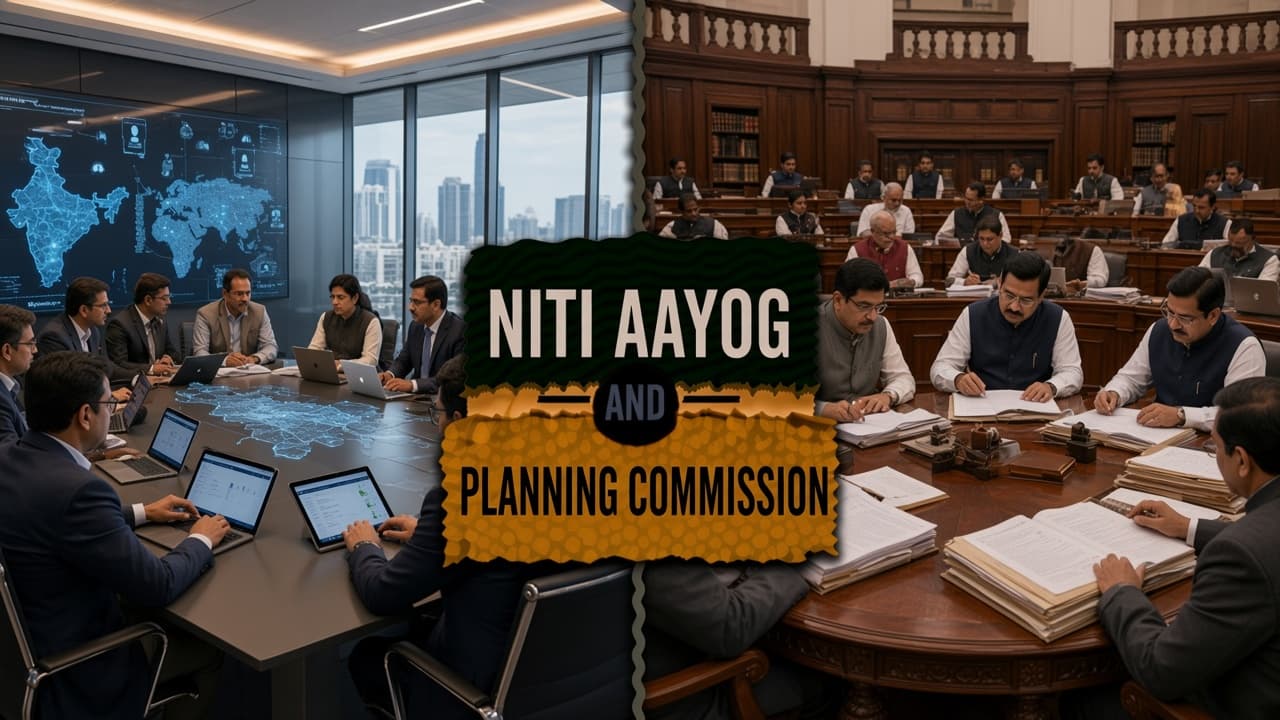
NITI Aayog is the Union government's policy think tank, created in 2015 to promote cooperative and competitive federalism through evidence-based advice. The Planning Commission, from 1950 to 2014, was an executive body that drafted Five-Year Plans and allocated central plan funds to the states by the Gadgil-Mukherjee formula. The Prime Minister chaired both. NITI Aayog does not allocate scheme money, and it is neither a constitutional body nor a statutory one. The Planning Commission was also an executive creation, and its leverage was the plan grant.
Difference between NITI Aayog and the Planning Commission
| Feature | NITI Aayog | Planning Commission |
|---|---|---|
| Meaning | Policy think tank and a platform for states | Central body that drafted plans and allocated plan money |
| When | Created in 2015 and still in place | 1950 to 2014; twelve Five-Year Plans from 1951 |
| Law | Executive resolution; not in the Constitution and not created by statute | Executive resolution; not a constitutional body either |
| Who | Prime Minister as chair; Governing Council of the Prime Minister and chief ministers | Prime Minister as chair; National Development Council as the state forum |
| Money | No plan allocation; does not draft the Union Budget | Central plan assistance, through the Gadgil-Mukherjee formula and annual plan meetings |
| Output | Strategy @75, Aspirational Districts, SDG India Index | Five-Year Plans and plan outlays, through the 12th Plan |
At a glance
Era
1950 to 2014, then dissolved
2015 to the present
Five-Year Plans
Drafted and coordinated the Five-Year Plans
No Five-Year Plan; vision documents and the SDGs instead
Fund allocation
Central plan assistance to the states
No power to allocate funds
Vice-Chairman role
A de facto economic lead, as in the Montek Singh Ahluwalia years
A vice-chairman and a CEO who advise, with less centralised control of funds
Example
12th Plan outlay vs Aspirational Districts programme
Under the Planning Commission, Maharashtra negotiated an annual plan outlay in meetings at the Centre, and the money was tied to that approval. After NITI Aayog there are no Five-Year Plans. NITI ranks districts on health and education and nudges states to compete, as in the Aspirational Districts programme. States receive more untied funds through the Finance Commission. NITI steers with advice and rankings, not with a plan sanction.
What this means for the exam
The Planning Commission made plans and allocated money. NITI Aayog is a think tank for cooperative federalism, and it does not allocate plan funds.
NITI Aayog
NITI Aayog was created by a Cabinet resolution in 2015. It is not under Article 280, which creates the Finance Commission, and it is not a constitutional body. The Prime Minister chairs it. The Governing Council brings chief ministers into the room, in place of the old National Development Council. The vice-chairman and the chief executive advise. They do not sanction plan funds. Flagship work includes the Aspirational Districts programme, the SDG India Index, and the strategy document called Strategy @75.
A common error is to treat NITI as the drafter of the Union Budget. The Budget is the Finance Ministry's document. Another error is to say that NITI allocates central plan funds to states. It does not. Untied fiscal transfers are the Finance Commission's field. NITI's influence is rankings, data, and advice. Critics say it lacks the enforcement the Planning Commission had when it could hold back plan assistance.
Planning Commission
The Planning Commission was set up in 1950 by executive resolution and dissolved in 2014. It coordinated twelve Five-Year Plans, from 1951 onward. It allocated central plan assistance to the states, using the Gadgil-Mukherjee formula, in annual plan meetings. The National Development Council was the political forum with the states. In the later years the vice-chairman, Montek Singh Ahluwalia is the usual name, carried unusual influence over economic allocations.
After the 1991 reforms, central micro-management of a plan sat awkwardly with a more open economy. States wanted flexibility. Finance Commission devolution, and later GST, reduced the need for plan grants. The 12th Plan outlay negotiation is the classroom picture of the old system: a state's development money depended on approval at the Centre. That stick is what NITI Aayog was not given.
Key takeaway
The Planning Commission wrote the Five-Year Plans and allocated plan money. NITI Aayog is an advisory think tank, and it does not allocate plan funds.
Difference between NITI Aayog and the Planning Commission FAQs
What is NITI Aayog?
NITI Aayog is the policy think tank created in 2015 by an executive resolution. The Prime Minister chairs it. It advises on development and federalism and does not allocate plan funds.
What was the Planning Commission?
The Planning Commission, from 1950 to 2014, drafted Five-Year Plans and allocated central plan assistance to the states. It was an executive body, not a constitutional one.
What is the main difference between NITI Aayog and the Planning Commission?
The Planning Commission made Five-Year Plans and controlled plan funds. NITI Aayog advises and ranks performance. It has no plan-allocation power and no Five-Year Plan.
Does NITI Aayog allocate central plan funds to the states?
No. That was the Planning Commission's role. NITI Aayog does not allocate plan funds.
Is NITI Aayog a constitutional body like the Finance Commission?
No. NITI Aayog was created by a Cabinet resolution. Article 280 creates the Finance Commission, not NITI Aayog.
Did the Planning Commission draft India's Five-Year Plans?
Yes. It coordinated twelve Five-Year Plans from 1951 until it was dissolved and replaced by NITI Aayog.
PYQ linkage
NITI Aayog replaced: