
Karst topography forms when acidic rainwater dissolves limestone into caves, sinkholes, stalactites, and stalagmites. Meghalaya examples for UPSC.
(Editorial Team)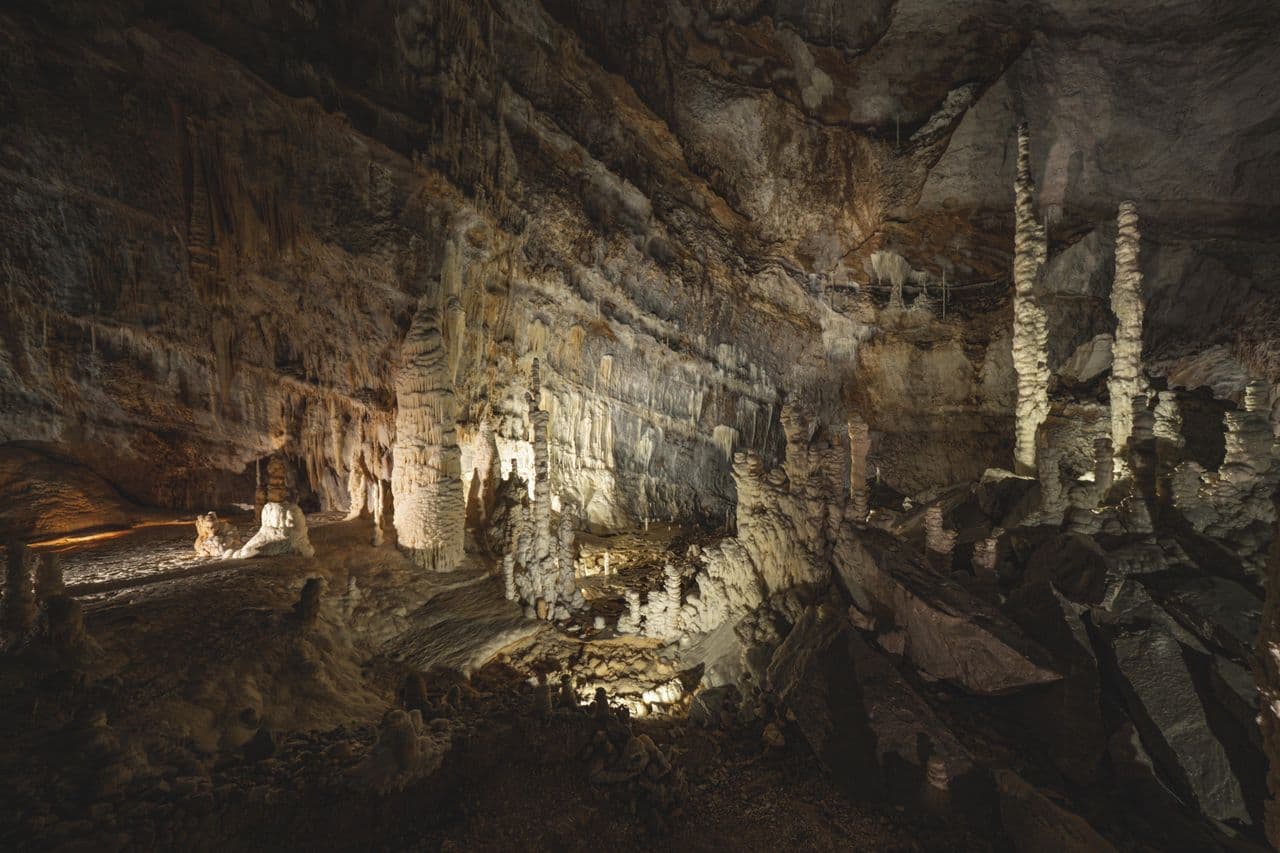
UPSCYatra’s editorial team researches and publishes syllabus guides, exam trends, previous years' questions analysis, and conceptual deep-dives for serious UPSC aspirants.
Valid till Mains 2027
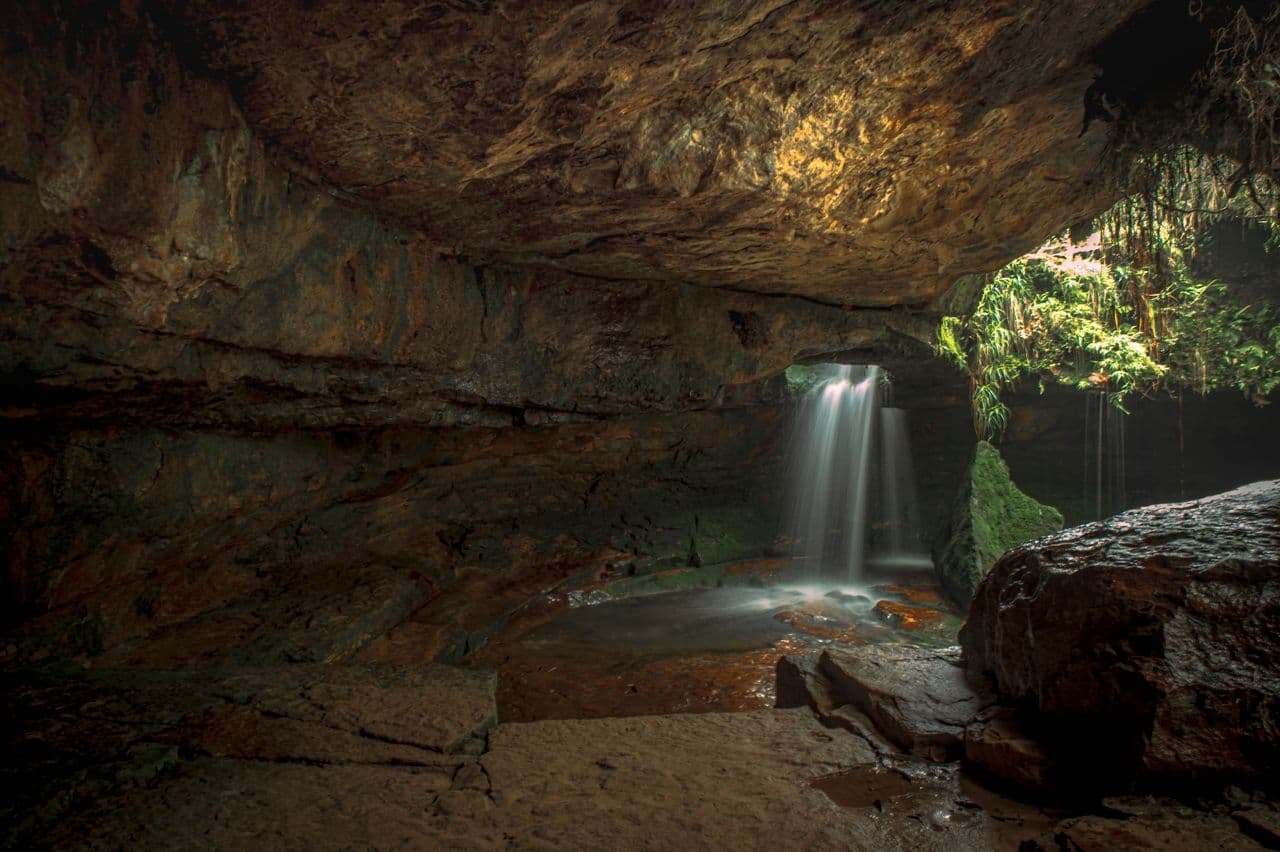
If you have ever stepped into a cave in the hills of Meghalaya or the Andamans, you have probably wondered the same thing: how did this giant hollow get here?
There is no digging machine. No river carved a tunnel through solid rock overnight. And yet here is this huge, cool, echoing space running deep into the hillside, sometimes for kilometres, with strange stone icicles hanging from the roof.
Here is the surprising part. Almost every big natural cave in the world is found inside one particular kind of rock: limestone. Not granite. Not sandstone. Limestone. There is a reason for that.
The answer comes down to one simple idea: rainwater is very slightly acidic, and limestone slowly dissolves in acid.
That is really the whole secret. A cave is not carved out. It is dissolved out. Drop by drop, over thousands of years, water eats the rock away from the inside. A bit like how a sugar cube slowly disappears in a cup of hot tea.
Let's walk through it step by step.
In one line
Limestone caves and karst topography form when slightly acidic rainwater dissolves calcium carbonate rock — hollowing caves and, later, depositing stalactites and stalagmites.
is a soft, pale rock. If you have ever held a piece of chalk, you have basically held limestone. They are made of the same thing.
That thing is . And here is where it gets interesting: most limestone started life at the bottom of the sea. It is made from the crushed shells, coral, and skeletons of tiny sea creatures that piled up over millions of years and got squeezed into rock.
So a limestone hill is really an ancient sea floor, lifted up over time. The white cliffs, the pale grey hills of Meghalaya, the rock inside the Andaman caves, all of it is stacked-up sea life turned to stone.
Calcium carbonate has one important weakness. It barely reacts with plain water. But put it next to even a weak acid, and it slowly dissolves. Hold that thought, because that weakness is the whole story.
Rain looks like the gentlest thing in the world. So how can it eat through solid rock?
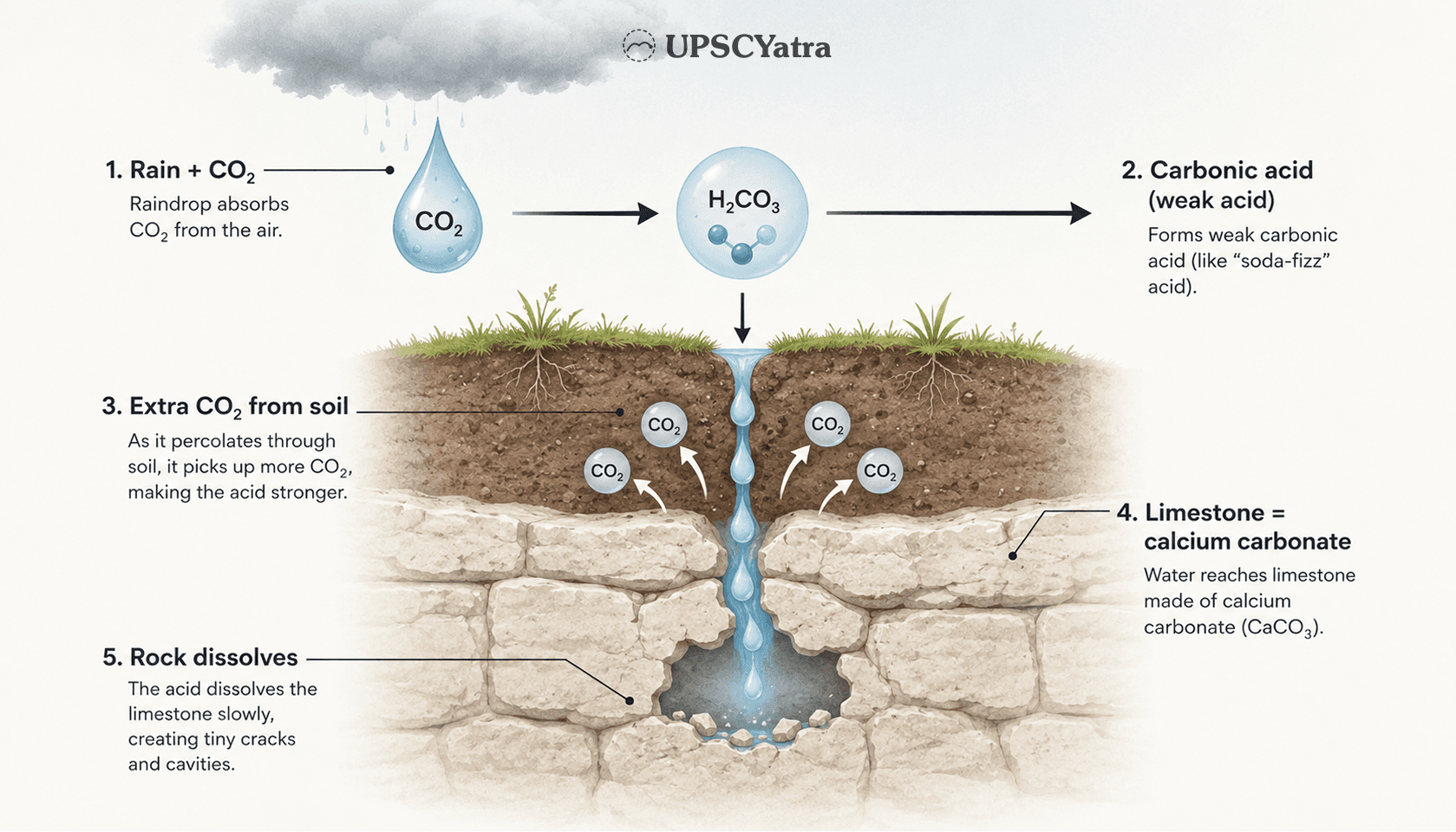
The trick is that rain is not quite pure water. As raindrops fall through the air, they pick up a little carbon dioxide, the same gas we breathe out. When that gas dissolves in water, it makes a very weak acid.
You already know this acid. It is the exact same fizz that makes a bottle of soda tingle on your tongue. Scientists call it , but you can just think of it as fizzy-water acid. It is far too weak to hurt your skin. But it is strong enough to slowly nibble at limestone.
The rain gets even more acidic after it lands. As it soaks into the soil, it picks up more carbon dioxide from rotting leaves and roots. So by the time this water reaches the rock below, it is a patient little acid, ready to go to work.
This slow dissolving of rock by acidic water has a name: . It is one type of what geographers call , where rock is broken down by chemical reactions rather than by force. The rock is not cracked or smashed. It is quietly melted away, molecule by molecule.
So we have mildly acidic water, and we have rock that dissolves in acid. Now watch how they build a cave together.
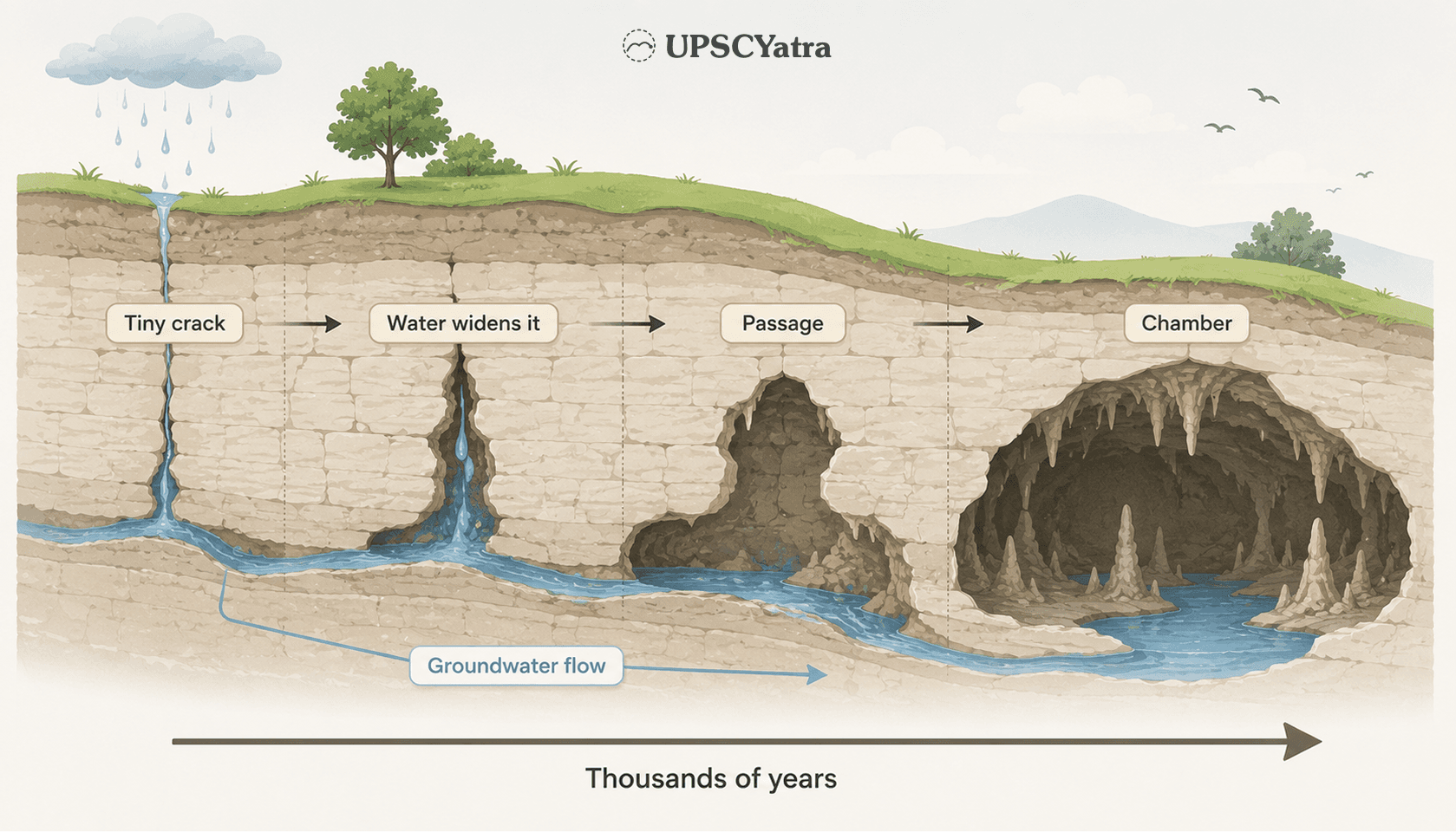
Every limestone hill is full of tiny cracks and joints, natural lines of weakness in the rock. Water always finds these cracks and trickles in. And once inside, it does what water does: it keeps flowing, and it keeps dissolving.
Here is the sequence, one step at a time:
The water that does this carving is , rain that has sunk below the surface and now moves slowly through the rock. It follows gravity downhill, hunting for the easiest path, widening every crack it uses.
Notice the pace. This is not a flood carving a canyon in a day. A cave grows about as slowly as a fingernail, over centuries and millennia. The cave you walk through today was being dissolved out before the first cities were ever built.
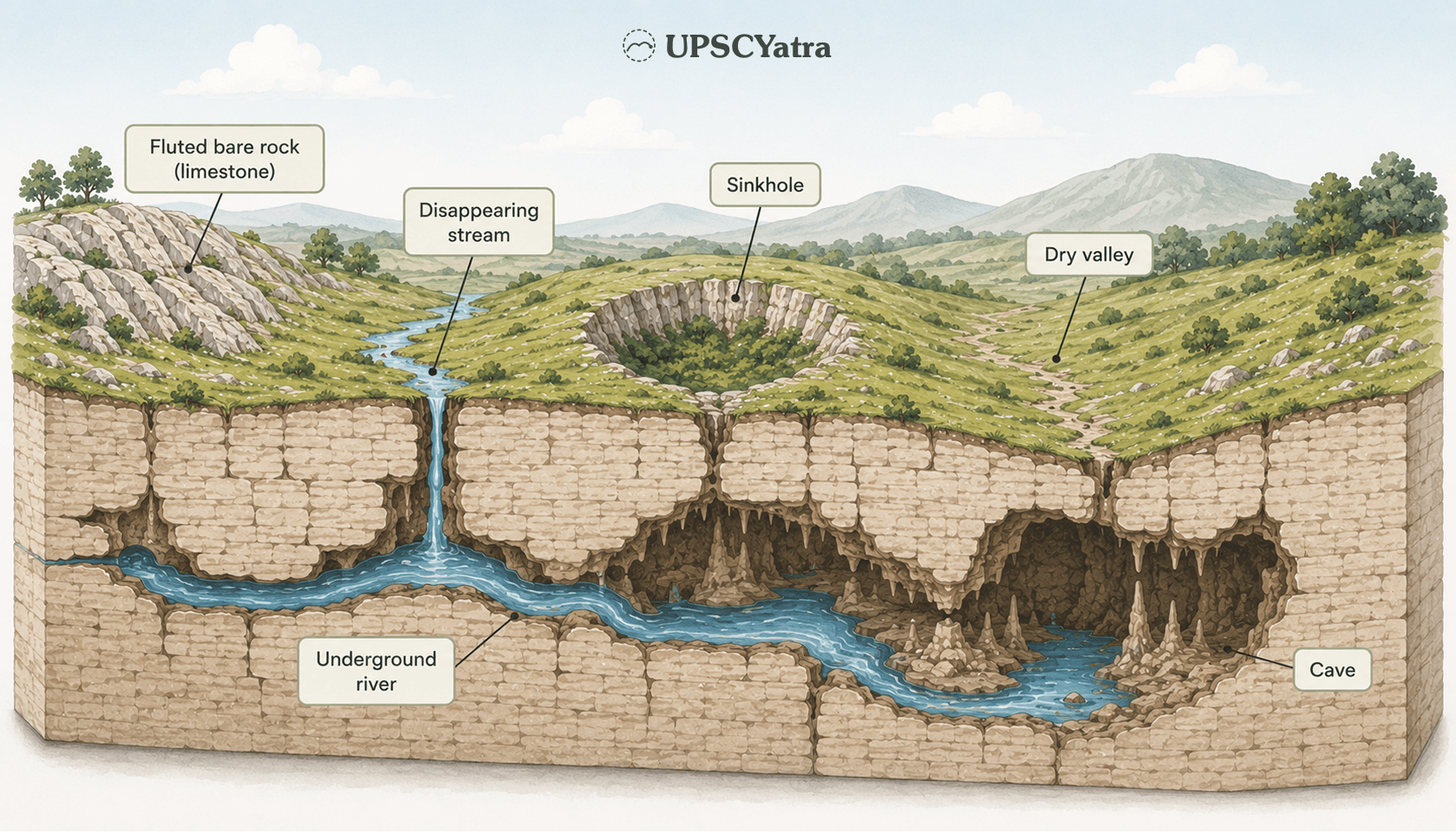
When a whole region sits on limestone, the dissolving does not just happen underground. It reshapes the surface too, into a landscape so distinctive it has its own name: .
You can spot karst country by its clues:
Meghalaya is India's great karst region. Its plateau is riddled with some of the longest cave systems in Asia, patiently dissolved out by the heaviest rainfall on Earth. All that Cherrapunji and Mawsynram rain is the perfect acid supply — the same kind of heavy monsoon rain that fuels evening thunderstorms across India's northeast.
So karst is really just the whole story written across a landscape: rock that dissolves, plus lots of water, equals caves below and a pockmarked, secretive land above.
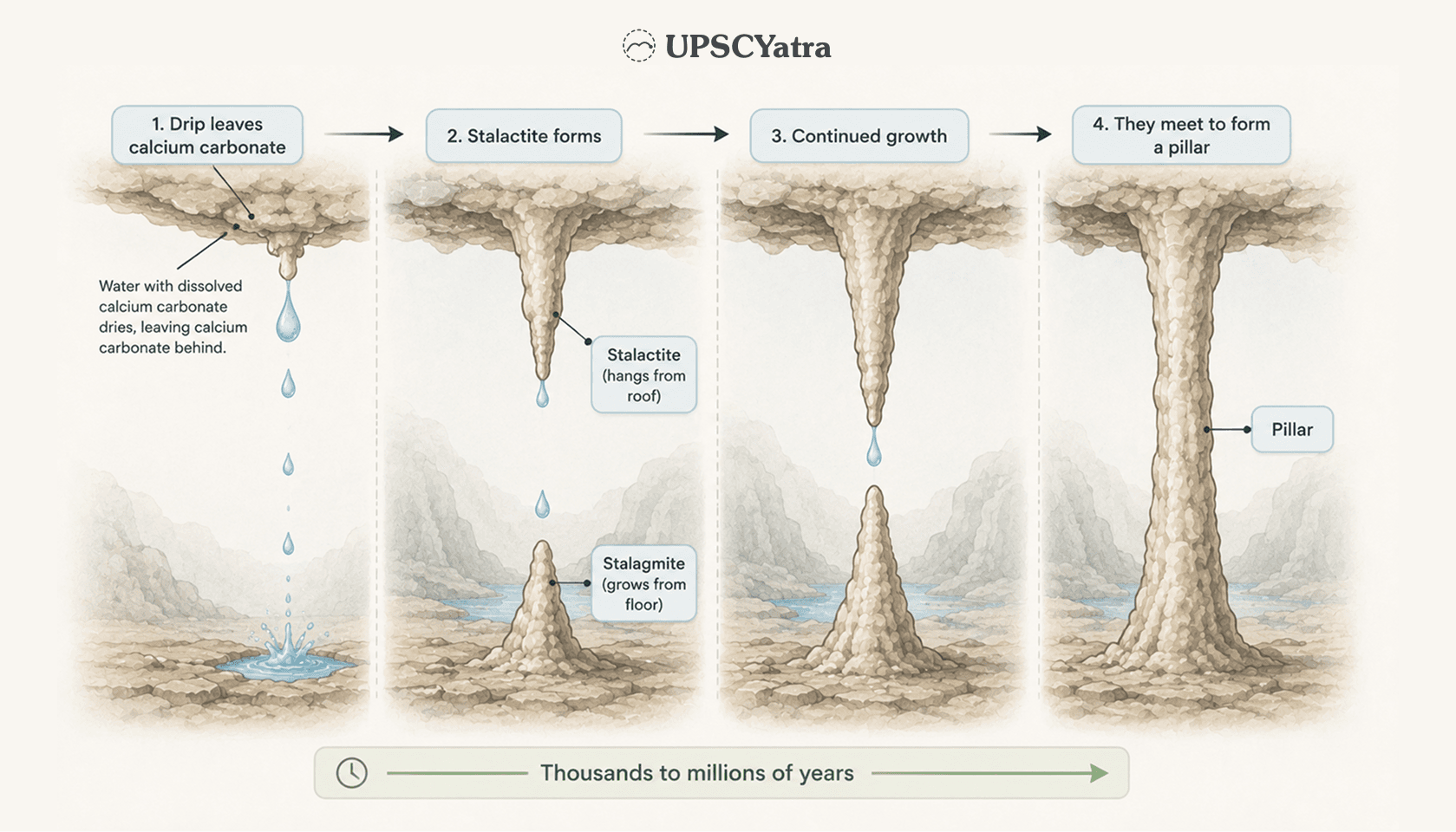
Step inside a limestone cave and you will see them: stone spikes hanging from the roof and stone mounds growing up from the floor. These are the postcard image of caves. And they form in a beautifully simple way.
Remember, the water dripping through the cave is carrying dissolved limestone in it. When a drop hangs from the roof, a tiny bit of its water evaporates and it lets go of some carbon dioxide. That forces it to leave behind a speck of calcium carbonate, the rock it was carrying.
Drop after drop, over centuries, those specks pile up:
An easy way to never mix them up: stalactites cling tight to the ceiling (the "t" is for the top); stalagmites grow up from the ground (the "m" is for the mound they build).
Together, these dripstone shapes are called . And they are the same process running in reverse. On the way in, water dissolves rock and makes the cave. Inside the cave, water lets go of rock and decorates it. Dissolving builds the room; depositing furnishes it.
You do not have to travel abroad to see any of this. India has two very different windows into limestone caves.
Meghalaya is the star. Beneath its green hills lie hundreds of caves, including some of the longest and deepest in the Indian subcontinent, like Krem Liat Prah and Krem Puri. The easy one to visit is Mawsmai Cave near Cherrapunji, a short, lit passage where you can see the dissolved walls and dripstone up close. Meghalaya works so well because it has the two ingredients in abundance: thick limestone, and record-breaking rain to supply the acid.
The Andaman Islands show the same chemistry in a coastal setting. The limestone caves of Baratang Island are reached by a boat ride through mangrove creeks and a walk through the forest. The rock here, too, is ancient marine limestone, slowly dissolved by rainwater into cool, dripping chambers.
Same rock, same reaction, two very different landscapes. One a rainy plateau, the other a tropical island. That is the quiet power of limestone: wherever it sits and wherever it rains, caves will eventually follow.
On a winter morning in those same Meghalaya hills, you might also see mist pooling in the valleys below while the ridges stay clear — another everyday geography story in why valley fog forms in mountain valleys.
Here is why this everyday curiosity matters for your preparation. Everything above is the real-world version of a topic sitting in your NCERT geography: geomorphic processes and landforms.
When your textbook talks about weathering, it splits it into physical, chemical, and biological. Limestone caves are the cleanest example of chemical weathering, specifically the process of carbonation you just watched in action.
When it talks about the work of groundwater and lists karst landforms, it is describing exactly this: caves, sinkholes, stalactites, stalagmites, and underground drainage, all born from soluble rock meeting acidic water.
So the next time you read those NCERT pages, you will not be memorising a list of hard words. You will be recognising something you already understand, because you have pictured a sugar cube dissolving in tea, a soda bottle fizzing, and a drop of water hanging patiently from a cave roof.
Limestone caves form when rainwater mixed with carbon dioxide becomes weak carbonic acid, seeps into joints in limestone, and dissolves calcium carbonate over thousands of years. The hollowed passages become caves; later, dripping water can redeposit minerals as stalactites and stalagmites.
Limestone is made of calcium carbonate, which dissolves in mildly acidic water through a process called carbonation. Rainwater becomes slightly acidic as it absorbs carbon dioxide, so it slowly dissolves the limestone from within, hollowing out caves. Most other rocks, like granite, do not dissolve this way, so large natural caves are rare in them.
Carbonation is a type of chemical weathering. Rainwater absorbs carbon dioxide from the air and soil to form weak carbonic acid. This acidic water reacts with the calcium carbonate in limestone and dissolves it, slowly widening cracks into cave passages and chambers.
Both are mineral deposits left behind by dripping water inside a cave. A stalactite hangs down from the cave roof, while a stalagmite grows upward from the floor where the drips land. Remember: stalactites cling tight to the ceiling, stalagmites grow up from the mud.
Meghalaya has some of the longest and deepest limestone caves in the subcontinent, with the accessible Mawsmai Cave near Cherrapunji. The Andaman Islands have the limestone caves of Baratang Island, reached by boat through mangrove creeks. Both formed from ancient marine limestone dissolved by acidic rainwater.
Karst topography is the distinctive landscape that develops where limestone dissolves. It features caves, sinkholes, underground rivers, disappearing streams, and dry valleys, all created as acidic water slowly eats away the soluble rock both underground and at the surface.