
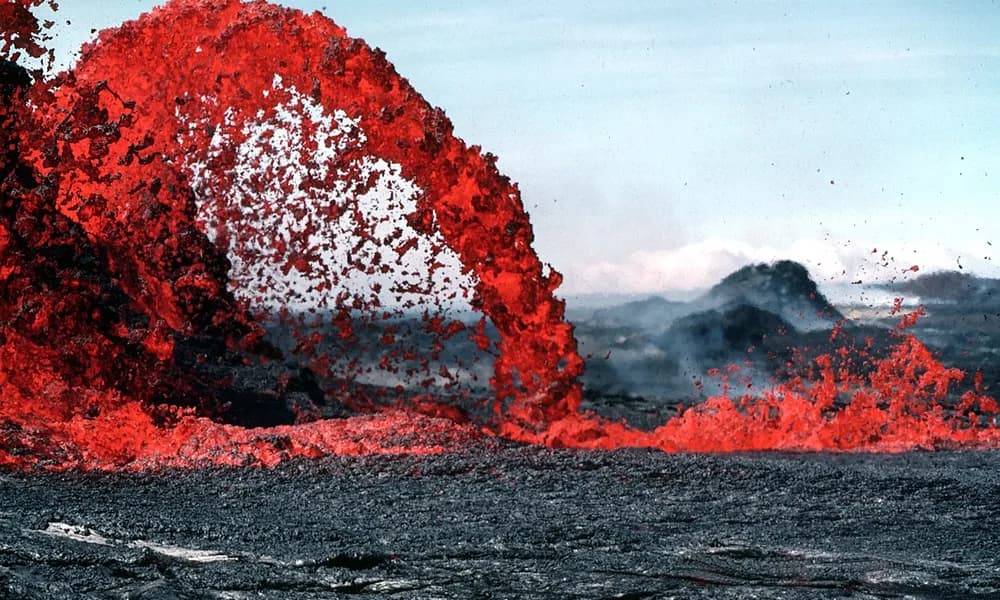
Kīlauea is an active shield volcano on the Island of Hawaiʻi, United States. It sits over the Hawaiian hotspot in the interior of the Pacific Plate, not on a plate boundary. Since 23 December 2024 the summit crater Halemaʻumaʻu, inside the caldera Kaluapele, has produced an episodic lava-fountaining eruption monitored by the USGS Hawaiian Volcano Observatory (HVO). Episode 53 ran on 12–13 August 2026. The exam trap is simple: Hawaii is not a typical Pacific Ring of Fire arc volcano.
Key highlights
- What it is: Intra-plate hotspot shield volcano; basaltic lava; Hawaiian-style fountaining.
- Where: Island of Hawaiʻi; summit at about 19.421° N, 155.287° W; elevation listed by HVO at about 1,247 m (4,091 ft).
- 2026 pulse: Episode 53 at Halemaʻumaʻu began about 3:45 p.m. HST on 12 August and ended 1:23 a.m. HST on 13 August (about 9.6 hours).
- USGS HVO numbers for that episode: North-vent fountains to about 150 m; plume to about 5,500 m above sea level.
- Status: The summit sequence that began 23 December 2024 remains the current eruptive crisis; HVO treated mid-August 2026 as a pause with another episode likely.
- Exam hook: Hawaii is not on a plate boundary. Contrast with Mount Etna (convergent stratovolcano) and Reykjanes (divergent ridge + hotspot).
- Official monitor: USGS Hawaiian Volcano Observatory.
Where is Kīlauea?
Kīlauea occupies the south-eastern slope of Hawaiʻi Island, the youngest large island in the Hawaiian chain. On a map it looks like a bulge on the flank of Mauna Loa. That appearance once led observers to treat it as a satellite vent. USGS research shows it has its own magma system, extending more than 60 km into the mantle. The summit caldera is Kaluapele. Halemaʻumaʻu is the pit crater inside that caldera where the 2024–2026 fountains have been erupting, inside a closed area of Hawaiʻi Volcanoes National Park.
Nearby towns on HVO fact sheets include Volcano, Pāhoa, Kalapana and Mountain View. The volcano also has two rift zones: a long East Rift Zone and a shorter Southwest Rift Zone. The 2024–2026 fountains have been a summit story. HVO’s mid-August 2026 updates reported no significant activity on either rift during the episode-53 pause.
| Fact | Detail |
|---|---|
| Volcano | Kīlauea |
| Island / country | Hawaiʻi Island, United States |
| Coordinates (approx.) | 19.421° N, 155.287° W |
| Summit elevation (HVO) | About 1,247 m (4,091 ft) |
| Type | Shield volcano |
| Magma | Basalt |
| Setting | Hawaiian hotspot; interior of the Pacific Plate |
| Summit caldera / crater | Kaluapele / Halemaʻumaʻu |
| Current sequence started | 23 December 2024 |
| Dated 2026 pulse | Episode 53, 12–13 August 2026 |
| Observatory | USGS Hawaiian Volcano Observatory |
Lock the pair island + crater. Prelims items on foreign volcanoes usually ask location first, then type. “Kīlauea is in Alaska” or “Kīlauea is a stratovolcano on a subduction zone” are the cheap traps.
What is a hotspot volcano?
A hotspot volcano forms where a plume of unusually hot mantle rises beneath a plate and melts the lithosphere, even though the plate is not being created or destroyed at that point. The Hawaiian Islands are the textbook case. The Pacific Plate moves roughly north-west over a relatively fixed plume. Volcanoes grow, go extinct as they ride off the plume, and a new volcano starts closer to the present melt source. The result is the Hawaiian–Emperor seamount chain: a long, age-progressive line of islands and drowned volcanoes.
That is intra-plate volcanism. The nearest plate boundary is thousands of kilometres away. There is no oceanic trench next to Hawaiʻi, no volcanic arc of andesite stratovolcanoes, and no megathrust earthquake cycle of the kind that defines Japan, the Andes or Indonesia.
Kīlauea is the current on-land eruptive centre of that chain, together with Mauna Loa. The next volcano in the sequence, still mostly submarine, is Kamaʻehuakanaloa (formerly Lōʻihi), south-east of the island. For a one-line Mains definition: hotspot volcanism is melting above a mantle plume, independent of a plate-boundary type.
India has its own hotspot memory. The Réunion plume is the standard comparison for the Deccan Traps. Hawaiʻi shows the oceanic-island end-member; the Deccan shows the continental flood-basalt end-member. Same class of deep-mantle melting, different crust.
Why Hawaii is not a Ring of Fire volcano
The Pacific Ring of Fire is a popular label for the belt of trenches, volcanic arcs and earthquakes around the Pacific. Almost every volcano in that belt sits on a convergent margin: an oceanic plate sinks, the slab dehydrates, and the overlying mantle wedge melts. The products are typically stratovolcanoes with more viscous, gas-rich magma and a higher chance of explosive eruptions.
Hawaii is inside the ring, not on it. Putting Kīlauea in the same sentence as Fuji, Krakatau or Mount St Helens without that distinction is a geography error. The Pacific Plate is the same plate that subducts at the Japan Trench and the Cascadia margin, but under Hawaiʻi that plate is simply travelling over a plume.
Three 2026 eruptions make the contrast concrete. Mount Etna is a stratovolcano on the African–Eurasian convergent margin in Sicily. Reykjanes is a fissure system where the Mid-Atlantic Ridge comes onshore, thickened by the Iceland hotspot. Kīlauea is the third type: hotspot only, no boundary.
| Volcano (2026) | Plate setting | Landform | Typical magma / style |
|---|---|---|---|
| Kīlauea | Intra-plate hotspot (Pacific Plate) | Shield | Basalt; Hawaiian fountains and lava flows |
| Etna | African–Eurasian convergence | Stratovolcano | Strombolian explosions, ash, lava flows |
| Reykjanes / Sundhnúkur | Divergent Mid-Atlantic Ridge + Iceland hotspot | Fissure row | Basalt; fissure eruptions, lava fields |
If a question says “all Pacific volcanoes are Ring of Fire volcanoes,” Hawaii is the counter-example. If it says “all basaltic volcanoes are shield volcanoes on hotspots,” Iceland’s ridge fissures and Etna’s hybrid behaviour are the counter-examples.
Shield volcano and basaltic lava
A shield volcano is a broad, gently sloping edifice built by many fluid lava flows. The name comes from the shape: a warrior’s shield laid on the ground. Basaltic magma is hot and low in silica, so it travels far before it freezes. The mountain grows sideways more than it grows into a steep cone.
Hawaiian eruptions are the reference style for that process. Gas-rich basalt can fountain from a vent, then feed pāhoehoe (smooth, ropy) or ʻaʻā (clinkery) flows. HVO’s episode-53 notice described fountaining from the north vent in Halemaʻumaʻu, overflows from the south vent, and a new west vent that produced flames and precursory overflows. That is summit-crater behaviour, not a flank-destroying Plinian column.
Do not flatten every basaltic eruption into “gentle.” The 2018 lower East Rift Zone outbreak destroyed neighbourhoods, drained the summit lava lake, and collapsed parts of Kaluapele. Fluid lava is still lava. The UPSC distinction is about relative explosivity and landform, not about safety.
Mauna Loa is the larger shield; Mauna Kea is a post-shield giant; Kīlauea is the younger, frequently erupting neighbour. HVO is explicit that Kīlauea is not a vent on Mauna Loa. In an answer, “one of the world’s most active volcanoes” is fair; “the largest volcano on Earth” is Mauna Loa (or, if the question is about the whole edifice from the seafloor, still not Kīlauea).
Halemaʻumaʻu and the 2026 summit sequence
The current summit eruption began on 23 December 2024 from north and south vents in Halemaʻumaʻu. HVO describes it as episodic: lava-fountaining pulses that generally last less than 12 hours, separated by pauses of two or more weeks. USGS numbers those pulses as episodes. The dated pulse in the Places in News record is episode 53 on 12–13 August 2026.
HVO’s 13–15 August 2026 notices give the operational facts for that pulse. Fountaining began around 3:45 p.m. HST on 12 August and ended abruptly at 1:23 a.m. HST on 13 August, after about 9.6 hours. The north vent reached about 150 metres. The south vent did not fountain in that episode. A collapse pit behind the south vent became a new west vent. The gas-and-ash plume reached about 5,500 metres above sea level. Tephra fall was mostly inside the closed park area, south-west of the vents. After the fountains stopped, summit tiltmeters recorded reinflation. HVO kept the volcano at Advisory and aviation colour Yellow during the pause, and said another episode was likely once more tilt data arrived.
That pause is not the same as “the volcano is finished.” Episodic summit eruptions can look quiet for days and then fountain again. For current-affairs notes, write ongoing summit sequence, latest dated pulse episode 53, not a single-day eruption that started and ended in August.
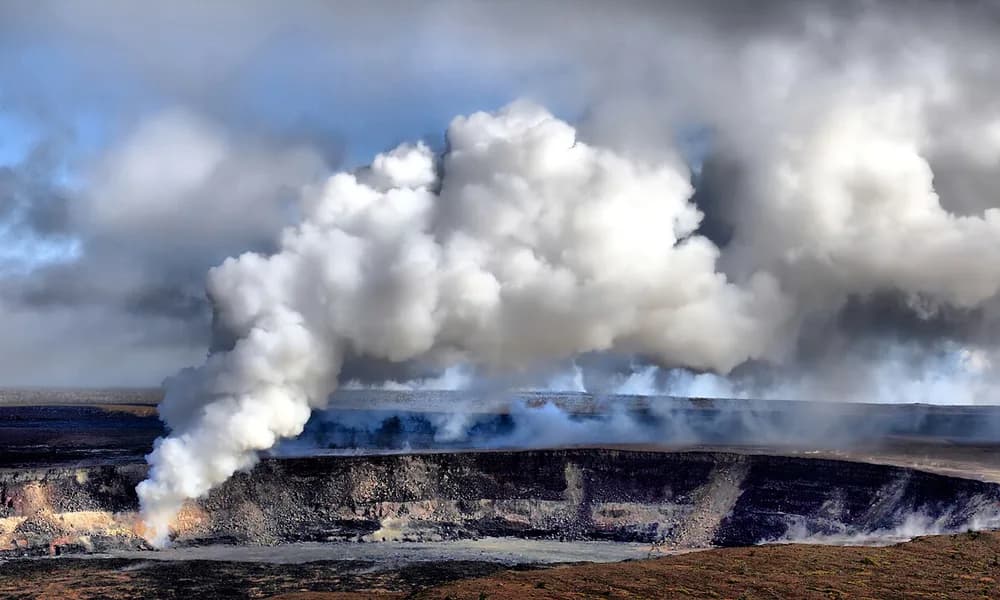
The longer memory matters for GS-1. From 1983 to 2018 the East Rift Zone erupted almost continuously at Puʻuʻōʻō and related vents. From 2008 to 2018 Halemaʻumaʻu held a lava lake. In 2018 that system collapsed. Summit eruptions since December 2020 have been refilling the collapsed crater. In 2024 magma also used the Southwest and East Rift Zones, including the September Nāpau eruption. The December 2024–2026 sequence brought activity back to the summit vents. One volcano, several preferred pathways.
How USGS HVO watches a hotspot shield
The Hawaiian Volcano Observatory is the USGS office that monitors Hawaiʻi’s volcanoes and earthquakes. Daily updates for Kīlauea combine tiltmeters, seismometers, webcams, gas measurements and field observations. During episode 53 the Uēkahuna (UWD) tiltmeter recorded about 14.0 microradians of deflation while lava was leaving the summit reservoir, then inflation when the fountains died. That deflation-to-inflation switch is the observatory’s short-term clue that the reservoir is refilling.
HVO also publishes aviation colour codes and ground alert levels. Advisory / Yellow during a pause means the system is restless and another outbreak is possible, not that tourists should walk to the crater rim. The caldera rim around Halemaʻumaʻu has been closed to the public since late 2007 because of collapse, rockfall and gas. Sulfur dioxide remains a hazard even between fountains; HVO’s inter-episode range is typically 1,000 to 5,000 tonnes per day.
For an Indian reader the institutional parallel is IMD / National Centre for Seismology plus a specialised volcano desk. India has only one historically active volcano, Barren Island in the Andaman Sea, and that one is an arc volcano above the subducting Indian Plate — the opposite tectonic class from Kīlauea.
Why this matters for UPSC
Physical geography papers and Prelims map questions still treat volcano type as a classification drill. Kīlauea is the cleanest living example of the class that textbooks draw and then immediately confuse with Indonesia.
Prelims. Expect a statement set: Kīlauea is a shield volcano; it is on a hotspot; it is not on a destructive plate boundary; its lava is basaltic. A second statement may dump it into the Ring of Fire. Mark that false. A third trap places it on the Mid-Atlantic Ridge or in Sicily.
GS-1 (geomorphology). Use Kīlauea to define hotspot, intra-plate melting, shield morphology and Hawaiian eruptive style. Then spend one sentence on the 2026 contrast set: Etna for convergence and stratovolcano form; Reykjanes for divergence and fissures. Three settings, three landforms, one year.
Disaster management (GS-3). Fluid lava, volcanic gas (vog), tephra and crater-wall collapse are the Hawaiian hazard list. Aviation disruption is usually smaller than at Etna because the fountains are short and the plume is often modest, but SO₂ and fine glass still matter. Do not copy-paste “pyroclastic flows and lahars” from a Cascade or Andes case study onto Kīlauea unless the question is about a different volcano.
India link. Deccan Traps / Réunion plume for flood basalt; Barren Island for the Indian arc volcano. Kīlauea is the oceanic-island teaching case, not an Indian site.
This explainer sits with the Places in News timeline, which logs the same ongoing summit eruption.
Facts that are easy to mix up
Hotspot versus Ring of Fire. The Pacific Plate has both. Subduction makes the ring. The plume makes Hawaii. They are not the same map.
Shield versus stratovolcano. Kīlauea is a shield. Etna is a stratovolcano. Both can erupt basalt. Form follows long-term eruptive style, not a single night of fountains.
Summit versus rift. Episode 53 was in Halemaʻumaʻu. The 2018 disaster was on the lower East Rift Zone. “Kīlauea always erupts at the summit” is false.
Kīlauea versus Mauna Loa. Separate magma systems. Mauna Loa is taller and more massive. Kīlauea erupts more often in the modern record.
Episode 53 versus the whole eruption. The sequence began 23 December 2024. Episode 53 is one dated pulse in August 2026. Do not invent later episode numbers from secondary blogs.
Hawaii versus Iceland. Both produce basalt. Iceland also sits on a divergent plate boundary. Hawaii does not.
Prelims snapshot
| Question type | Answer to lock |
|---|---|
| Country / island | United States / Hawaiʻi Island |
| Plate setting | Intra-plate hotspot (Pacific Plate) |
| Landform | Shield volcano |
| Magma | Basalt |
| Summit crater | Halemaʻumaʻu, in Kaluapele |
| Ring of Fire? | No — not a plate-boundary arc |
| 2026 dated pulse | Episode 53, 12–13 August 2026 |
| Sequence start | 23 December 2024 |
| Observatory | USGS HVO |
| Contrast pair | Etna (convergent stratovolcano); Reykjanes (divergent fissures) |
Frequently asked questions
What is the Kilauea volcano eruption in 2026?
It is the continuation of an episodic summit eruption that began on 23 December 2024 in Halemaʻumaʻu crater. The dated 2026 pulse in official HVO notices is episode 53 on 12–13 August 2026, with about 9.6 hours of lava fountaining from the north vent.
Is Kilauea on the Ring of Fire?
No. Kīlauea sits in the interior of the Pacific Plate above the Hawaiian hotspot. The Ring of Fire is the belt of subduction-zone volcanoes and earthquakes around the Pacific margin. Hawaii is inside that ring, not on it.
Why is Kilauea called a shield volcano?
Repeated fluid basaltic flows have built a broad, gently sloping mountain rather than a steep cone. USGS classifies Kīlauea as a shield volcano of basaltic composition. That landform is the long-term product of Hawaiian-style eruptions.
Where is Halemaʻumaʻu?
Halemaʻumaʻu is a crater inside Kaluapele, Kīlauea’s summit caldera, in Hawaiʻi Volcanoes National Park. The 2024–2026 fountains have come from vents on its floor. The immediate crater area is closed because of collapse, gas and tephra hazards.
What did USGS HVO report for episode 53?
HVO said episode 53 began about 3:45 p.m. HST on 12 August 2026 and ended at 1:23 a.m. HST on 13 August. North-vent fountains reached about 150 metres; the plume reached about 5,500 metres above sea level. After the pulse, tiltmeters showed reinflation and HVO said another episode was likely.
How is Kilauea different from Mount Etna and Reykjanes?
Kīlauea is hotspot-only shield volcanism. Etna is a stratovolcano on a convergent African–Eurasian setting. Reykjanes is a fissure system on the Mid-Atlantic Ridge, also influenced by the Iceland hotspot. All three were in the news in 2026; the plate setting is what distinguishes them.
What should UPSC aspirants remember about Kilauea?
Hawaiʻi Island; hotspot; shield; basalt; Halemaʻumaʻu; not a plate boundary; not a typical Ring of Fire volcano; USGS HVO; episode 53 on 12–13 August 2026; sequence since 23 December 2024; contrast with Etna and Reykjanes.