
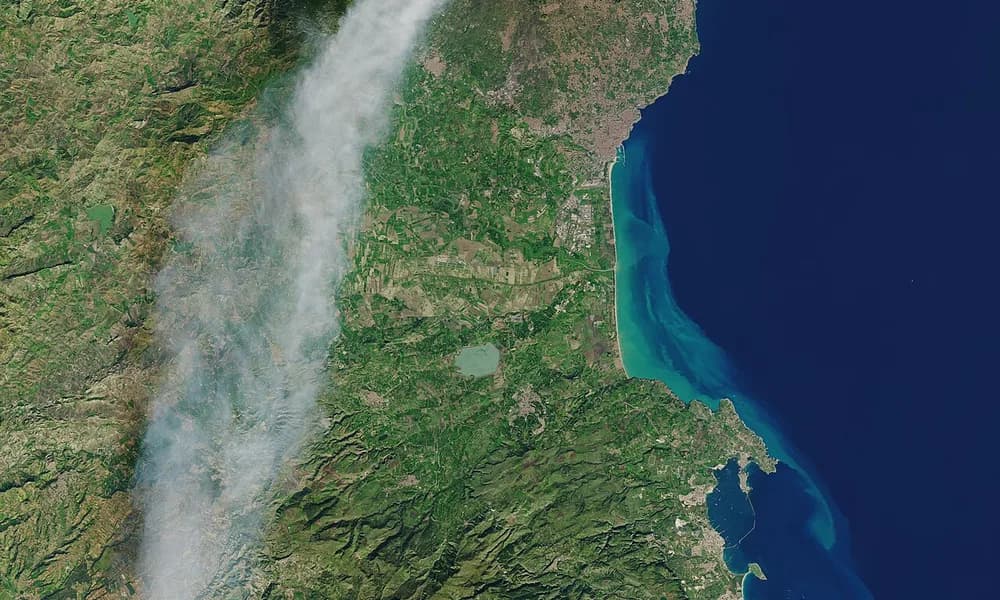
Mount Etna is Europe’s most active volcano: a stratovolcano on the east coast of Sicily, Italy. It stands at the African–Eurasian convergent margin, where African lithosphere is moving north toward Eurasia and the Ionian slab sinks beneath the Calabrian Arc. Through 2026 the mountain produced repeated Strombolian explosions, ash plumes and lava flows. That is a different tectonic class from Kīlauea, a hotspot shield in the middle of the Pacific Plate, and from Reykjanes, a divergent-ridge fissure system in Iceland.
Key highlights
- What it is: Stratovolcano (composite cone) on a convergent African–Eurasian setting; Europe’s most active volcano.
- Where: Eastern Sicily, Italy; about 37.748° N, 14.999° E; Smithsonian GVP elevation 3,357 m.
- 2026 behaviour: Ongoing Strombolian activity and lava flows, not a single-day blast. INGV documented a stronger August phase at Voragine plus new vents in the Valle del Bove.
- Style: Intermittent explosions of scoria and ash, lava fountains, and flank flows — named Strombolian after nearby Stromboli.
- Human impact: Ash repeatedly disrupted Catania-Fontanarossa Airport; lava stayed in uninhabited drainages in the August 2026 notices.
- Exam hook: Convergent-margin stratovolcano versus Hawaii’s intra-plate shield and Iceland’s Mid-Atlantic fissures.
- Official monitor: INGV Osservatorio Etneo, Catania.
Where is Mount Etna?
Etna rises on Sicily’s Ionian side, above the city of Catania and a ring of towns on its southern and eastern flanks. The Smithsonian Global Volcanism Program lists the summit at 37.748° N, 14.999° E and 3,357 metres. Summit height changes as cones grow and collapse; INGV aviation notices often round it to about 3,300 m. For map work, use the GVP coordinate pair and “eastern Sicily.”
The upper mountain is a cluster of summit craters, not one neat chimney. The names that appear in 2026 INGV and GVP reports are Voragine (VOR), Bocca Nuova (BN), Northeast Crater (NEC) and Southeast Crater (SEC). East of the summit, the Valle del Bove is a large horseshoe depression that has captured many historic lava flows. In August 2026, new vents opened in the Valle del Leone (the upper Valle del Bove) and lower down the same drainage.
| Fact | Detail |
|---|---|
| Volcano | Mount Etna (Etna) |
| Island / country | Sicily, Italy |
| Coordinates (approx.) | 37.748° N, 14.999° E |
| Elevation (GVP) | 3,357 m |
| Type | Stratovolcano (composite) |
| Plate setting | African–Eurasian convergence; Calabrian / Ionian context |
| Typical 2026 style | Strombolian explosions, ash, lava flows |
| Summit craters | Voragine, Bocca Nuova, Northeast, Southeast |
| Flank drainage | Valle del Bove |
| Observatory | INGV Osservatorio Etneo (Catania) |
| UNESCO | Mount Etna World Heritage site (2013) |
Aspirants should keep Sicily + stratovolcano + Africa–Eurasia as a single bundle. “Etna is in mainland Italy” and “Etna is a Hawaiian-type shield” are the usual wrong options.
What is a stratovolcano?
A stratovolcano, or composite volcano, is a steep-sided cone built from alternating layers of lava, ash and volcanic bombs. The magma is often more viscous and more gas-rich than Hawaiian basalt, so eruptions can be explosive. The classic textbook picture is an andesitic arc volcano: Fuji, Vesuvius, or a Cascade peak.
Etna complicates that cartoon in a useful way. It is a stratovolcano in form — a tall, layered mountain with summit craters and pyroclastic deposits — but much of its lava is still basaltic to trachybasaltic. Fluid flows can travel kilometres down the Valle del Bove even while the summit is throwing ash. The lesson for Prelims is: landform and silica content are related, not identical. A convergent setting favours composite cones; it does not forbid basalt.
Strombolian activity is the style INGV keeps naming in 2026. It means rhythmic explosions that throw incandescent scoria and bombs a few hundred metres, often with a pulsing ash cloud. The name comes from Stromboli, another Aeolian volcano north of Sicily. Strombolian events are more explosive than a quiet Hawaiian pāhoehoe sheet and less catastrophic than a Plinian column. They can still close an airport when the wind blows ash over a runway.
Etna also produces lava fountains (paroxysms) and, when loose hot material collapses, small pyroclastic flows. GVP’s weekly report for 6–12 August 2026 recorded pyroclastic flows generated by the collapse of loose material near new Valle del Bove vents. That is a hazard class Hawaiian episode-53 fountains inside a closed crater did not present to towns.
African–Eurasian convergence, not a Pacific arc
Sicily sits where the African Plate is converging with Eurasia. To the east, Ionian oceanic lithosphere sinks beneath the Calabrian Arc. To the west, the collision is more continental. Etna is not a simple one-trench, one-arc cartoon like the Sunda Arc. It is still a convergent-margin volcano: compression, a nearby subducting slab, and a long-lived central cone.
That is the opposite of Kīlauea. Kīlauea has no trench, no colliding continent, and no volcanic arc. It is a hotspot punch through the Pacific Plate. Etna’s 2026 news is therefore not “another Hawaii.” It is Europe’s working example of the class Indian textbooks attach to the Alps–Himalaya collision story, even though Etna’s melt is not Himalayan granite.
Compare the third 2026 case. Reykjanes sits on a divergent boundary. Plates move apart; fissures open; lava floods a peninsula. Etna’s plates move together; the edifice is a piled cone; ash is part of the weekly weather. One year, three boundary types.
| Feature | Etna | Kīlauea | Reykjanes / Sundhnúkur |
|---|---|---|---|
| Boundary type | Convergent (Africa–Eurasia) | None (intra-plate hotspot) | Divergent (Mid-Atlantic Ridge) + hotspot |
| Landform | Stratovolcano | Shield | Fissure / crater row |
| 2026 signature | Strombolian ash + lava | Summit lava fountains | Magma under Svartsengi; fissure lava fields |
| Aviation issue | Ash over Catania | Usually local tephra / gas | Gas and, in large events, ash |
| Monitor | INGV Catania | USGS HVO | Icelandic Met Office |
For Mains, one paragraph can carry the whole contrast. Do not write three separate “volcano essays” that repeat “lava is dangerous.”
What INGV reported in 2026
The Istituto Nazionale di Geofisica e Vulcanologia (INGV), through the Osservatorio Etneo in Catania, is the scientific authority. It issues camera and seismic interpretations, field reports, and Volcano Observatory Notices for Aviation (VONA) with a colour code: Green, Yellow, Orange, Red.
Etna was already in a multi-year eruptive period before 2026. The Places in News card treats 2026 as continuous activity, dated from April, not as a volcano that suddenly “started” in August. The August intensification is the best-documented pulse for revision.
GVP, citing INGV, reconstructed the week of 6–12 August 2026. An explosion at 02:50 on 6 August opened a stronger Strombolian phase at Voragine. That night the activity rose into a lava fountain; the aviation colour code went to Orange and then Red. Ash fell on Ragalna, Adrano, Piano Vetore and Nicolosi. On 7 August a new vent opened at about 2,750 m in the Valle del Leone and sent flows past Monte Simone. On 8 August another vent opened at about 2,360 m near Monte Rittmann, with small pyroclastic flows from collapsing loose material. Further vents opened near Monte Simone at about 1,900 m (10 August) and 2,090 m (11 August). By 12 August the most advanced front, fed from the 1,900 m vent, was near Rocca Capra at about 1,365 m. The aviation code was Red at the end of that week.
An INGV VONA at 13:52 UTC on 8 August had briefly dropped the colour to Orange while explosive activity decreased, with lava still observed in the Valle del Leone and Valle del Bove. The oscillation between Orange and Red is itself a teaching point: Etna’s output changes over hours, and aviation risk tracks the ash, not the prettiest lava photograph.
Salvo Gambino, director of the Etnean Observatory, told European media that the unusual feature of the August phase was duration. Recent paroxysms often lasted hours; this sequence ran for days with summit fountains and flank vents at the same time. He also said the flows were not threatening inhabited areas. The disruption was the plume. Southerly winds pushed ash toward Catania airport and beyond Sicily. Italy’s civil-protection minister noted the awkward geography: the airport is close to the volcano, so even a “normal” Etna week can stop flights.
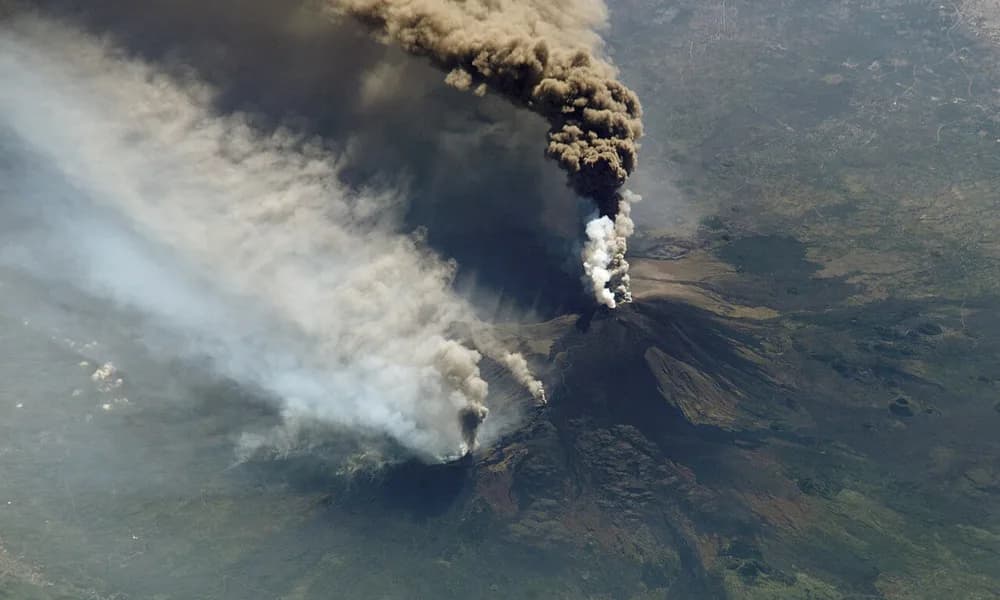
Do not invent a single lava-volume figure for 2026. INGV and GVP describe vents, elevations and ash direction. That is enough for an exam note. Secondary travel articles that guess tourist numbers or cubic metres are not sources.
Ash, airports and living on a stratovolcano
Catania-Fontanarossa sits on the southern apron of Etna. Fine ash damages jet engines and makes runways unusable. In the August 2026 phase the airport closed, reopened when the colour code eased, and closed again when Voragine picked up. That on-off pattern is typical of a frequently active composite volcano next to a city. It is not the same problem as a Hawaiian fountain inside a closed national-park crater, and not the same as a Reykjanes fissure next to a small fishing town and a geothermal plant.
Other Etna hazards belong in a GS-3 paragraph: ballistic bombs near the summit, lava in the Valle del Bove, gas, and occasional pyroclastic flows from collapsing cones. Large historical flank eruptions have reached cultivated land. The 2026 August fronts, as reported, remained in the uninhabited valley. “No town buried” is not “no risk.” Hiking on the upper mountain during a paroxysm is the behaviour INGV keeps warning against.
Etna has been a UNESCO World Heritage site since 2013, listed for its exceptional record of documented eruptions and as a natural laboratory. Heritage status does not pause magma. It does explain why the mountain is both a scientific observatory and a tourist landscape — a combination that makes aviation and trail closures politically visible.
Why this matters for UPSC
Prelims. Location (Sicily, Italy), type (stratovolcano), setting (African–Eurasian convergence), style (Strombolian), monitor (INGV). False statements to expect: Etna is on the Mid-Atlantic Ridge; Etna is a hotspot shield like Kīlauea; Etna is in Greece; Etna is dormant.
GS-1. Use Etna to define convergent-margin volcanism in the Mediterranean, then contrast the 2026 trio. The Mediterranean is not only “fold mountains.” It still has live magma. Pair Etna with Vesuvius and Stromboli if the question is Italian volcanoes; pair it with Kīlauea and Reykjanes if the question is plate-boundary types.
GS-3 / disaster management. Ash-aviation coupling is the modern Etna case. India’s analogue for ash and aviation is thinner (Barren Island is remote), so Etna is the imported example. Do not import Hawaiian vog or Icelandic fissure-and-town evacuation as if they were Etna’s main 2026 story.
Map. Eastern Sicily, Ionian Sea to the east, Catania on the south flank, Aeolian Islands (Stromboli, Vulcano) to the north. Etna is not in the Alps and not on the Italian boot’s toe — that is the Aspromonte / Calabria side of the same convergent system.
This explainer sits with the Places in News timeline.
Facts that are easy to mix up
Stratovolcano versus shield. Etna is the cone. Kīlauea is the shield. Both can erupt basalt. The form is still different.
Strombolian versus Hawaiian versus Plinian. Strombolian = rhythmic explosions and scoria. Hawaiian = fluid fountains and lava sheets. Plinian = high, sustained ash column. August 2026 at Voragine moved between Strombolian and fountaining; it was not a Pompeii-scale Plinian blast.
Etna versus Vesuvius. Vesuvius is the Bay of Naples volcano of 79 CE. Etna is Sicily. Mixing the two cities is a common rush-hour error.
Convergent versus Ring of Fire. Etna is convergent, but it is not on the Pacific Ring of Fire. The ring is a Pacific map. The Africa–Eurasia collision is a Mediterranean–Alpine map.
One eruption day versus ongoing activity. The Places in News date is 10 April 2026 because the mountain was already active. August is a documented intensification, not the only 2026 activity.
Valle del Bove versus Catania. Lava in the valley is not the same as lava in the city. Ash in the city can still close the airport.
Prelims snapshot
| Question type | Answer to lock |
|---|---|
| Country / island | Italy / Sicily |
| Plate setting | African–Eurasian convergence |
| Landform | Stratovolcano |
| 2026 style | Strombolian activity, ash, lava flows |
| Observatory | INGV Osservatorio Etneo |
| Summit crater named in August 2026 | Voragine |
| Flank valley | Valle del Bove |
| Nearby city / airport | Catania |
| Contrast | Kīlauea (hotspot shield); Reykjanes (divergent fissures) |
| UNESCO | World Heritage site, 2013 |
Frequently asked questions
What is the Mount Etna eruption in 2026?
It is continuing activity at Europe’s most active stratovolcano in Sicily: repeated Strombolian explosions, ash plumes and lava flows through 2026. INGV and GVP documented a stronger phase from 6 August 2026 at Voragine, with new lava vents in the Valle del Bove.
Why is Etna a stratovolcano if some lava is basaltic?
A stratovolcano is defined by its layered, steep cone and mixed explosive-effusive history, not by a single chemical analysis. Etna builds that cone on a convergent margin even though many flows are still relatively fluid. Form and magma chemistry should be stated separately in an answer.
Is Mount Etna on the same plate boundary as Kilauea?
No. Etna is on the African–Eurasian convergent setting. Kīlauea is an intra-plate hotspot volcano in Hawaii and is not on a plate boundary at all. Reykjanes is the divergent-boundary member of the 2026 set.
What is Strombolian activity?
Strombolian activity is a series of discrete explosions that throw incandescent scoria, bombs and ash, named after Stromboli. It is more explosive than a quiet Hawaiian lava flow and less extreme than a Plinian eruption. It is the style INGV most often assigned to Etna in 2026.
Who monitors Etna?
Italy’s INGV Osservatorio Etneo in Catania. It issues scientific bulletins and VONA aviation colour codes. The Smithsonian Global Volcanism Program summarises those notices for a global audience.
Did lava destroy Catania in August 2026?
No. INGV reporting placed the August lava fronts in the Valle del Bove drainage, not in the city. The main public disruption was volcanic ash at Catania airport and on southern-flank towns.
What should UPSC aspirants remember about Etna?
Sicily; stratovolcano; African–Eurasian convergence; Strombolian; INGV; Voragine and Valle del Bove in the August 2026 pulse; Europe’s most active volcano; contrast with Kīlauea (hotspot shield) and Reykjanes (ridge fissures).