
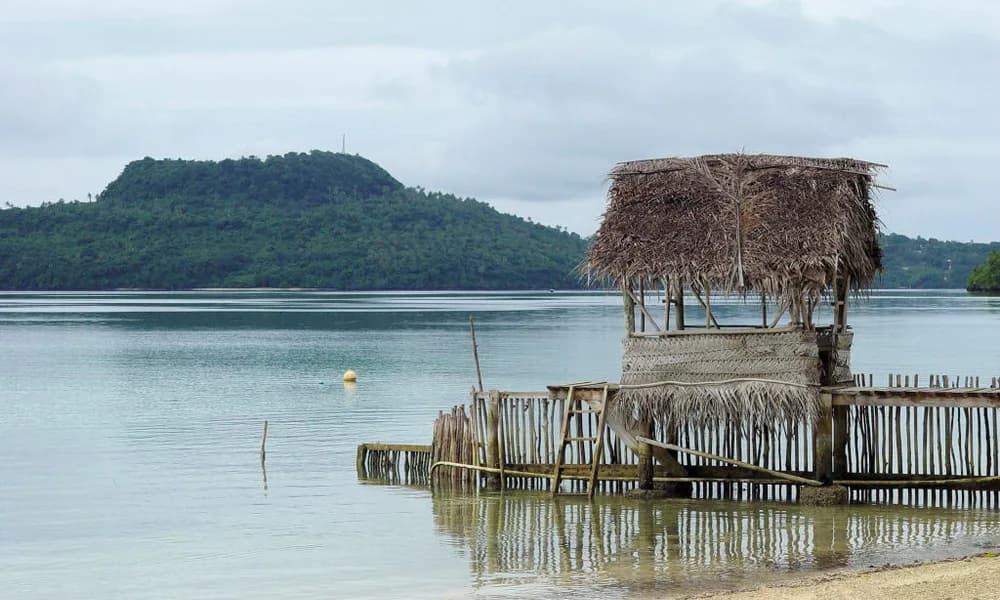
An M7.5 earthquake struck offshore Vava'u, Tonga, on 24 March 2026. The hypocentre sat at about 230 km depth. There were no fatalities. As of that date it was the strongest earthquake of 2026. The setting is the Tonga Trench, where the Pacific Plate subducts westward — one of Earth’s deepest and most active convergent margins. Magnitude alone does not decide damage or tsunami risk. Depth and whether the rupture offsets the seafloor do.
Key highlights
- Date: 24 March 2026.
- Magnitude: M7.5 — strongest earthquake of 2026 as of that date.
- Location: Offshore Vava'u, Tonga, South Pacific.
- Depth: about 230 km (intermediate, not deep-focus).
- Casualties: no fatalities.
- Tectonics: Pacific Plate subducting at the Tonga Trench.
- Exam hook: a strong quake at this depth typically does not generate a tsunami; contrast with shallow megathrust events such as the Mindanao earthquake 2026.
Where is Tonga, and where was the epicentre?
Tonga is a Polynesian island kingdom in the south-west Pacific, east of Fiji and north of New Zealand. The inhabited islands sit on the overriding plate. The trench itself lies to the east, where the Pacific seafloor bends down. The March 2026 epicentre was offshore Vava'u, the northern island group, not under the capital Nukuʻalofa on Tongatapu.
Map work for Prelims is simple if you keep three names distinct. Tonga is the country. Vava'u is the island group nearest this epicentre. The Tonga Trench is the seafloor depression to the east, the surface expression of the subduction zone. A statement that “the Tonga Trench is in New Zealand” is false; the trench system continues south as the Kermadec Trench, but this event belongs to the Tonga segment.
| Fact | Detail |
|---|---|
| Date | 24 March 2026 |
| Magnitude | M7.5 |
| Depth | about 230 km |
| Casualties | None reported |
| Place | Offshore Vava'u, Tonga |
| Coordinates (approx.) | 18.6° S, 174° W |
| Plate setting | Pacific Plate subducting at the Tonga Trench |
| Depth class | Intermediate (70–300 km) |
| Tsunami from this event | Not expected from a rupture this deep |
Coordinates in the event record are longitude −174, latitude −18.6. Write them as 18.6° S, 174° W in an answer. Do not flip the pair.
What the Tonga Trench is
The Tonga Trench is a convergent plate boundary. The Pacific Plate — the largest oceanic plate — moves westward and dives beneath the plate that carries the Tonga arc. That descent creates a narrow, extremely deep seafloor trough. Among ocean trenches it is one of Earth’s deepest, in the same class as the Mariana, Philippine, and Kermadec trenches. “Deepest trench” in a casual sentence usually means the Mariana Trench (Challenger Deep). Tonga is the correct answer when the question is about the south-west Pacific arc, the fastest Pacific subduction, or the island chain east of Fiji.
Subduction here is not a slow academic diagram. Convergence along the Tonga–Kermadec system is among the fastest on the planet. Fast descent produces a long, steep Wadati–Benioff zone: a dipping sheet of earthquakes that traces the cold slab from the trench down into the mantle. Shallow events cluster near the trench and the volcanic arc. Intermediate events, such as this M7.5, sit inside the descending slab. Deep-focus events, deeper than about 300 km, occur still further down the same slab — Tonga is one of the few places on Earth where that deep tail is well recorded.
The volcanic islands of Tonga are the surface expression of melting above the slab. The 2022 Hunga Tonga–Hunga Haʻapai eruption is a separate current-affairs item (volcanism and a meteorological tsunami). Do not merge that eruption with the March 2026 earthquake. Same arc, different process.
Deep-focus, intermediate, and shallow — the definition that decides this event
UPSC and standard seismology use a three-fold depth classification. Learn the boundaries as numbers, then apply them.
| Class | Typical depth | Where it usually occurs | Surface effect |
|---|---|---|---|
| Shallow | 0–70 km | Crust, plate interface, upper slab | Strong shaking; tsunami possible if the seafloor moves |
| Intermediate | 70–300 km | Inside the descending slab | Felt over a wide area; tsunami unlikely |
| Deep-focus | greater than 300 km | Lower Wadati–Benioff zone | Often little damage; no tsunami |
The Tonga event at about 230 km is intermediate. It is “deepish” compared with a crustal quake under a city, but it is not a deep-focus earthquake. Deep-focus is a reserved term. The Sabah Malaysia earthquake 2026 at about 629 km is the 2026 teaching case for that class. The Hindu Kush earthquake felt in India at about 188 km is another intermediate event — closer to Tonga in depth class, different in plate setting (India–Eurasia collision, not Pacific subduction).
Why does the classification matter? Seismic waves from a deep hypocentre spread through a larger volume of rock before they reach the surface. Intensity at any one town is lower than for a shallow quake of the same magnitude. Buildings on Tonga’s islands were not sitting on top of a 10 km rupture. They were sitting above a source more than two hundred kilometres down.
Why a strong quake may not equal a tsunami
A tsunami is a sea wave generated by a sudden displacement of the water column. The usual tectonic cause is a shallow megathrust: the plate interface ruptures, the seafloor is jacked up or dropped, and the ocean above it is displaced. Magnitude helps — a larger rupture moves more seafloor — but depth and mechanism decide whether the seafloor moves at all.
At about 230 km, the rupture is inside the slab, far below the ocean floor. The seafloor does not lurch as a single block. Water is not displaced in the way a trench-interface earthquake displaces it. That is why a “major” Pacific earthquake can still produce no tsunami. Preliminary news alerts often trigger coastal precaution in Tonga because the country is low-lying and the 2022 volcanic tsunami is still in living memory. Precaution is not the same as a confirmed tsunami. For an exam answer, write: strong magnitude, intermediate depth, no seafloor offset, no tsunami expected.
Contrast this with the Mindanao earthquake 2026: an M7.8 thrust event off southern Mindanao that triggered regional tsunami warnings. That is the shallow-interface pattern. The Pacitan Java earthquake 2026 was also a thrust on the Sunda subduction zone — the same family of mechanism — but at M5.8 it was too small to generate a destructive wave, even though the same Java margin produced tsunamigenic earthquakes in 1994 and 2006.
Three 2026 Pacific-margin events, three different lessons:
| Event | Magnitude | Depth class | Tsunami lesson |
|---|---|---|---|
| Tonga, 24 March 2026 | M7.5 | Intermediate (~230 km) | Strong ≠ tsunami if the rupture is too deep |
| Pacitan, 6 February 2026 | M5.8 | Shallow thrust | Right mechanism, insufficient size |
| Mindanao, 8 June 2026 | M7.8 | Shallow thrust | Interface rupture → regional warnings |
Pacific Plate, Ring of Fire, and what “subduction” means here
The Pacific Plate is being consumed at almost every western and northern margin: Japan Trench, Izu–Bonin–Mariana, Philippine, Tonga–Kermadec, and the Aleutians. That ring of trenches, arcs, and volcanoes is the Ring of Fire. Tonga is a clean example because the geometry is simple to draw: oceanic plate in the east, trench, volcanic islands, back-arc basin toward Fiji.
“Pacific Plate subducting” is the phrase to lock. Do not write that Tonga sits on the Pacific Plate in the sense of riding the incoming slab. The islands sit on the overriding side. The incoming plate is the Pacific seafloor. A common Prelims trap swaps the two.
The Tonga slab is also a favourite of geophysicists because it produces earthquakes to great depth. That does not mean every Tonga earthquake is deep-focus. This one was not. If a question says “deep-focus earthquake in Tonga, March 2026,” the statement is false on the standard 300 km cutoff.
Why there were no fatalities
Tonga is sparsely populated relative to Java or Mindanao. The epicentre was offshore. The source was about 230 km down. Those three facts together explain a high-magnitude event with no fatalities. Magnitude is a measure of energy at the source, not a death-toll predictor. The Hindu Kush event of 3 April 2026 was only M5.8 and still killed people because the setting, building stock, and — in that case — a still-damaging intermediate source under a mountain population were different. Do not rank 2026 earthquakes by magnitude and assume the ranking matches human impact.
For GS-3 (disaster management), the Tonga case is a one-line illustration: early warning and depth can decouple magnitude from casualty. The same paragraph can note that Tonga’s tsunami risk remains real for a future shallow interface event, even though this particular shock was not that event.
Why this matters for UPSC
Physical geography in Prelims rewards a named trench, a plate pair, and a depth class. Tonga supplies all three.
Prelims. Expect a map or match-the-following: Tonga Trench — Pacific Plate — south-west Pacific. Also expect a statement question: “An earthquake of magnitude 7.5 must generate a tsunami.” False. “Earthquakes below 70 km cannot be felt.” False. “The March 2026 Tonga earthquake was a deep-focus event.” False — it was intermediate. “The Tonga Trench is formed by the Pacific Plate subducting westward.” True.
GS-1. A short paragraph can use Tonga to illustrate: (a) ocean trenches as the surface expression of subduction; (b) Wadati–Benioff zones as the dipping earthquake sheet; (c) why island arcs and trenches come as a pair.
GS-3. Disaster management: tsunami generation requires seafloor displacement; intermediate and deep-focus events are the counter-examples. Pair with the 2004 Indian Ocean tsunami (shallow megathrust, Sunda) so the examiner sees you can hold two cases at once.
Current affairs stacking. Read this explainer next to the Places in News timeline and the 2026 set: Pacitan (Sunda thrust), Sabah (deep-focus), Hindu Kush (intermediate, felt in India), Mindanao (shallow megathrust, tsunami warnings). One comparison table beats five isolated notes.
Facts that are easy to mix up
Tonga Trench versus Mariana Trench. Mariana holds the deepest measured point. Tonga is still one of the deepest trenches and the relevant name for this event. Do not “correct” Tonga to Mariana in an answer about March 2026.
230 km versus deep-focus. Deep-focus starts at about 300 km. 230 km is intermediate. Sabah at about 629 km is the deep-focus pair.
Strongest of 2026. True as of 24 March 2026. The later Mindanao M7.8 (8 June 2026) was larger. If a question is set after June, “strongest of 2026” is no longer this event.
2022 eruption versus 2026 earthquake. Hunga Tonga–Hunga Haʻapai was a volcanic explosion and a tsunami. This article is a tectonic earthquake. Same country, different syllabus heading (vulcanism versus earthquakes).
Vava'u versus Tongatapu. The epicentre is tied to offshore Vava'u. Tongatapu is the main southern island and the seat of the capital. Mixing the two is a cheap error.
Pacific Plate direction. In this sector the Pacific Plate subducts westward. Writing “eastward subduction under Tonga” reverses the geometry.
How to write a 30-second Mains insert
If a GS-1 question asks you to explain ocean trenches or Pacific seismicity, Tonga is a compact example. One usable skeleton:
The Tonga Trench marks westward subduction of the Pacific Plate beneath the Tonga arc. It is among Earth’s deepest trenches and part of the Pacific Ring of Fire. Earthquakes occur from the shallow interface down the Wadati–Benioff zone into intermediate and deep-focus depths. The 24 March 2026 M7.5 shock at about 230 km was intermediate: high magnitude, no fatalities, and no tsunami, because the rupture did not displace the seafloor. Tsunami risk on this margin remains attached to future shallow megathrust events, not to every large number on the magnitude scale.
That paragraph uses the event as evidence, not as a news recap.
Prelims snapshot
| Question type | Answer to lock |
|---|---|
| Date | 24 March 2026 |
| Magnitude | M7.5 |
| Depth | about 230 km |
| Depth class | Intermediate, not deep-focus |
| Fatalities | None |
| Nearest island group | Vava'u |
| Trench | Tonga Trench |
| Incoming plate | Pacific Plate (westward subduction) |
| Tsunami from this shock | No (too deep for seafloor offset) |
| Strongest of 2026? | Yes as of 24 March; later surpassed by Mindanao M7.8 |
Frequently asked questions
What was the Tonga earthquake of 2026?
An M7.5 earthquake on 24 March 2026, offshore Vava'u, Tonga, at about 230 km depth. It was the strongest earthquake of 2026 as of that date. No fatalities were reported.
Where is the Tonga Trench?
In the south-west Pacific, east of the Tonga islands. It is the surface trace of Pacific Plate subduction and is one of Earth’s deepest ocean trenches. Southward it continues as the Kermadec Trench toward New Zealand.
Why did such a strong earthquake not cause a tsunami?
Tsunami generation needs the seafloor to move. At about 230 km the rupture was inside the descending slab, not on the shallow plate interface. Water was not displaced the way a megathrust displaces it. Strong magnitude without shallow seafloor offset does not equal a tsunami.
Is 230 km a deep-focus earthquake?
No. Deep-focus means deeper than about 300 km. This event is intermediate (70–300 km). For a 2026 deep-focus example, use the Sabah Malaysia earthquake at about 629 km.
Which plate is subducting at Tonga?
The Pacific Plate, westward, beneath the overriding plate that carries the Tonga volcanic arc. The islands are not riding the incoming Pacific slab.
How should UPSC aspirants use this event?
Lock trench name, plate name, depth class, and the tsunami rule. Pair it with Hindu Kush (another intermediate case, India-relevant) and Mindanao (shallow thrust, tsunami warnings). The comparison is the syllabus point.
Was this the strongest earthquake of 2026?
It was the strongest as of 24 March 2026. A later M7.8 off Mindanao (8 June 2026) was larger. Always attach the date to the superlative.
Sources
- Event parameters as recorded on the Places in News timeline (USGS-linked compilation): M7.5, 24 March 2026, about 230 km, no fatalities, Tonga Trench
- USGS Earthquake Hazards Program — depth classes and tsunami physics
- Related explainers: Sabah Malaysia earthquake 2026, Pacitan Java earthquake 2026, Hindu Kush earthquake felt in India, Mindanao earthquake 2026