
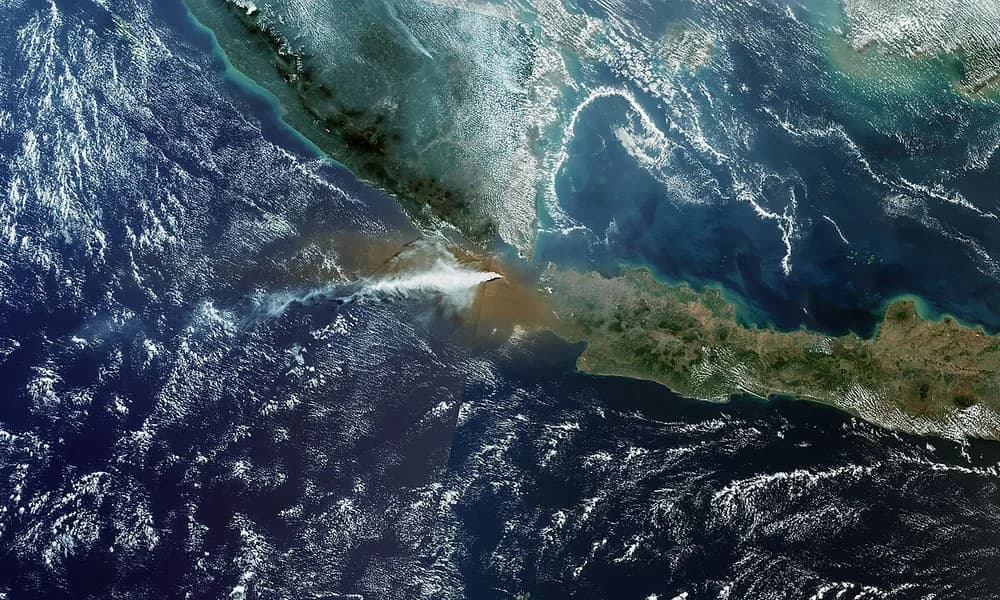
Anak Krakatau, the young volcano in Indonesia’s Sunda Strait between Java and Sumatra, erupted continuously for about 25 hours from late on 4 September 2026. Ash rose high enough to close Jakarta’s Soekarno–Hatta airport and several others. By 7 September about 3,000 flights had been grounded, affecting some 341,000 passengers. Smaller explosions followed for days, and by early October two small new islets had appeared in the surrounding caldera. Anak Krakatau — “child of Krakatoa” — grew out of the caldera left by the 1883 eruption. For UPSC, it combines a Sunda Arc subduction volcano, one of history’s most famous eruptions, a modern volcanic tsunami (2018) and the ash-and-aviation hazard.
Key highlights
- What it is: A young volcanic cone in the Sunda Strait, Indonesia, inside the caldera of the 1883 Krakatoa eruption; part of the Sunda Arc.
- 2026 eruption: Continuous activity from 23:07 on 4 September to 00:04 on 6 September (local time), about 25 hours.
- Ash: Reported in two clusters, up to about 20,000 ft and about 50,000 ft.
- Aviation: Soekarno–Hatta and other airports closed temporarily; about 3,000 flights grounded by 7 September (around 80% domestic), about 341,000 passengers affected; airports reopened on 7–8 September.
- Aftermath: 14 further Strombolian eruptions by 11 September; two new islets spotted by early October; 3-km exclusion zone.
- Plate setting: Indo-Australian Plate subducting beneath the Sunda Plate at the Sunda (Java) Trench.
- Exam hook: 1883 (caldera, tsunami, global cooling) → 1927 (Anak Krakatau emerges) → 2018 (flank-collapse tsunami) → 2026 (ash closes airports).
Where is Anak Krakatau?
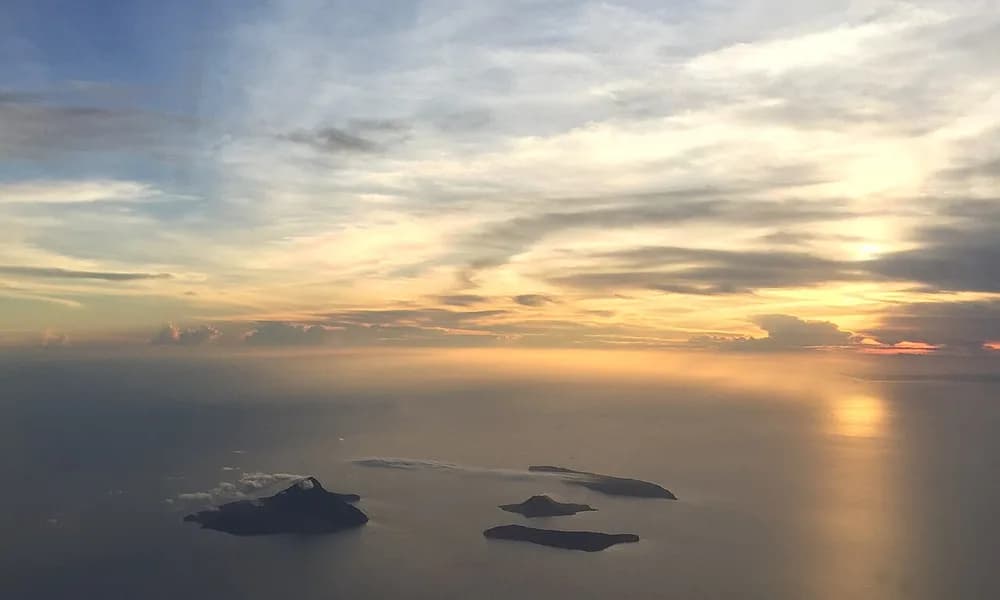
The Sunda Strait separates Java (to the east) from Sumatra (to the north-west) and links the Java Sea with the Indian Ocean. The Krakatau island group sits in the middle of the strait, roughly 40–50 km from the coasts of Banten (Java) and Lampung (Sumatra). Four islands are usually named: Rakata, Sertung and Panjang — remnants of the old volcano and its caldera rim — and Anak Krakatau in the centre.
Jakarta lies to the east. That short distance is why an ash cloud from a small island volcano can close the busiest airport in the country. The islands are part of the Krakatau Nature Reserve, which is included in the Ujung Kulon National Park UNESCO World Heritage site on the western tip of Java.
| Fact | Detail |
|---|---|
| Volcano | Anak Krakatau (“child of Krakatoa”) |
| Location | Sunda Strait, between Java and Sumatra, Indonesia |
| Coordinates (approx.) | 6.10° S, 105.42° E |
| Type | Young stratovolcano cone inside a caldera |
| Plate setting | Indo-Australian Plate beneath the Sunda Plate |
| Arc / trench | Sunda Arc / Sunda (Java) Trench |
| First emerged | 1927 |
| 2026 eruption | 4–6 September 2026, about 25 hours |
| Ash heights reported | About 20,000 ft and about 50,000 ft |
| Flights grounded | About 3,000 by 7 September |
| Exclusion zone | 3 km from the crater |
| Monitor | PVMBG (Centre for Volcanology and Geological Hazard Mitigation) |
Lock Sunda Strait + Java and Sumatra + 1883 caldera. A question that places Krakatau in the Strait of Malacca, or between Bali and Lombok, is wrong.
What happened in September 2026
The main eruption began at 23:07 local time on 4 September and continued without a break until 00:04 on 6 September, about 25 hours. Ash was reported in two clusters: one at about 20,000 ft drifting east, towards Java, and another as high as about 50,000 ft drifting west over the Indian Ocean.
The eastward ash cloud was the problem. Airport operators shut Soekarno–Hatta, Jakarta’s main international airport, along with other airports in western Java and southern Sumatra. Reports differ on the count: Al Jazeera described five airports reopening on 8 September, while a fuller list compiled later names eight, including Halim Perdanakusuma (Jakarta) and Radin Inten II (Lampung). All were open again by 7–8 September. Indonesia’s Ministry of Transportation estimated that about 3,000 flights were grounded by 7 September, around 80% of them domestic, affecting about 341,000 passengers. The transport minister asked passengers for patience while aircraft were inspected before returning to service. The head of the Geology Agency said the impact was smaller than in some past eruptions but monitoring would continue.
On 7 September, a speedboat carrying eight people, including five journalists covering the eruption, went missing in the strait. The search was called off after seven days without finding them.
Activity did not stop with the main eruption. By 11 September, the volcano had produced 14 further Strombolian eruptions — short explosions throwing out glowing fragments and ash. In early October, PVMBG reported that satellite images showed two small new islets in the caldera: one about 760 m north-west and another about 495 m south-west of the cone. Officials cautioned that they may not last. When Anak Krakatau itself first appeared in 1927, several short-lived islands rose and were washed away before a lasting island formed. As of early October the volcano was at Alert Level 2 (the second of four levels), and people were told to stay at least 3 km from the crater.
From Krakatoa 1883 to Anak Krakatau
The story begins with Krakatoa (Krakatau). On 26–27 August 1883, a series of huge explosions destroyed most of the original volcanic island. The volcano emptied its magma chamber and the summit collapsed, leaving a submerged caldera. The eruption generated tsunamis that swept the coasts of Java and Sumatra. About 36,000 people died, most of them from the waves. The explosions were heard thousands of kilometres away, and ash and sulphur gases injected into the stratosphere spread around the world. They produced vivid red sunsets and lowered average global temperatures for several years.
In 1927, new volcanic activity broke the sea surface in the middle of the caldera. After several temporary islands came and went, a permanent island formed around 1930. This was Anak Krakatau. It grew steadily through the twentieth century with frequent small eruptions.
On 22 December 2018, part of Anak Krakatau’s south-western flank collapsed into the sea during an eruption. The sudden landslide displaced water and sent a tsunami onto the coasts of Banten and Lampung with almost no warning. More than 400 people were killed. The volcano lost more than two-thirds of its volume, and its height dropped from about 338 m to about 110 m. It has since partly rebuilt.
The 2018 event is the key lesson for disaster management. It was a volcanic tsunami, caused by a landslide, not by an earthquake. Tsunami warning systems built around seismic sensors did not detect it in time, because there was no large earthquake to trigger them.
| Year | Event | Why it matters |
|---|---|---|
| 1883 | Krakatoa explodes; caldera forms | Tsunami, ~36,000 dead, global cooling |
| 1927 | Anak Krakatau emerges | A new cone grows in the caldera |
| 2018 | Flank collapse | Volcanic (landslide) tsunami, 400+ dead |
| 2026 | 25-hour eruption | Ash closes airports; new islets appear |
Tectonics: the Sunda Arc
Indonesia’s volcanoes are mostly products of one process. The Indo-Australian Plate moves north and sinks beneath the Sunda Plate (part of Eurasia) at the Sunda Trench, also called the Java Trench, south of Sumatra and Java. As the oceanic slab descends to about 100 km, it releases water into the mantle above it. That water lowers the melting point of the mantle, producing magma that rises to form a curved line of volcanoes parallel to the trench: the Sunda Arc. Krakatau, Merapi, Kelud, Tambora and Agung all belong to it.
These are classic subduction-zone stratovolcanoes. Their magma is richer in silica and gas than the basalt of Hawaii, so they tend to erupt explosively. That is why ash columns tens of thousands of feet high, pyroclastic flows and caldera collapse appear so often in Indonesia’s volcanic record.
The Sunda Strait also marks a change in how the plates meet. Off Java, the plate comes in nearly head-on. Off Sumatra, it comes in at an angle, and the sideways part of the motion is taken up by the Great Sumatran Fault. The strait sits at the hinge between these two styles.
The same arc continues east through Bali and Nusa Tenggara. The Flores earthquake of August 2026 broke a thrust fault on the back side of that arc, while the Pacitan earthquake of February 2026 was on the trench side off Java. Anak Krakatau is the volcanic member of the same 2026 Sunda Arc story.
Why volcanic ash grounds aircraft
Volcanic ash is not soft soot. It is made of tiny fragments of rock and volcanic glass. When a jet engine sucks it in, the ash melts in the hot combustion chamber and then sticks to cooler parts of the engine as glassy deposits, which can cause the engine to stall. Ash also scratches windscreens, blocks sensors and contaminates fuel and air systems. The classic warning is British Airways Flight 9 in 1982, which lost power in all four engines after flying through ash from Galunggung on Java; the crew restarted the engines and landed safely.
Because ash clouds are hard to see on aircraft radar, the aviation system relies on Volcanic Ash Advisory Centres (VAACs). Nine VAACs cover the world. Indonesia falls under VAAC Darwin in Australia, which tracks ash clouds from satellite and observatory data and issues advisories to airlines and air traffic control. Airports close when ash is over or near them, then reopen once the air is clear and runways and aircraft have been checked.
That chain explains September 2026. A small island volcano produced a cloud that drifted over the capital region. Thousands of flights stopped not because the volcano was large, but because Jakarta’s airspace is among the busiest in Asia and lies close by.
Why this matters for UPSC
Prelims. Expect location and history. Sunda Strait between Java and Sumatra; Anak Krakatau grew in the 1883 caldera; emerged 1927; 2018 flank collapse caused a tsunami. Traps: confusing the Sunda Strait with the Strait of Malacca (between Sumatra and the Malay Peninsula) or the Lombok Strait; confusing Krakatoa 1883 with Tambora 1815 (the larger eruption that caused the “Year Without a Summer” in 1816).
GS-1 (geography). Anak Krakatau illustrates subduction volcanism, caldera formation and new land creation in one place. It can also be used to show volcanic influence on climate through stratospheric sulphur aerosols (1883).
GS-3 (disaster management). Two strong points. First, volcanic tsunamis: 2018 showed that an eruption can trigger a tsunami without any earthquake, so warning systems must watch volcanoes as well as faults. Second, aviation and economic disruption: 2026 shows how ash hazards cross from a remote island into national transport and trade.
India link. India’s only historically active volcano, Barren Island in the Andaman Sea, sits on the northern extension of the same subduction system that feeds the Sunda Arc. The 2004 Indian Ocean tsunami came from the Sumatra–Andaman segment of the same plate boundary.
Contrast set. Pair Anak Krakatau with the other 2026 volcanoes on the Places in News timeline: Mount Etna (convergent stratovolcano, also an aviation story at Catania), Kīlauea (hotspot shield, no plate boundary) and Reykjanes (divergent ridge fissures).
Facts that are easy to mix up
Krakatoa versus Anak Krakatau. Krakatoa is the older volcano that collapsed in 1883. Anak Krakatau is the new cone that rose inside its caldera from 1927.
1883 versus 2018 tsunamis. 1883 tsunamis came from a giant explosive eruption and caldera collapse. 2018 came from a flank landslide of the young cone. Both were volcanic, not earthquake-generated.
Krakatoa versus Tambora. Tambora (1815, Sumbawa) was larger and caused the 1816 “Year Without a Summer”. Krakatoa (1883) is more famous for its sound, tsunamis and sunsets.
Sunda Strait versus Strait of Malacca. Sunda: Java–Sumatra. Malacca: Sumatra–Malay Peninsula.
Five airports versus eight. Early wire reports counted five airports reopening on 8 September; later compilations list eight that had closed. Both agree Soekarno–Hatta was among them.
New islets versus permanent islands. The two islets seen in October may be eroded away, as happened to several temporary islands in 1927–1930.
Prelims snapshot
| Question type | Answer to lock |
|---|---|
| Volcano | Anak Krakatau |
| Location | Sunda Strait, between Java and Sumatra |
| Plate setting | Indo-Australian beneath Sunda Plate |
| Arc / trench | Sunda Arc / Sunda (Java) Trench |
| 2026 eruption | 4–6 September, about 25 hours |
| Flights grounded | About 3,000 by 7 September |
| Parent eruption | Krakatoa, 1883 |
| Emergence | 1927 |
| 2018 event | Flank collapse → tsunami, 400+ dead |
| Ash advisory centre | VAAC Darwin |
Frequently asked questions
What happened at Anak Krakatau in September 2026?
The volcano erupted continuously for about 25 hours, from 23:07 on 4 September to 00:04 on 6 September 2026. Ash clouds reached about 20,000 ft and about 50,000 ft. Ash drifting east forced temporary closures at Soekarno–Hatta and other airports, grounding about 3,000 flights and affecting about 341,000 passengers by 7 September.
Where is Anak Krakatau?
In the Sunda Strait, Indonesia, between the islands of Java and Sumatra. It rises inside the caldera left by the 1883 Krakatoa eruption, surrounded by the older islands of Rakata, Sertung and Panjang.
Why does Anak Krakatau erupt?
It sits on the Sunda Arc. The Indo-Australian Plate is subducting beneath the Sunda Plate at the Sunda (Java) Trench. Water released from the sinking slab melts the mantle above it, and the magma feeds a line of explosive stratovolcanoes, including Krakatau.
What caused the 2018 Anak Krakatau tsunami?
During an eruption on 22 December 2018, a large part of the volcano’s flank slid into the sea. The landslide displaced water and sent a tsunami onto the coasts of Java and Sumatra, killing more than 400 people. Because no large earthquake occurred, seismic-based warning systems did not catch it.
Why does volcanic ash ground flights?
Ash particles melt inside jet engines and can make them stall; they also damage windows and sensors. Airlines and air traffic control rely on Volcanic Ash Advisory Centres — VAAC Darwin for Indonesia — to track ash clouds and decide when to close and reopen airspace.
Are the new islets permanent?
Not necessarily. PVMBG said it was not yet clear how they formed, and officials cautioned they may be temporary. When Anak Krakatau first emerged in 1927, several small islands appeared and disappeared before a lasting one formed.
What should UPSC aspirants remember about Anak Krakatau?
Sunda Strait (Java–Sumatra); Sunda Arc subduction volcano; child of Krakatoa 1883; emerged 1927; 2018 flank-collapse tsunami; 4–6 September 2026 eruption of about 25 hours; about 3,000 flights grounded; new islets; 3-km exclusion zone; ash as an aviation hazard.