
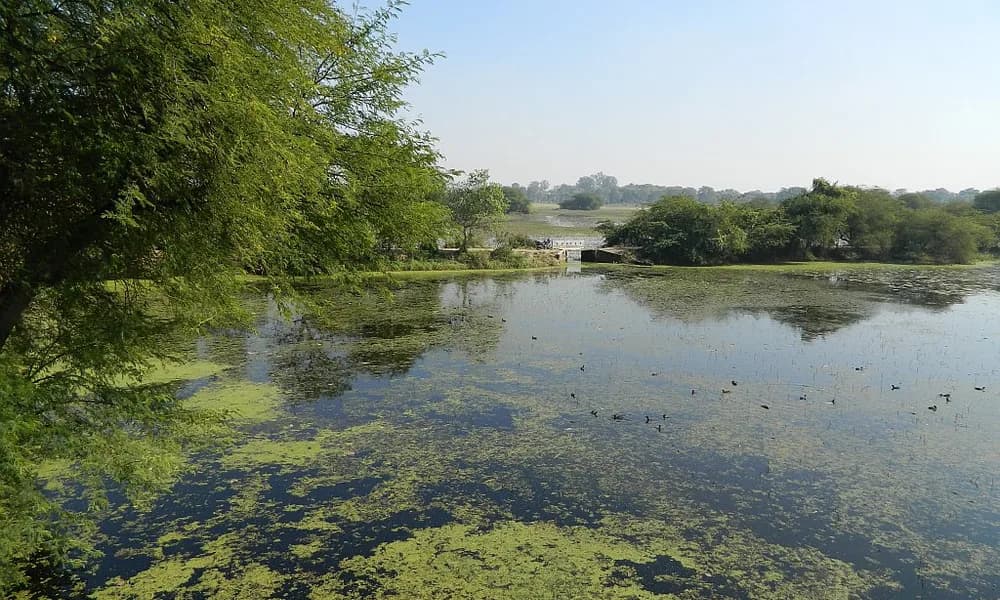
Surha Tal, officially listed as the Jai Prakash Narayan Bird Sanctuary, is a freshwater oxbow wetland in Ballia district, eastern Uttar Pradesh. On 5 June 2026 — World Environment Day — Prime Minister Narendra Modi announced that the site had been designated a Wetland of International Importance under the Ramsar Convention. It is India’s 100th Ramsar site and Uttar Pradesh’s 13th. The lake sits in the middle Ganga basin, on an abandoned meander of the river, and is one of the largest floodplain waterbodies in the Ballia tract.
Key highlights
- Announcement date: 5 June 2026 (World Environment Day) — India’s 100th Ramsar site.
- Location: Ballia district, eastern Uttar Pradesh, middle stretch of the Ganga basin.
- Official name: Jai Prakash Narayan Bird Sanctuary; local name Surha Tal / Suraha Taal.
- Type: Natural perennial oxbow lake formed from a Ganga meander; rain-fed, with three freshwater inlets.
- State tally: Uttar Pradesh rose to 13 Ramsar sites.
- India’s rank (as of June 2026): Most Ramsar sites in Asia; third globally after the United Kingdom (176) and Mexico (144).
- Exam hook: Pair the 100th-site milestone with the oxbow landform and Ballia — not with Aligarh or Arunachal.
- Official coverage: DD News; Wildlife Institute of India.
Where is Surha Tal?
Surha Tal lies in the Middle Ganga Plain, in Ballia, the easternmost district of Uttar Pradesh. The district sits where the Ganga and the Ghaghara (Sarayu) systems approach each other. That is a different geography from the canal-fed wetlands of western Uttar Pradesh and from the mountain lake listed two months later in Arunachal Pradesh. For a map question, lock Ballia — eastern UP — left-bank Ganga floodplain.
The Wildlife Institute of India describes the waterbody as an oval oxbow of about 34.32 square kilometres, rain-fed, and linked to the Ganga by a narrow outlet named Kathar Nala, roughly 23 kilometres long. The lake surface is not a fixed pond. It expands to its maximum in the monsoon months of August–September. In high floods on the Ganga and Sarayu, flow in Kathar Nala can reverse, pushing river water back into the lake. That two-way connection is the hydrological fact that separates Surha Tal from a closed depression.
| Fact | Detail |
|---|---|
| Official / local names | Jai Prakash Narayan Bird Sanctuary; Surha Tal / Suraha Taal |
| State / district | Uttar Pradesh / Ballia |
| Coordinates (approx.) | 25.88° N, 83.97° E |
| Landform | Oxbow (cut-off Ganga meander) |
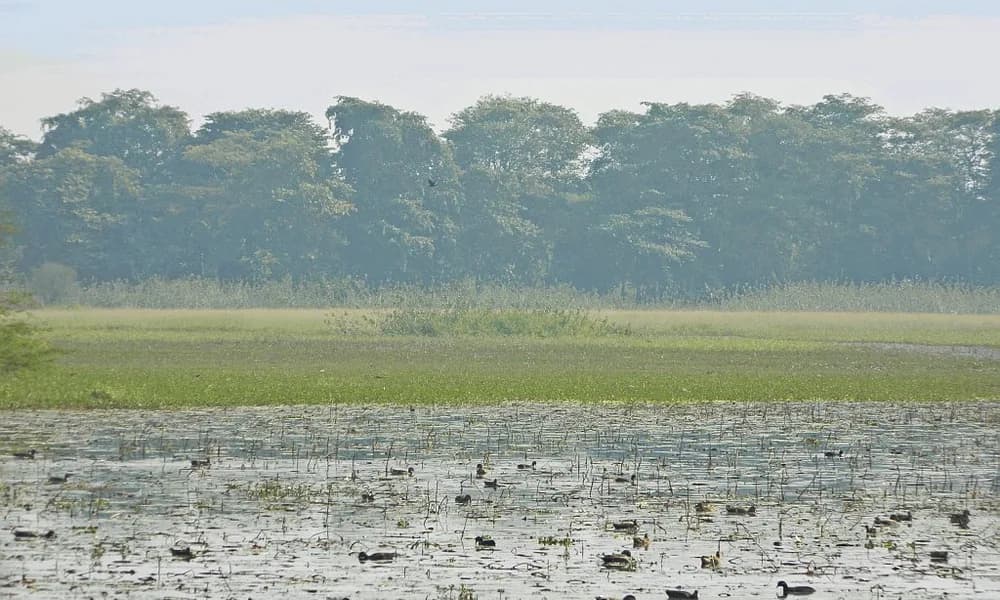
| Setting | Middle Ganga floodplain; marshes, seasonal flood, rice paddies |
| Outlet | Kathar Nala (~23 km) to the Ganga |
| Sanctuary notification | 1991 (Uttar Pradesh) |
| Announced as Ramsar | 5 June 2026 (World Environment Day) |
| India’s Ramsar rank | 100th site (UP’s 13th) |
Aspirants should keep district (Ballia) and landform (oxbow) as a pair. Prelims items on new Ramsar sites almost always ask the state. For Surha Tal they also like to test whether the wetland is a Himalayan lake, a canal tank, or a river cut-off. Only the last is correct.
What is an oxbow lake?
An oxbow lake is a curved, often U-shaped or oval still-water body left behind when a meandering river cuts through the neck of a bend and abandons the old loop. On a flat floodplain the channel migrates sideways. A neck cutoff shortens the river. The abandoned meander fills with water and, over time, silts at the ends. The result is a lake that still remembers the river’s curve.
Surha Tal is that landform at Ganga scale. The Ramsar Secretariat note issued at designation says the wetland was originally formed from a meander of the Ganga and receives freshwater through three channels. It is a perennial lake: it does not vanish every summer, which is why it becomes a refuge when smaller floodplain wetlands dry.
Do not treat “oxbow” as a synonym for every Gangetic jheel. Shekha Jheel in Aligarh is a canal-created freshwater lake beside the Upper Ganga Canal (1852). Glaw Lake is a mountain-stream lake inside a tiger reserve. Surha Tal is a river-abandonment wetland. The three 2026 listings are useful precisely because they are not the same landform.
What is a Ramsar site?
A Ramsar site is a wetland placed on the List of Wetlands of International Importance under the Ramsar Convention, adopted in 1971 in Ramsar, Iran. India acceded in 1982. Designation does not invent a new category in the Wildlife (Protection) Act. It is an international recognition that the site meets at least one of nine ecological criteria — for example, it supports vulnerable species, or it regularly holds a large number of waterbirds, or it is a representative wetland type in its biogeographic region.
India already protects many of these places as sanctuaries, reserves, or notified wetlands under the Wetlands (Conservation and Management) Rules, 2017. Ramsar listing adds a global inventory, reporting duties, and political attention. It is also the fact UPSC tests: “Which of the following is a Ramsar site?” remains a staple Environment question.
Wise use — the Convention’s core idea — means using the wetland so that ecological character is maintained. For Surha Tal that includes living with fishing, paddy, and a densely settled floodplain, not pretending the oxbow is an empty wilderness.
Why Surha Tal was listed
The Ramsar Secretariat’s note, reported at designation, describes a landscape of floodplains, extensive marshes, seasonally flooded ground, and rice paddies. In summer, when many smaller wetlands in the region dry out, the site remains a waterbird refuge. Recorded waterfowl include the vulnerable common pochard (Aythya ferina) and the Indian river tern (Sterna aurantia).
The same briefing records a wide supporting biota: 221 plant species, 66 fish species, seven reptile species, and three amphibian species. Notable fish include the vulnerable Wallago attu and Bagarius bagarius (the goonch / bagarius catfish that appears in Himalayan-foothill and Gangetic fishery notes). Fish biomass also draws the vulnerable fishing cat (Prionailurus viverrinus), which uses the site as a feeding ground. Management responses already include seasonal fishing controls and a ban on destructive gear — a reminder that listing a used wetland is not the same as emptying it of people.
WII’s Ganga-protected-area note adds a fishery detail that is useful for Mains, not Prelims memorisation: the sanctuary holds a diverse native fish assemblage (cyprinids, catfishes, perciforms and others) and four recorded exotic species, including common carp and silver carp. Invasion risk in a connected floodplain lake is a live management problem. So are weed infestation, drainage for cultivation, and catchment encroachment in a densely populated eastern-UP countryside.
Ballia, the Ganga, and Jai Prakash Narayan
Ballia is not a generic “UP district” in an exam answer. It is the state’s eastern edge, historically tied to the freedom movement and to Jayaprakash Narayan, whose name the sanctuary now carries. The waterbody was notified as a bird sanctuary in 1991. Official communications in 2026 use the dual form Jai Prakash Narayan Bird Sanctuary (Surha Tal). Locals still say Surha or Suraha. In a Prelims option, both names refer to the same place.
The Ganga here is a migrating alluvial river, not a mountain torrent. Oxbows, levees, and backswamps are the normal landforms of that reach. A question that places Surha Tal “in the Himalaya” or “inside a tiger reserve” is recycling the Glaw Lake template onto the wrong site. A question that places it in Aligarh is recycling Shekha Jheel.
Eastern UP’s floodplain wetlands are also livelihood systems. Villages around the tal fish, graze, and grow paddy on seasonal margins. A Lok Sabha reply after the listing confirmed the 100th-site status and pointed to the National Plan for Conservation of Aquatic Ecosystems (NPCA) and the centrally sponsored Development of Wildlife Habitats scheme as the domestic funding routes. Ramsar does not send a police force. Money and rules still run through MoEFCC and the state forest department.
Hydrology that UPSC can actually ask
Three hydrological sentences are enough for an answer booklet.
First, Surha Tal is rain-fed in the WII description, but it is not isolated. Three channels bring freshwater; Kathar Nala ties the lake to the Ganga.
Second, the lake grows in the monsoon and shrinks in the dry months, yet remains perennial. That is why it is a summer refuge.
Third, reverse flow during high Ganga–Sarayu floods can refill the oxbow from the river. The wetland is therefore both a storage basin and a flood buffer. Those are the ecosystem services — flood storage, groundwater recharge, fishery, bird habitat — that the Ramsar listing is meant to keep intact.
Do not invent a single “official Ramsar hectare” figure unless you are reading the Information Sheet. Coaching notes sometimes quote the sanctuary area, sometimes a monsoon inundation, sometimes a catchment. For this explainer, the safe, sourced number is WII’s 34.32 km² for the oxbow/sanctuary waterbody, with the explicit caveat that the wet area is seasonal.
India’s Ramsar tally: 26 to 100 — then 101
The political fact attached to the World Environment Day announcement is the century mark.
| Year / milestone | India’s Ramsar count |
|---|---|
| 2014 | 26 |
| World Wetlands Day window, 31 January 2026 | 98, after Patna Bird Sanctuary (Etah, UP) and Chhari-Dhand (Kutch, Gujarat) |
| Earth Day, 22 April 2026 | 99, Shekha Jheel (Aligarh; UP’s 12th) |
| World Environment Day, 5 June 2026 | 100, Surha Tal (UP’s 13th) |
| 3 August 2026 | 101, Glaw Lake (Arunachal Pradesh’s first) |
At the June 2026 announcement, reporting that cited the Secretariat put India first in Asia and third in the world after the United Kingdom (176) and Mexico (144). Surha Tal was also described as the world’s 2,595th Ramsar site. Those global ranks move when other countries list new wetlands; treat them as the June 2026 snapshot, not as a permanent league table.
Quantity is not quality. Several Indian sites face invasive plants, pollution, or altered hydrology. Listing is the start of reporting, not a certificate that the oxbow is safe. Designation-week reporting put India’s rise at 26 to 100 in eleven years, with 58 sites added in the four years before the century mark. That pace is the GS-3 argument: India expanded the list rapidly after 2014, including many state bird sanctuaries in the Gangetic plain.
Montreux Record — the list of Ramsar sites whose ecological character has changed for the worse — remains a separate Prelims fact. Surha Tal is a new listing, not a Montreux site.
Uttar Pradesh’s own stack is now a revision table of its own. Before 2026 the state already had a long list of Gangetic jheels and river stretches (among them the Upper Ganga River site from Brijghat to Narora, Haiderpur, Bakhira, Nawabganj, Sur Sarovar, Sarsai Nawar, Samaspur, Sandi, Saman, and Parvati Arga). In 2026 it added Patna Bird Sanctuary (Etah — not Patna, Bihar), Shekha Jheel, and Surha Tal. After June, UP stood at 13.
Why this matters for UPSC
Environment in Prelims rewards a precise location plus a convention fact. Surha Tal supplies both, and it supplies a milestone number that paper-setters like.
Prelims. Expect match-the-following: Surha Tal — Ballia — Uttar Pradesh — oxbow of the Ganga — 100th Ramsar site — World Environment Day 2026. Traps include placing the site in Aligarh, calling it a canal lake, calling it India’s first Gangetic Ramsar site (it is not), or swapping the 99th/100th/101st ranks. Another trap is Patna Bird Sanctuary: that 2026 listing is in Etah, Uttar Pradesh, not in Patna city.
GS-3 / GS-1. A short Mains paragraph can use Surha Tal to illustrate: (a) floodplain oxbow hydrology and flood buffering; (b) wise use on a fished, farmed wetland rather than a fortress reserve; (c) the post-2014 expansion of India’s Ramsar list; (d) overlap of a 1991 bird sanctuary with a 2026 international listing. Ballia’s association with Jayaprakash Narayan is a one-line GS-1 hook if the question is about places in the news, not a reason to write a biography.
Geography. Map the eastern-UP Ganga–Ghaghara belt. Contrast an oxbow (Surha) with a canal jheel (Shekha) and a Himalayan headwater lake (Glaw). That three-way contrast is more useful than three isolated current-affairs notes.
Current affairs stacking. Treat 2026 as a Ramsar year: Patna and Chhari-Dhand in January, Shekha Jheel in April, Surha Tal in June, Glaw in August. One revision table beats five newspaper cuttings.
This explainer sits alongside the Places in News timeline, which logs the same designation as a geography event.
Facts that are easy to mix up
Surha Tal versus Jai Prakash Narayan Bird Sanctuary. Same wetland. Use either name; the dual form is what the Prime Minister’s announcement used.
100 versus 99 versus 101. Shekha Jheel is the 99th (Earth Day, 22 April 2026). Surha Tal is the 100th (World Environment Day, 5 June 2026). Glaw Lake is the 101st (3 August 2026). Mixing the calendar hooks is the most likely hurried-test error.
Oxbow versus canal versus mountain lake. Surha is a Ganga cut-off. Shekha is fed by the Upper Ganga Canal. Glaw is inside Kamlang Tiger Reserve. Do not copy one sentence across all three.
Ballia versus Balia. The district is Ballia. Some headlines drop an L. Write Ballia.
Patna Bird Sanctuary versus Patna, Bihar. The January 2026 Ramsar site is in Etah district, Uttar Pradesh. It is not a Bihar site.
Chhari-Dhand. That sibling listing is a seasonal saline wetland on the Kutch–Banni edge in Gujarat, not another UP jheel.
First in Uttar Pradesh. No. UP already had the largest state cluster before 2026. Surha Tal is the 13th in the state, not the first.
Area. Prefer WII’s 34.32 km² for the oxbow/sanctuary waterbody, and say the wet area changes with the monsoon. Do not quote an unsourced “25,000 hectare flood” from tourism pages.
India’s global rank. Third after the UK and Mexico as of the June 2026 announcement. Do not memorise those foreign counts as eternal.
How designation works in India
States propose wetlands through their wetland authorities. MoEFCC vets the Ramsar Information Sheet and sends it to the Ramsar Secretariat in Gland, Switzerland. The Secretariat adds the site to the list when documentation is complete. Ministers often announce designation on a calendar hook — World Wetlands Day (2 February), Earth Day (22 April), World Environment Day (5 June). Surha Tal’s public milestone was timed to 5 June.
Once listed, India is expected to maintain the ecological character of the site and to apply wise-use principles. Domestic enforcement still runs through forest law, wetland rules, and schemes such as NPCA. That distinction is worth a line in a Mains answer on the effectiveness of international environmental agreements: the treaty creates a list and a reporting habit; the Forest Department still does the work.
Prelims snapshot
| Question type | Answer to lock |
|---|---|
| State / district | Uttar Pradesh / Ballia |
| Rank | India’s 100th Ramsar site; UP’s 13th |
| Date / hook | 5 June 2026, World Environment Day |
| Landform | Oxbow of the Ganga (middle basin) |
| Official name | Jai Prakash Narayan Bird Sanctuary |
| Sanctuary year | 1991 |
| Outlet | Kathar Nala to the Ganga |
| Convention | Ramsar, 1971; India a party since 1982 |
| India in Asia / world (June 2026) | Highest in Asia; 3rd globally (after UK, Mexico) |
| Do not confuse with | Shekha Jheel (Aligarh, 99th); Glaw Lake (Arunachal, 101st); Patna Bird Sanctuary (Etah, not Bihar) |
Frequently asked questions
What is Surha Tal and where is it located?
Surha Tal is a natural freshwater oxbow lake in Ballia district, eastern Uttar Pradesh, in the middle Ganga basin. It is officially the Jai Prakash Narayan Bird Sanctuary and was announced as India’s 100th Ramsar site on 5 June 2026.
Why is Surha Tal in the news in 2026?
It became India’s 100th Ramsar site on World Environment Day. With that listing, Uttar Pradesh rose to 13 sites, and India was described as having the most Ramsar wetlands in Asia and the third-highest total globally.
Is Jai Prakash Narayan Bird Sanctuary different from Surha Tal?
No. They are the same wetland. Surha Tal is the local name of the oxbow; the sanctuary, notified in 1991, carries Jayaprakash Narayan’s name in official use.
How many Ramsar sites did India have after Surha Tal?
100, as of the 5 June 2026 announcement. The count was 26 in 2014, 98 after Patna Bird Sanctuary and Chhari-Dhand (January 2026), 99 after Shekha Jheel (April 2026), and 101 after Glaw Lake (August 2026).
Is Surha Tal a Himalayan lake or a canal wetland?
Neither. It is a Gangetic oxbow — a cut-off meander of the Ganga — rain-fed and linked to the river by Kathar Nala. Shekha Jheel is the canal-fed contrast; Glaw Lake is the Himalayan contrast.
Which animals are linked to Surha Tal in official notes?
The Ramsar Secretariat note recorded the vulnerable common pochard and Indian river tern among waterbirds, a rich fish fauna including Wallago attu and Bagarius bagarius, and the vulnerable fishing cat as a predator that feeds at the site.
What should UPSC aspirants remember about Surha Tal?
State and district (Uttar Pradesh, Ballia), 100th Ramsar site, World Environment Day 2026, oxbow of the Ganga, Jai Prakash Narayan Bird Sanctuary, UP’s 13th site, India first in Asia and third globally at the time of listing, 1991 sanctuary, Kathar Nala link to the Ganga.
Sources
- DD News — Surha Tal designated as India’s 100th Ramsar site
- Wildlife Institute of India — Surha Taal Wildlife Sanctuary
- Lok Sabha reply on Jai Prakash Narayan (Surha Tal) Bird Sanctuary
- Ramsar Convention on Wetlands
- Places in News timeline
- Related explainers: Shekha Jheel, Glaw Lake, India’s 101st Ramsar site, Patna Bird Sanctuary, Chhari-Dhand